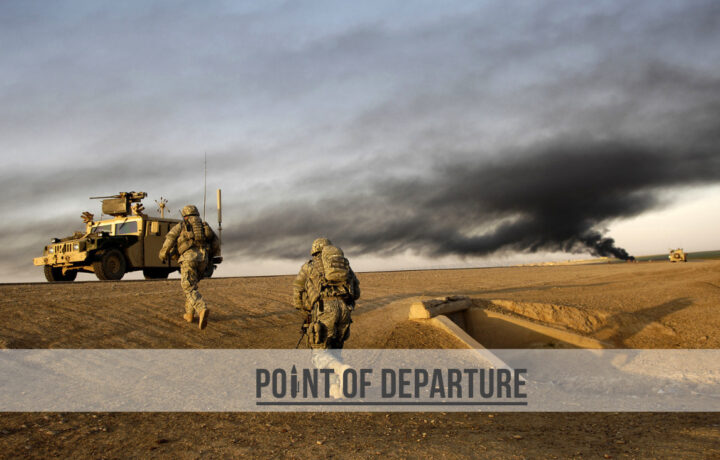
“Leadership and learning are indispensable to each other.” – John F. Kennedy
War is a brutal, unforgiving teacher.
I have long joked that everything I needed to know in life I learned in combat. War tends to be a powerful learning crucible. The stakes tend to be high and the room for error almost non-existent.
Early on, I learned to keep my head on a swivel, a euphemism for maintaining a high degree of situational awareness. “I didn’t see that coming” is not something you want to hear a lot when you are within sight of enemy forces. As a result, I could often be found listening and observing more than standing and talking.
Learning as Decisive Advantage
Learning has always been the decisive variable in warfare. While technology, numbers, and resources shape the battlefield, it is the ability to learn and adapt – faster and more intelligently you adversaries – that drives success. In its own unique way, war is a contest of competing learning systems, with the opposing sides trying to observe, interpret, and respond to a dynamic operating environment faster than the other. Leaders who fail to learn become predictable; those who learn and adapt become resilient, innovative, and dangerous opponents.
Learning is essential to overcoming uncertainty, the ubiquitous fog of war. Ultimately, warfare punishes stagnation. It rewards curiosity, reflection, and institutional humility. The most successful militaries cultivate a culture of learning that is continuous, decentralized, and ruthlessly honest. In a world where conflict is the norm rather than the exception, learning is not just a decisive advantage, it is the crucible of success.
The Crucible
Crucible experiences matter. They compress learning into brief moments of intensity that day-to-day life typically can’t replicate. They push us to our limits – physically, emotionally, and intellectually. They challenge our fundamental beliefs – who we are and what we aspire to be. The pressure we experience in those moments forces reflection, adaptation, and the evolution of our basic mental models.
Nowhere is this more relevant than in combat, where crucible experiences are far more likely to present themselves than in ordinary life. The constant stress sharpens attention, deepens memory, and accelerates growth. Those crucible experiences reveal character and transform identity, forging leaders who can adapt, endure, and persevere when it matters most.
Top 10 Lessons of My Own Crucible Experiences
The lessons of my own crucible experiences have endured. While I don’t tend to tell war stories too often in mixed company, I will sometimes share the wisdom that those lessons have imparted. While they may not rise to the level of principles, they are fundamental, nonetheless. And they have stood the test of time, representing multiple deployments into vastly different areas under a broad array of conditions with a variety of different organizations.
1. Simplicity is a principle of war for a reason.
Simplicity has a beauty and elegance all its own. The more complicated you make something, the less flexibility you have and the more likely you are to experience catastrophic failure. Keep things simple and you’ll find that things tend to work out.
2. Always plan for failure.
Murphy’s Law is an inevitability of war. If you assume that whatever genius plan you’re pondering will fail at some point, it forces you to consider alternatives, build in flexibility, and explore ways to mitigate risk. That kind of thinking breeds success.
3. Expect the unexpected.
In the same vein, the enemy gets a vote. Unless you’re engaged with the militant wing of the Salvation Army, your opponent won’t follow your playbook. Assume your enemy will have some surprises waiting. Account for the unexpected.
4. Better to have it and not need it than to need it and not have it.
Redundancy is resilience. Professionals talk logistics. When your plan defines efficiency on a razor’s edge, you might be sacrificing lethality and endurance. Keep that in mind.
5. The details will get you every time.
Every brilliant plan is rooted in the details. When you shortcut your analysis or whitewash the details, they come back at you like fermented gas station sushi. Invest time in the details. They matter.
6. Embrace the suck.
Colin Powell famously said, “Perpetual optimism is a force multiplier.” Misery is a choice. Savor the good moments – like a rare hot meal or a fresh cup of coffee – because they won’t always be there. War sucks; learn to appreciate the little things.
7. It is what it is.
If you don’t have control over whatever situation you find yourself in, there isn’t much reason to waste time worrying about it. Let it go. Better to use that time to figure out what’s next and do something about that.
8. Take the fight to the enemy.
Channel your inner Patton: “A good plan violently execute now is better than a perfect plan executed next week.” Decisiveness fuels momentum. When all else fails, speed and audacity can do more to overwhelm your opponent than a detailed plan.
9. Fight from the moral high ground.
When the dust settles, your principles matter. Acting with integrity – even in moment of intense pressure – sets the foundation of legitimacy and credibility. That’s a strategic asset that compounds over time.
10. Lighten up, Francis.
My favorite go-to movie quote is also a lesson learned in combat. Lead with humility and never take yourself too seriously. If you’ve ever had to pluck your pistol out of a barrel of human waste or had a seagull crap in your face on your way to an embassy meeting, you’ll know what I mean. Stuff happens. Laugh at yourself. Take life as it comes and enjoy it while you can.
There’s an old military saying that “experience is something you don’t get until after you need it.” You don’t pack your ruck and enter the crucible of war without bringing home a few hard-earned pieces of wisdom. That’s the circle of life as warfighter: you live, you learn, you laugh. And, hopefully, you learn a little along the way.


