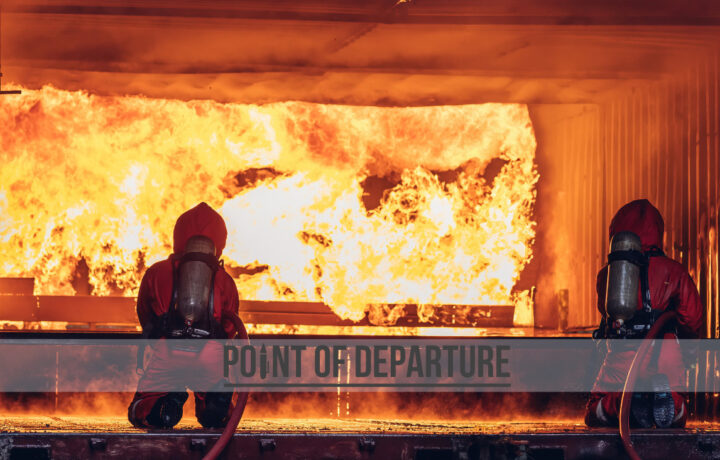
I’d been a firefighter for all of one day when I responded to my first call: a collision between a motorcycle and a car. The car won.
As we worked to stabilize the operator of the motorcycle – who was in a state of panic – what we initially thought was a broken ankle was soon revealed to be an open dislocation with an all but complete separation of the foot from the leg. I was holding his lower leg in one hand and his foot in the other, all the while trying to maintain my composure.
After a quick trip to the hospital – surgeons were able to reattach the foot – we returned to the station. Everything was business as usual. The ambulance crew cleaned up, the firefighters headed for the kitchen, and I stood there in the bay, lost in my own thoughts.
“You alright?” the Chief asked me.
“How do you get used to that?” I asked.
“Today was a good day. You’re gonna see a lot worse. You either learn to deal with it, or you find something else to do.”
After over 20 years in the chair and decades in the department, the Chief didn’t mince words. Everybody wants to be a firefighter, but not everyone is cut out for it.
Leadership Under Fire
I understood what the Chief was saying that day. Like most kids, I grew up fascinated by the fire station near my elementary school and in awe of the firefighters who crewed the equipment. But by the time I started college, any aspirations of that profession were in the distant past.
Then, one summer, I shared a class with a couple of firefighters. There was a special program for college students that provided free room and board and graduation always opened up a few slots. I applied, was accepted into the program, and was initiated into some of the most intense training imaginable. We didn’t just fight fires, we operated equipment, served as 911 dispatchers, and represented an institution with deep ties to the community. We also signed an agreement with the Chief – if we stepped out of line or failed to do our duty, he could terminate us with just 24 hours’ notice.
That say his “find something else to do” clause.
The fire service was a crucible experience. A lot of them, in fact. Typically, when someone dials 911, they need help, often desperately. We pulled out of the station on every call at peak adrenaline and usually came back absolutely spent. We carried people from burning buildings, extracted others from wrecked cars, and spent more than a few dying moments holding someone’s hand.
Along the way, I learned a lot about myself and a thing or two about leading people. As an ROTC cadet at the University of Idaho, I heard more than a few lectures on leadership and management, and we even practiced it in the field. But when you’re the first truck on scene in the dead of night, decisions have to be made and there are no do-overs. Those life-or-death moments brought it all home.
Lessons from the Chief
The Chief – who could be equal parts profane and irascible – was also an incredible mentor. Even when he was in the midst of delivering a biblical chewing out, you would later realize that it was a learning moment. If he took the time to explain to you that you could have done something better, smarter, or safer, he was passing on lessons of the trade, not invoking his 24-hour rule.
Eventually, the Army came calling and it was time to move on. As I packed out my gear, I took with me years of experience that shaped my early growth as a leader. But I also carried the lessons I learned from the Chief, lessons that would come to define my leadership philosophy.
1. Leadership doesn’t have to be loud.
The Chief never raised his voice. No matter how intense the situation might be, he was the calm in the eye of the storm. He understood better than anyone the necessity of a leader keeping their emotions in check.
2. Leadership demands courage under pressure.
Dwayne “The Rock” Johnson captured this well: “When everyone else is running away from danger, they run into it.” Fortitude – the courage to make difficult decisions, navigate uncertainty, and exude calm – is a non-negotiable trait in a successful leader.
3. Leadership requires sacrifice.
When the station bell rang, you answered the call. Day or night, rain or snow. Being a first responder means always putting the needs of others first. Self-sacrifice is fundamental to leadership. Leaders eat last is a truism.
4. Leadership is about teamwork.
From the outset, the Chief trained us as a team – every firefighter on a truck had a specific job, whether it was running the pump, hauling hose, or taking the nozzle. Leaders understand that trust, coordination, and a common purpose translate to success. Teams succeed or fail as a group, not as individuals.
5. Leadership is about making decisions.
When you’re the first truck on the scene, you typically have seconds to assess the situation and take action. A fire won’t wait for you to make a decision. Successful leaders hone their ability to evaluate information quickly and make timely decisions.
6. Leadership expects adaptability.
Fire can be an unpredictable adversary. What worked on one scene might not work on another. To truly thrive, leaders need to adapt to their circumstances, to the changing conditions of their environment.
7. Leadership depends on communication.
Clear, effective communication is absolutely essential in high-pressure situations. For leaders, communication skills are the glue that binds trust, loyalty, and teamwork.
8. Leadership requires resilience.
When the Chief told me after that first call that “today was a good day,” he was dead serious. We had our share of bad days and sometimes they ran together. A successful leader is one who possesses the grit to bounce back from adversity even stronger than before.
9. Leadership by example is non-negotiable.
I’d heard the same phrase throughout my time as a cadet, but the Chief was the first leader I knew personally who exemplified leadership by example. Whether at a fire scene in the middle of the night or at a city council meeting, he consistently set the example others followed.
10. Leadership works better with a sense of humor.
The Chief has a legendary sense of humor, and it infected the entire department. That humor helped us deal with the realities of a profession in which you see people at their absolute lowest. A good leader understands that good-hearted humor can be an essential element to a positive workplace culture. People need to laugh.
During the annual Independence Day parade one summer, we were waiting in Old No. 7 – the 1921 American LaFrance pumper we maintained for ceremonial occasions – for the grand marshal to signal the start. The Chief turned to the police officers behind us and, with a glint in his eye, asked them if they knew the difference between our two professions. “When the little kids wave at us, they use all five fingers.”
It was an old joke he told all the time, but one that always brought out the laughs.


