“Music gives a soul to the universe, wings to the mind, flight to the imagination, and life to everything.” – Plato
Every war has a soundtrack.
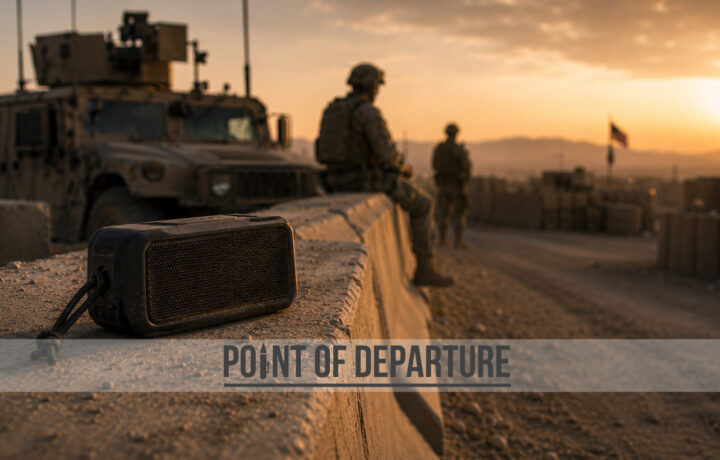
Not the official one – division bands playing John Philip Sousa marches or the various renditions of “Rendezvous with Destiny,” “Dogface Soldier,” or “Garryowen.” The real one. The one you heard playing from a sunbaked Bluetooth speaker on a Jersey barrier or from a dusty cellphone wedged into the console of a HMMWV. The one the troops choose for themselves.
America has been going to war since, well … before it was America. Each generation brought its own music along for the ride. When we crossed the border into Iraq in 1991, the peal of AC/DC’s “Hell’s Bells” on a Sony Walkman carried me over the berm. A dozen years later, Guns N’ Roses’ “Welcome to the Jungle” announced our arrival into southern Baghdad.
Music, it seems, is an indispensable part of our combat kit – something we take with us whenever we get our war on.
The Great War
When the United States finally entered World War I in April 1917, the country’s musical identity was still finding its footing. Jazz was barely a word. Radio was a novelty. Sheet music was how a song traveled.
What soldiers took to France was a curious blend of earnestness and sentimentality. George M. Cohan’s “Over There“ became the defining anthem of American involvement, a bouncing, chest-thumping call to arms that managed to make shipping off to the Western Front sound like a varsity football game. Eddie Cantor, Al Jolson, and Enrico Caruso filled the phonograph cylinders that followed doughboys across the Atlantic. “K-K-K-Katy” captured the awkward longing of young men leaving sweethearts behind. The music was hopeful because the men who carried it didn’t yet know what was waiting for them.
The Good War
The Second World War arguably had the best soundtrack. The big band era was at its peak. Glenn Miller – who traded his bandleader’s baton for a major’s oak leaf only to disappear over the English Channel in 1944 – gave the war its musical soul: “In the Mood,” “Moonlight Serenade,” “Pennsylvania 6-5000.” These were songs you could dance to, and Americans danced, both at home and in the distant USO halls that followed the flag across Europe and the Pacific.
The Andrews Sisters were everywhere. Bing Crosby’s “White Christmas“ became the most requested song on Armed Forces Radio. The music of that war possessed the rare quality of simultaneously conveying sacrifice and hope. It told troops that the country that sent them to war was worth fighting for. That is an extraordinary thing to ask of a song.
The Hard War
Vietnam broke the formula. For the first time, the music soldiers carried to war was not the music their country sang back to them. The 1960s shattered the cultural consensus, and the divide showed up in the hooches and firebases of Southeast Asia. Troops on the wire listened Jimi Hendrix’s “All Along the Watchtower.” Others put on the Rolling Stones. The Doors’ “The End” became the unofficial anthem of a war that didn’t seem to have one.
Back home, the soundtrack was different and decidedly confrontational. Country Joe and the Fish performed the “I-Feel-Like-I’m-Fixin’-to-Die Rag” to 400,000 people at Woodstock. Creedence Clearwater Revival’s “Fortunate Son” became the enduring shorthand for a generation’s grievance. Edwin Starr asked “War – what is it good for?” Vietnam was the first war to produce a protest soundtrack louder than its patriotic one. The music didn’t just reflect the ambivalence of the era – it amplified it, and the amplification never fully faded.
The Quick War
The Gulf War was brief enough that its soundtrack barely had time to curate itself. But what a soundtrack it was, a fusion of 80s hair bands, punk, hip-hop, and heavy metal. AC/DC, The Clash, Metallica, and Run DMC filled the desert with decibels. These were not songs of nuance or ambiguity. They were designed to get a human being ready to do something violent, and they worked.
I also remember Lee Greenwood’s “God Bless the U.S.A.“ playing at every send-off ceremony and homecoming parade. It became the de facto anthem of Operation Desert Storm, although no one I knew under the age of 40 listened to it. The metal kept playing, the desert burned, and a hundred hours later it was over. It was a war that ended so quickly the music barely had time to form calluses.
The Long War
The wars in Iraq and Afghanistan produced the most eclectic military soundtrack in American history, mostly because they lasted long enough to absorb several generations of popular music. Soldiers who deployed in 2001 came home to find that the songs they had taken with them were already classics. Their replacements brought new ones. And so it went, for twenty years.
Drowning Pool’s “Bodies“ became the unofficial anthem of the war in ways its creators almost certainly did not intend. Toby Keith promised to light up the world like the Fourth of July. Eminem was everywhere. So was country music, hip-hop, and anything loud enough to be heard over a Humvee engine. The playlist on a single FOB could span Hank Williams Jr. to Jay-Z with a detour through Disturbed, and nobody thought this was unusual.
The Long War soundtrack also reflected something no previous conflict had: a generation of veterans for whom the war never really ended, and whose relationship with its music is correspondingly complicated. The music carries weight that the artists never intended and could not have anticipated.
The Wars to Come
Every era gets the combat music it deserves. The Greatest Generation got Glenn Miller. The Vietnam era got Hendrix. The Long War generation got Drowning Pool. Which raises a question that deserves careful consideration: What will the troops of tomorrow’s wars listen to?
Every generation of warfighters finds the music that carries it through. They will find theirs. And somewhere – in a fighting position, on a distant FOB, in a cubicle in the Pentagon – someone will hear a song and be transported – briefly, mercifully – to another place and time. That is what music has always done for people at war. That is what it will always do.
The soundtrack changes. The need for it never does.


