“I think we might be going a bridge too far.”— Lt. Gen. Frederick “Boy” Browning, to Maj. Gen. Roy Urquhart, days before the operation
When I teach strategy, one hallmark of my lectures is the film clip. When the subject is creative thinking, I weave in snippets from The Martian, as Mark Watney (played by Matt Damon) solves one problem after another. As we shift to strategic thinking and the complexities of a competitive environment, Danny Ocean’s (played by George Clooney) planning monologue from Ocean’s Eleven is a perfect lead-in. When we get to the finer points of formulating a strategy, I draw on Richard Attenborough’s 1977 film A Bridge Too Far.
The movie, which recounts the events of Operation Market Garden, the September 1944 Allied effort to push across the Rhine River and into the industrial heart of Germany during World War II, has long been a staple when teaching strategy. Not because it provides a positive example, however. “Montgomery’s Folly,” as the operation came to be known, was, as British Historian Max Hastings noted, “a rotten plan, poorly executed.”
The particular scene we review is one in which the British XXX Corps (30 Corps) commander, Lieutenant General Brian Horrocks (played by Edward Fox), briefs his subordinate leaders on the plan. In almost an instant, it’s clear the plan is fatally flawed. Success depended on perfectly timed execution along a single, narrow Dutch road against a fully compliant enemy.
It was a recipe for failure.
ONE BOLD STRIKE
By September 1944, the Allies were riding a wave they didn’t want to lose. Paris had fallen in August, German forces were reeling, and for the first time since D-Day, it looked like the war in Europe might end before winter. As Field Marshal Bernard Montgomery watched Patton’s 3rd Army relentlessly push across France, he pitched Dwight Eisenhower on an audacious plan. Instead of waiting out a slow grind through the Siegfried Line, he could punch a corridor through the Netherlands, seize a chain of bridges over the Maas, the Waal, and finally the Lower Rhine at Arnhem, and pour Allied armor into the industrial heart of the Ruhr.
End the war by Christmas.
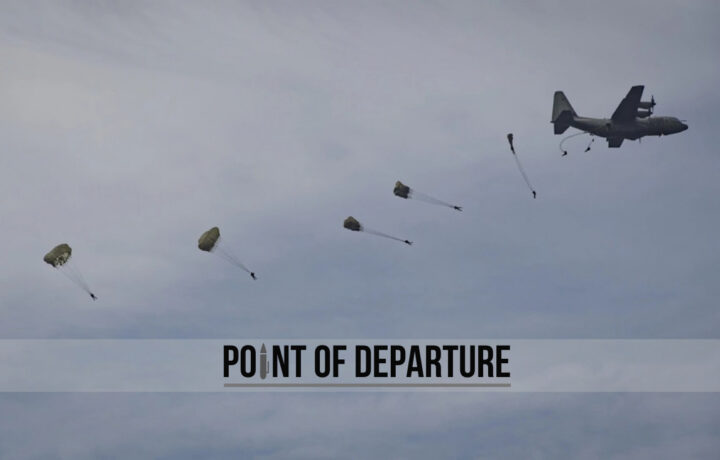
The plan had two moving parts. Market was the airborne element, the largest airborne operation in history, dropping three divisions of paratroopers – the American 101st and 82nd Divisions and the British 1st Airborne with a Polish brigade in support – over 60 miles behind enemy lines to capture and hold a series of key bridges. Garden was the ground element, with XXX Corps racing up a single elevated highway to link up with the airborne divisions and cross each bridge in succession, all the way to Arnhem.
The decision wasn’t purely operational. Eisenhower was managing a strategy across a broad front with commanders competing for the same limited resources. Montgomery needed a mission that justified concentrating resources on his sector. The Netherlands also hosted V-2 launch sites tormenting London, and liberating Dutch civilians carried real moral weight. Ambition, opportunity, and politics converged, and Eisenhower ultimately approved a plan that assumed everything would go right.
But the enemy gets a vote.
THE NARROW ROAD TO VICTORY
Market Garden failed for reasons that compound one another, and that compounding is the real lesson buried in the wreckage. First, the narrow road to victory. XXX Corps’ entire advance depended on a single, elevated highway that Dutch resistance fighters nicknamed Hell’s Highway, a road so exposed that a handful of German anti-tank guns could stall an armored corps for hours. When engineers blew the bridge at Son and fighting bogged down at Nijmegen, the execution timeline collapsed, and every hour lost was an hour the lightly armed British and Polish paratroopers at Arnhem didn’t have.
Second, ignored intelligence. Both Dutch resistance reports and aerial photography hinted that II SS Panzer Corps was refitting near Arnhem, a much greater presence than assumed in Market Garden planning. Battered but very much intact, II Panzer straddled the drop zones. Planners downplayed the intelligence reports because the operation was already approved and, for Montgomery, momentum mattered more than doubt.
Third, the phasing of Market. The airborne plan itself asked for more than physics allowed. There weren’t enough transport aircraft to drop everyone at once, so landings stretched across three days, giving the Germans time to react between waves. Drop zones for the British paratroopers sat miles from the Arnhem bridge, and the radios meant to coordinate the fight were unreliable, leaving commanders blind to what was happening a few hundred yards away.
By the time the lead elements of XXX Corps reached the Waal, the British paratroopers holding the north end of the Arnhem bridge had been fighting alone for days. The timeline was shot. The bridge too far stayed exactly that.
WHAT THE BRIDGE STILL TEACHES
Every failed operation leaves behind more than casualty figures. It leaves a case study, and Market Garden is one of the most thoroughly dissected in modern military history, precisely because so much went right in planning and so much went wrong in execution. I’ve sat through enough after-action reviews over the years to know the ones worth remembering aren’t the clean wins. The losses – where reasonable people made reasonable calls that still added up to failure – are where the real learning occurs.
Eighty years on, Market Garden still has something to teach anyone who plans under pressure.
1. Logistics determines how far and how fast a force can advance.
Tempo and operational reach are set by logistics, not ambition. A plan that outruns its own sustainment is already failing, no matter how brilliant it looks on day one.
2. Embrace inconvenient intelligence.
The Market Garden planners had real-time intelligence about German armor near the drop zones and chose confidence over caution. Good decision-making relies on weighing evidence you’d rather not have.
3. Avoid single points of failure.
One road, one bridge, one radio frequency: Market Garden ran its entire operation through chokepoints with no redundancy and zero flexibility, and each one became a liability at the worst possible moment.
4. Communication is the lynchpin to success.
It isn’t a supporting function; it’s the operation. Commanders who can’t talk to their forward elements aren’t commanding; they’re hoping. Build redundant, tested communications into a plan before you weave the timeline around it.
5. Hope is not a method.
Market Garden succeeded on paper before a single paratrooper boarded a glider, because senior leaders wanted a war-ending win badly enough to discount the risks. Yogi Berra had it right: it ain’t over till it’s over, and a plan that assumes it’s already over is the one that gets the fewest second chances.
None of this makes the men who fought at Arnhem or along Hell’s Highway any less courageous. It means the courage was spent covering for a plan that asked too much of too little, too fast.


