Native Americans have served in the U.S. military at some of the highest rates of any demographic, carrying forward a warrior tradition deeply rooted in their cultures. Their service reflects extraordinary courage, sacrifice, and resilience. Too often, their stories remain overlooked in mainstream military history.
By honoring their legacies, we also acknowledge the unique challenges they faced both on the battlefield and back home.
Ira Hayes (Pima) – The Flag Raiser of Iwo Jima
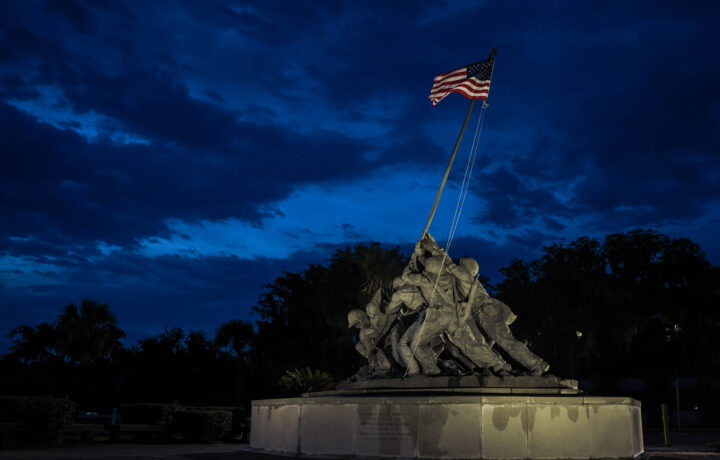
Few images are as iconic as the raising of the American flag on Iwo Jima. Among the six Marines captured at that moment was Corporal Ira Hayes of the Pima Nation. Hayes became a symbol of Native American patriotism and sacrifice during World War II, but the sudden fame also weighed heavily on him.
After returning home, he struggled with alcoholism and the burden of representing a people who were still marginalized in their own country. His story reminds us that heroism in war can sometimes be followed by painful battles in peace. It also remains a stark lesson in why we must continue to take care of veterans when they come home.
Joseph Medicine Crow (Crow) – Warrior and Historian
Joseph Medicine Crow brought the old and the new together in a way few could. Serving as a scout in Europe during World War II, he fulfilled all four requirements to become a traditional Crow war chief: touching an enemy in combat, stealing his weapon, leading a successful war party, and capturing an enemy’s horse.
After the war, he earned acclaim as a historian and author, preserving Crow history and Indigenous perspectives for future generations. In 2009, President Barack Obama awarded him the Presidential Medal of Freedom, cementing his dual legacy as both warrior and scholar.
Lori Piestewa (Hopi) – Breaking Barriers and Making History
Specialist Lori Piestewa’s service and sacrifice in Iraq marked a historic moment: she was the first Native American woman to die in combat while serving in the U.S. military. A Hopi mother of two, Piestewa’s death in a 2003 ambush near Nasiriyah resonated deeply within Native communities and across the nation. Arizona later renamed Squaw Peak to Piestewa Peak in her honor, ensuring her name lives on as a symbol of bravery, trailblazing service, and the often-overlooked role of Native women in the military.
According to an article by The National Museum of the United States Army, Wayland, Piestewa’s oldest brother, said, “My sister is a warrior because she did the right thing, the honorable thing: going to Iraq when she didn’t have to, because she felt it was the ethical and moral thing to do. That’s what being a warrior is about: doing what’s right, even when it’s difficult and means sacrifice.”
Charles Chibitty (Comanche) – The Last of the Code Talkers
During World War II, Charles Chibitty and fellow Comanche code talkers used their language to transmit messages that baffled the enemy. Serving in the U.S. Army, Chibitty helped ensure secure communications during critical operations in Europe.
Decades later, he was honored by both the U.S. and French governments, including receiving the Chevalier of the National Order of Merit. Chibitty was the last surviving Comanche code talker when he passed in 2005, representing a chapter of history where Native languages became unbreakable weapons of war.
Mitchell Red Cloud Jr. (Ho-Chunk) – Valor in Korea
Corporal Mitchell Red Cloud Jr.’s Medal of Honor citation reads like a lesson in ultimate sacrifice. During the Korean War, though mortally wounded, he held his ground against overwhelming enemy forces, buying his unit enough time to regroup and mount a defense. His actions cost him his life but saved countless others.
His citation reads, “Cpl. Red Cloud, Company E, distinguished himself by conspicuous gallantry and intrepidity above and beyond the call of duty in action against the enemy. From his position on the point of a ridge immediately in front of the company command post, he was the first to detect the approach of the Chinese Communist forces and give the alarm as the enemy charged from a brush-covered area less that 100 feet from him. Springing up he delivered devastating point-blank automatic rifle into the advancing enemy. His accurate and intense fire checked this assault and gained time for the company to consolidate its defense. With utter fearlessness he maintained his firing position until severely wounded by enemy fire. Refusing assistance he pulled himself to his feet and wrapping his arm around a tree continued his deadly fire again, until he was fatally wounded. T
Red Cloud’s name is etched not only into military history but also into the collective memory of his people, embodying courage that transcends generations.
Pascal Cleatus Poolaw Sr. (Kiowa) – America’s Most Decorated Native Soldier
Master Sergeant Pascal Poolaw’s career spanned three wars — World War II, Korea, and Vietnam — making him one of the most decorated Native American service members in history. With four Silver Stars, five Bronze Stars, and three Purple Hearts, his record speaks to relentless service and dedication. Tragically, Poolaw was killed in Vietnam while trying to pull a wounded soldier to safety. His story underscores a lifetime of selflessness and sacrifice, carried not only by him but also by his family, many of whom served as well.
Sgt. Poolaw’s wife Irene spoke at his funeral: “He has followed the trail of the great chiefs,” she said. “His people hold him in honor and highest esteem. He has given his life for the people and the country he loved so much.”
Clarence Tinker (Osage) – Breaking Barriers in the Air
Major General Clarence Tinker shattered barriers as the first Native American to reach that rank in the U.S. Army. Leading bombing missions in the Pacific during World War II, he was killed in action in 1942. His legacy lives on at Tinker Air Force Base in Oklahoma, a daily reminder of his trailblazing leadership and ultimate sacrifice. For many Native service members, Tinker remains a symbol that no rank or role was beyond reach.
While he was stationed in England, Tinker received the Soldier’s Medal for gallantry. As a major, he rescued a naval officer, Commander Robert A. Burg, from a crashed and burning airplane, which he himself had been piloting. Despite his own injuries, he succeeded in saving the life of his passenger, although he was severely burned in the process.
Michael Thornton (Cherokee Ancestry) – Navy SEAL Legend
Navy SEAL Michael Thornton’s actions in Vietnam remain legendary within the special operations community. In 1972, under withering fire, Thornton saved his commanding officer’s life, carrying him through the surf to safety despite his own injuries. For this, he received the Medal of Honor. Thornton’s story demonstrates not only physical courage but also the unbreakable loyalty that defines military brotherhood. These are the same values deeply rooted in Indigenous warrior traditions.
Marcella LeBeau (Cheyenne River Sioux) – Healing on the Frontlines
As an Army nurse in World War II, Marcella LeBeau served in field hospitals across Europe, including during the brutal Battle of the Bulge. Her care and dedication saved countless lives, and after the war, she became a lifelong advocate for Native rights and healthcare.
In 2004, France chose her among 100 other WWII nurses and awarded her the Legion of Honor for her service. LeBeau’s story reminds us that Indigenous contributions were not only on the frontlines of combat but also in the tireless work of healing and recovery. Marcella continued to serve as a professional nurse for more than 30 years. She received the O. Marie Henry RNDNSC Chief Nurse and the Mable Ann Wagner Award for her exemplary contributions during her career.
A Legacy of Service and Sacrifice
From code talkers to generals, medics to Medal of Honor recipients, Native Americans have played pivotal roles in nearly every major conflict in U.S. history. Their stories reflect not only extraordinary individual bravery but also a collective legacy of service that continues today, with Indigenous peoples still enlisting at higher rates than the national average.
To honor these warriors is to recognize both their sacrifices and the traditions they carry. Their service was never just about battles fought overseas; it was about upholding a warrior spirit rooted deeply in culture, community, and resilience.


