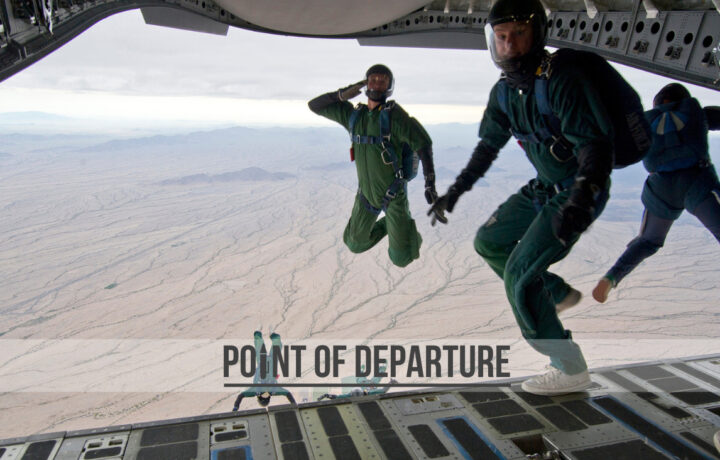
“Il nous faut de l’audace, encore l’audace, et toujours de l’audace!” – Georges Danton
In the spring of 1989, I rolled my platoon out of the motorpool gates in the pre-dawn hours of a frosty March morning as we departed for one of Fort Campbell’s more remote training areas for a platoon-level tactical evaluation. We needed to dig in quickly and establish a sound defensive perimeter within four hours – the battalion training standard – but we were also fighting the lingering effects of a long winter: the ground was still frozen solid.
To solve that issue, one of my NCOs coordinated for engineer support, who immediately set to work with a backhoe on the rough fighting positions from which we’d defend our position from an aggressor attack sure to come later that night. As a result, we were firmly entrenched and camouflaged within two hours, leaving plenty of time to fine-tune the quality of our defenses.
The evaluators with us were impressed with the ingenuity and even more so with the fact that everyone worked in concert with the machine to perfect every aspect of our defensive position. The battalion commander, on the other hand, was furious. Although nothing in our standard operating procedures specifically prohibited us from doing what we did, he thought it violated the spirit of the training event… and literally chewed me up one side and down the other. Then directed that we reposition to another training area and start again.
As I stood there watching his CUCV drive away, my platoon sergeant just chuckled to himself. “L-T, it ain’t nothing but a thing,” he said. “If you’re not getting’ your *ss chewed once in a while, you’re not doing your job.”
The Right Stuff
Like much of the common sense wisdom dispensed by my platoon sergeant during our time together, those words struck a chord. While no one particularly enjoys being dressed down, there are moments when it stings a little less. We’d found a gap in our standard operating procedures and exploited it to advantage. Doing so allowed our platoon to overcome one obstacle – the weather – while preparing to face down another – the aggressor platoon that would be probing our defenses after nightfall. We were pushing the envelope, testing boundaries in a way that others might normally avoid as too risky or radical.
The phrase originated in the aviation community and described how test pilots routinely pushed beyond the performance limits of new aircraft. The envelope – a technical term for the graphical representation of performance boundaries for speed, altitude, and maneuverability – represented the safety of the operating limits of an aircraft. But the rigors of combat flight demanded that pilots push beyond those boundaries to test the full range of an aircraft’s performance.
Testing the Limits
As I matured as a leader, pushing the envelope became central to my leadership philosophy. I drew inspiration from bold leaders who seized the initiative, acted decisively, and created their own luck. Leaders who, rather than color within the lines, tested the limits of their authority and, as my platoon sergeant often told me, “Made sh*t happen.”
Sometimes, it was better to beg forgiveness than ask permission.
Few typified this attitude more than Admiral Arleigh Burke – the Chief of Naval Operations from 1955-1961 – who famously said, “Any commander who fails to exceed his authority is not of much use to his subordinates.” Burke believed deeply that rigid obedience to the status quo could hinder operational effectiveness, especially under fire. He also felt that sailors relied on leaders who were willing to exercise initiative, take risks, and make the tough calls.
That type of moral courage – doing what’s necessary for the team even if it bends protocol – is essential to adaptive leadership in complex environments, where strict adherence to authority can stifle innovation and responsiveness. It is also fundamental to mission command, the military’s model for leadership that emphasizes decentralized decision-making, initiative, and risk taking.
The Benefits of Risk
Burke viewed risk as a necessary and often noble component of leadership. Avoiding risk – something all too common in his view – undermined effective leadership. He not only embraced risk, he championed it. Nowhere was this more evident than in his leadership philosophy, which was framed around risk: calculated boldness, initiative over caution, and empowerment through trust.
Risk is not recklessness. It’s not a gamble, but calculated decision making and a willingness to take bold action when the stakes demand it. As Burke knew from years of command at sea, leadership without risk is leadership without impact.
His approach to leadership – one that’s shaped much of my professional life – reflected his sincere belief that the benefits of risk far outweighed the dangers. It’s equal parts getting comfortable being uncomfortable and taking ownership of the outcome, good or bad. And when the dust settles, the advantages are both significant and tangible.
1. Fosters innovation and a competitive edge.
Taking the road less travelled comes with some degree of risk, but if you’re successful, it can lead to a decisive competitive edge. And if you can make a habit of taking calculated risks, you can retain that edge over time.
2. Inspires and engages subordinates.
I learned two important lessons about being decisive in the face of risk early on in my military career. One, troops enjoy following a leader willing to push the envelope. Two, doing so – especially when they understand that you’re doing it with their best interests at heart – builds trust and loyalty.
3. Leverages critical and creative thinking.
Risk taking inevitably involves coloring outside the lines. You’re engaging problems with innovative approaches that require equally innovative thinking.
4. Builds resilience.
As you become increasingly comfortable with risk, you’re also creating opportunities for learning from failure. As long as the culture allows for mistakes, you will build resilience from the experience. And to be fair, even if the culture doesn’t allow for mistakes, you’re going to develop a thick skin.
5. Encourages a culture of accountability.
Indecisive, risk averse leaders are usually the first to try to delegate accountability for their actions. The opposite proves true for decisive leaders who embrace risk. They not only savor the opportunity to take risks, they hold themselves accountable in the process. That culture of accountability breeds the type of innovation that spurs opportunity.
You’ll never grab that brass ring sitting safely in your office chair. You have to get up, get out, and reach for it. You have to take a little risk and see where the cards fall.


