On the morning of April 18, 1942, Lieutenant Colonel Jimmy Doolittle led sixteen B-25 Mitchell bombers off the deck of the USS Hornet into the gray Pacific sky. Their destination was Japan itself – Tokyo, Yokohama, Nagoya, and Kobe – attacking targets that had been unreachable by American forces just months earlier.
The mission, later known as the Doolittle Raid, was considered by many to be daring to the point of recklessness. The aircraft were not designed for carrier launches. The crews knew they would not be able to return to the carrier – theirs was a one-way mission and they would likely have to bail out after the strike or ditch in China. The odds of survival were slim, and the odds of success were even slimmer.
Yet the raid went forward. When the bombs fell on Tokyo, the physical damage was modest, but the psychological impact was seismic. Japan’s aura of invincibility shattered. American morale surged. And a new, undeniable truth emerged: airpower could alter the course of the war without first gaining command of the seas or massing boots on the ground. It could reach across oceans, strike deep, and be decisive in its own right.
From Warrior to Strategist
Although Billy Mitchell had died six years earlier, the raid bore his unmistakable hallmark. It wasn’t just that the airframes carried his name, the mission itself validated the very ideas for which he had been court-martialed, disgraced, and driven from the service. The Dolittle Raid was not merely a tactical success – it was posthumous vindication for a man whose leadership was defined by vision, courage, and an unyielding willingness to challenge institutional inertia.
Born into a prominent Wisconsin family in 1879, he entered the U.S. Army Signal Corps during the Spanish-American War, where he demonstrated unrivaled organizational talent and an insatiable appetite for innovation. When aviation emerged as a military specialty, Mitchell recognized its potential earlier and more clearly than his peers. He learned to fly at a time when many senior officers held a dismissive view of aircraft, seeing them as novelties or with only limited military utility.
Then came the Great War.
World War I transformed Mitchell from a promising young general into a fervent advocate of airpower. As chief of air operations for the American Expeditionary Forces, he coordinated thousands of aircraft during the St. Mihiel and Meuse-Argonne offensives, proving that massed airpower could shape ground campaigns while earning the Distinguished Service Cross and a multitude of foreign decorations. He returned from the war convinced that aviation deserved independence, resources, and strategic primacy.
Lessons in leadership
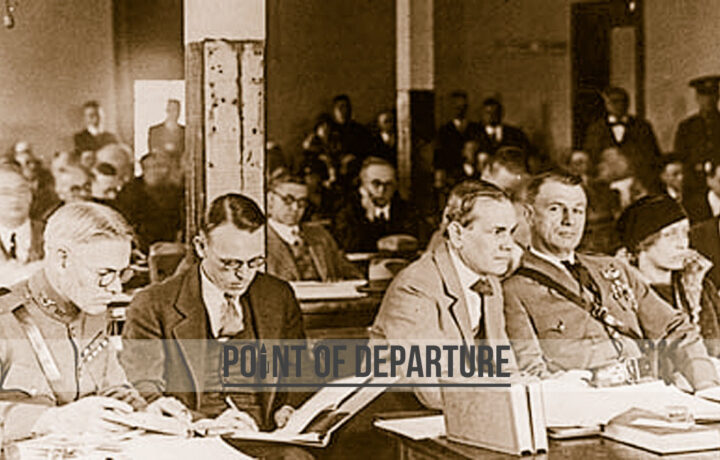
But his brash methods and difficult manner alienated many of his superiors. In the years after the war, his leadership took an increasingly confrontational turn. Frustrated by what he saw as willful blindness among senior leaders, he publicly attacked the Navy and War Departments for neglecting air defense and clinging to battleships, which he saw as obsolete. His outspoken criticism led to a 1925 court-martial for insubordination – Mitchell lost the trial, resigned from the Army, and spent his final years writing, lecturing, and warning about the war to come.
Billy Mitchell’s leadership legacy is deeply rooted in moral courage and strategic foresight, a legacy reflected in five key lessons that proved as enduring as his reputation.
1. The power (and peril) of vision.
Mitchell saw clearly what others couldn’t– airpower would fundamentally alter warfare. True leaders, he believed, possessed the vision to see beyond existing structures and prepare for futures that institutions often resist acknowledging. His failure was not a lack of insight, but an inability – or refusal – to temper his message when his career was on the line.
2. The necessity of conviction.
Mitchell took a stand where others wouldn’t. He accepted personal and professional ruin rather than soften that stance. His uncompromising approach galvanized supporters and provoked enemies, a brutal reminder that transformative leadership often comes at a cost.
3. The resoluteness of intellectual courage.
Mitchell exemplified intellectual courage– he grounded his arguments in facts, data, and experience. He recognized that a leader had to do more than talk. Innovation must be demonstrated, not merely theorized. Leaders advocating change must provide undeniable evidence that forces institutions to reckon with new realities.
4. The importance of social and emotional intelligence.
Mitchell was blunt to a fault. His public attacks alienated potential allies and accelerated his downfall. His story serves as a cautionary tale of speaking truth to power– vision that isn’t conveyed with social and emotional intelligence will hit a proverbial brick wall, even if history later proves them right.
5. Influence is not constrained by time.
Though silenced in his day, his ideas shaped generations of airmen and, ultimately, the creation of the U.S. Air Force. Effective leadership is not bound by time. As Billy Mitchell proved, it plants seeds that may only bear fruit long after the leader is gone.
A Legacy in Words
At 7:55 a.m. on December 7, 1941, the Japanese attacked Pearl Harbor. Hours later, the attacked again on Clark Field in the Philippines. In an official report filed in 1924, Billy Mitchell predicted the attack. He recognized the dangerous expansionism taking hold in Japan and warned that war was inevitable. That conflict would likely begin with a Japanese attack on Pearl Harbor followed by a second assault on the Philippines. Few people took notice of his warning.
Long after his death in 1936, his words continue to reverberate, cementing a legacy that has endured through generations. When people were listening, Billy Mitchell was more than the “prophet of air power.” He was an exception leader whose vision transformed warfare.
1. “In the future, whoever holds the mastery of the air will ultimately hold the mastery of the world.”
Strong words, but words that foreshadow a time when the ability to wage war across domains would determine success.
2. “The day is not far distant when the battleship will be as obsolete as the wooden man-of-war.”
While the battleship still had a few more rounds left in her, Mitchell’s warning was one of complacency. Don’t wait until obsolescence is proven in battle. Innovate and experiment while you have the luxury to do so.
3. “One does not build a great organization by timid leadership.”
Go big or go home. Or, as someone once told me, “If you’re scared, buy a dog.” Be bold.
4. “Aviation is the most revolutionary military development of our time.”
Innovation is fundamental to warfare. As in many endeavors, those who fuel innovation find successes that endure the test of time.
5. “Truth is more important than rank.”
In Mitchell’s view, true leadership was less about rank and formal authority than moral courage and the willingness to speak truth to power.
Billy Mitchell was a trailblazer, a leader with unparalleled vision yet not always the most politically adept. But he was a necessary leader at a time that demanded nothing less. His career stands as a testament to the enduring power of vision, the cost of principled defiance, and the long arc of leadership that bends toward those willing to speak uncomfortable truths before the world is ready to hear them.

