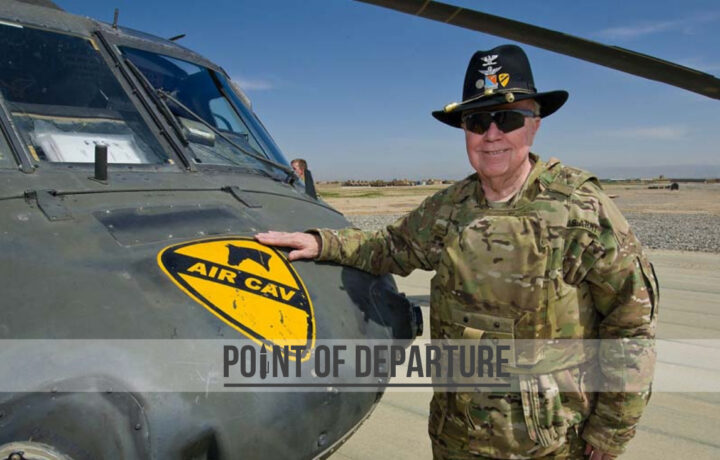
“I never left a soldier behind. That wasn’t something I decided in the valley — it was something I decided long before I ever flew into it.” – Bruce Crandall
A framed print hangs above my desk. Of all the prints in my collection, it holds personal meaning, linking my military heritage to one of the most impactful battles of the Vietnam War: Landing Zone X-Ray.
The print, William Phillips’s First Boots on the Ground, captures the early moments of the battle, when Lieutenant Colonel Hal Moore led his cavalry troopers into a small clearing at the base of the Chu Pong massif. It was the first test of the Army’s airmobile concept. It also represented the first time regular forces from North Vietnam engaged U.S. forces in battle.
In the background of the print, three UH-1 Huey helicopters hover over the landing zone. The lead chopper is piloted by Major Bruce Crandall, affectionately known to his crew as “Old Snake.” Over the next two days, Crandall’s exploits would cement his legacy as a legend of Army aviation and his reputation as one of the bravest pilots to take the controls of a helicopter.
Taking Flight
Born in Olympia, Washington, in 1933, Bruce Crandall demonstrated an early sense of duty that came to define his life. He enlisted in the Washington Army National Guard at just fifteen years old and, when he was drafted in 1953, left the University of Washington to attend Engineer Officer Candidate School at Fort Belvoir, Virginia. After he earned his commission, he attended fixed- and rotary-wing training before being assigned to an aviation mapping unit at the Presidio of San Francisco.
Crandall quickly became an experienced pilot on multiple airframes. He flew the Cessna L-19 Bird Dog and the de Havilland DHC-2 Beaver in Alaska, then added the DHC-3 Otter and OH-23 Raven in Libya, where he earned his rating as both a test pilot and instructor pilot. He left Tripoli for Howard Air Force Base in Panama, where he mapped thousands of miles or unexplored mountains and jungles in Central and South America. By early 1965, he was serving as an XVIII Airborne Corps liaison officer to the Dominican Republic Expeditionary Force.
Then war came calling.
The Airmobile Division
The doctrine that would come to define American ground combat in Vietnam was hammered out over years of field experimentation by leaders who truly believed that helicopters could transcend the tyranny of terrain. The vision that had been first proposed by Lieutenant General James Gavin – who rose to fame in the Second World War as the youngest division commander since the Civil War – was realized in 1962 with the formation of the Tactical Mobility Requirements Board, which recommended the adoption of helicopters in a wide range of combat roles and missions.
A year later, elements of the 11th Airborne Division were reactivated at Fort Benning, Georgia, as the 11th Air Assault Division (Test) to explore the feasibility of the airmobile concept on the conventional field of battle. In September 1963, Air Assault I exercises at Fort Stewart, Georgia, put the airmobile concept to the test at the battalion level. The following year, Air Assault II sprawled across two states and committed 35,000 troops, with the entire division squaring off against the 82nd Airborne Division.
Crandall was central to this crucible. As a seasoned aviator, he helped perfect the new air assault tactics that would eventually reshape how the Army fought. On July 1, 1965, the 11th Air Assault Division was re-flagged as the 1st Cavalry Division (Airmobile), and twenty-seven days later President Johnson ordered the division to Vietnam. When the “airmobile division” set sail from Charleston, South Carolina on August 16, Crandall was widely recognized as one of the craftsmen who built the air assault doctrine they would test in the proving ground of the Central Highlands of South Vietnam.
Into the Fire
In the early morning hours of November 14, Crandall’s flight of sixteen helicopters ascended from Plei Me for the short, 13-minute flight to Landing Zone X-Ray in the Ia Drang valley. The initial eight Hueys dropped their tails to reduce speed and touched down in the tall elephant grass, the door gunners firing into the trees around the clearing. It was just 10:48 on a clear, quiet morning; Lieutenant Colonel Hal Moore stepped off Crandall’s helicopter and was the first American to set foot in X-Ray.
Crandall’s crews continued to transport Moore’s battalion into the valley throughout the morning. By the fourth troop lift, the helicopters began to take enemy fire. As Crandall and the first eight helicopters landed on the fifth troop lift, his unarmed helicopter came under such intense fire that Moore ordered the second flight of eight aircraft to abort their mission.
Crandall flew back to Plei Me, only to turn around.
Crandall knew that the survival of Moore’s besieged battalion was more important than his own safety. The battalion was already short on ammunition and many of the wounded required urgent medical evacuation. He adjusted his base of operations to Firebase Falcon to shorten the flight distance, immediately sought volunteers, and led two aircraft back into the hot landing zone.
Over the course of the next 16 hours, his helicopters were shot up so badly he was forced to change aircraft three times. On one approach, enemy soldiers were visible just beyond his rotor blades. Three men were killed inside his aircraft; his crew chief was shot in the neck. He did not stop. Of thirty-one helicopter loads of ammunition and supplies brought into X-Ray after it was declared closed to air traffic, Crandall’s flight accounted for twenty-eight. Of approximately seventy-eight soldiers wounded in action who were evacuated, Crandall’s aircraft carried out seventy. Throughout the day and into the evening, he flew a total of twenty-two missions, most under intense enemy fire, leaving the valley only after all possible support had been rendered.
For his actions that day, Crandall – as well as his fellow pilot Ed “Too Tall” Freeman – received the Medal of Honor. The citation captured what his presence meant to the men on the ground: his voluntary decision to land under intense fire inspired the other pilots to continue landing their own aircraft and gave the troops on the ground a fighting chance to survive the day.
On May 31, Bruce Crandall made his final flight at the age of 93, passing away at his home in Tempe, AZ. Perhaps the most fitting tribute came from the late Joe Galloway, who along with Moore told the story of the Battle of the Ia Drang Valley in their book, We Were Soldiers Once… and Young: “Col. Bruce ‘Ol’ Snake’ Crandall is the bravest, craziest, funniest helicopter pilot I ever met in 43 years of going to war. Snake and his wingman, Maj. Ed ‘Too Tall to Fly’ Freeman, led 16 slick Hueys into Landing Zone X-Ray again and again… Scores of the wounded are alive today because of their heroism.”


