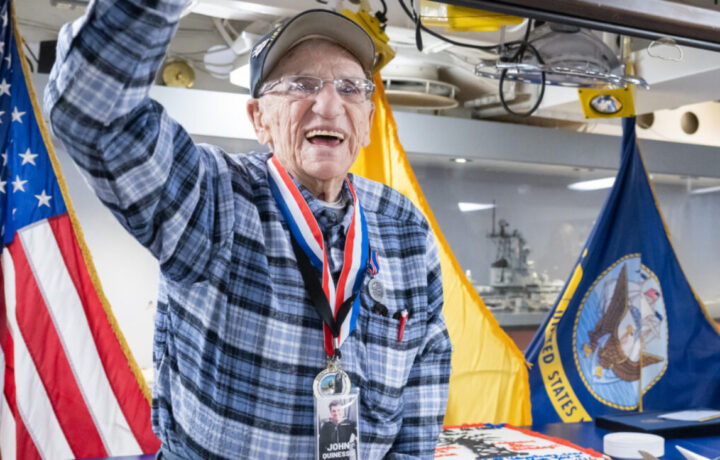
At a time when fewer Americans have any kind of connection to World War II, the story of a 100-year-old Navy veteran in New Jersey serves as a powerful reminder that military service doesn’t end when the uniform comes off.
In January, World War II veteran John “Johnny Q” Quinesso Sr. celebrated his 100th birthday aboard the historic Battleship New Jersey, permanently docked as a museum ship in Camden, NJ, where he has spent more than two decades volunteering as a tour guide and educator. The celebration honored not only 100 years of birthdays, but a lifetime of service that continued long after his military career ended.
Quinesso’s military journey began in 1943 when he joined the Navy at 19 years old. He served as a Radioman 2nd Class aboard the LSM-302. While on board, he participated in operations throughout the Pacific theater, including deployments near Guam, Okinawa, Saipan, and Wake Island during some of the most intense fighting of World War II.
A Moment in History
One moment from his service remains etched in his memory more than 80 years later.
While standing watch aboard his ship near Guam, Quinesso received a radio transmission announcing that Japan had surrendered and the war was over. The message sparked an emotional celebration among the crew, ending years of uncertainty and bringing hope that they would finally return home.
After leaving the Navy, Quinesso built a successful 43-year civilian career at the IRS. Yet retirement did not signal the end of his commitment to service. When the Battleship New Jersey reopened as a museum in 2001, he found a new mission: educating future generations about military service, sacrifice, and the cost of freedom.
Why This Matters to Today’s Workforce
For the military community, Quinesso’s story highlights an important truth: military service creates lifelong public servants.
Many veterans transition from active duty into government agencies, defense contractors, public service roles, volunteer organizations, and community leadership positions. While the mission changes, the desire to serve often remains the same.
That continued sense of purpose is especially important as we face a growing challenge: preserving the firsthand experiences of the Greatest Generation before those stories disappear forever.
According to the VA, the number of living World War II veterans continues to decline rapidly. Every remaining veteran represents a direct connection to one of the most consequential periods in modern history. Their stories provide lessons in resilience, leadership, sacrifice, and national service that remain relevant for today’s military and civilian workforce.
The Value of Preserving Military History
The Battleship New Jersey itself represents a living classroom. As the most decorated battleship in U.S. Navy history, the ship served during World War II, the Korean War, the Vietnam War, and even operations in the Middle East. Today, it functions as a museum and memorial dedicated to preserving naval history and educating visitors about the sacrifices made by generations of service members.
For visitors, hearing stories directly from veterans like Quinesso creates a connection that no textbook or documentary can fully replicate. That connection matters. Understanding the experiences of previous generations helps provide context for today’s service members, veterans, and cleared professionals who continue to support national security missions around the globe.
Service Beyond the Uniform
One of the most compelling aspects of Quinesso’s story is its challenge to the notion that service has an expiration date. Whether serving in uniform, supporting government missions as a civilian, mentoring younger generations, volunteering in local communities, or preserving military history, veterans continue to make meaningful contributions long after their military careers end.
At 100 years old, Quinesso’s legacy is not simply that he served during World War II. It’s that he never stopped serving.
For today’s transitioning service members wondering what comes next after military life, his example offers a simple but powerful lesson: your mission may change, but your purpose doesn’t have to.


