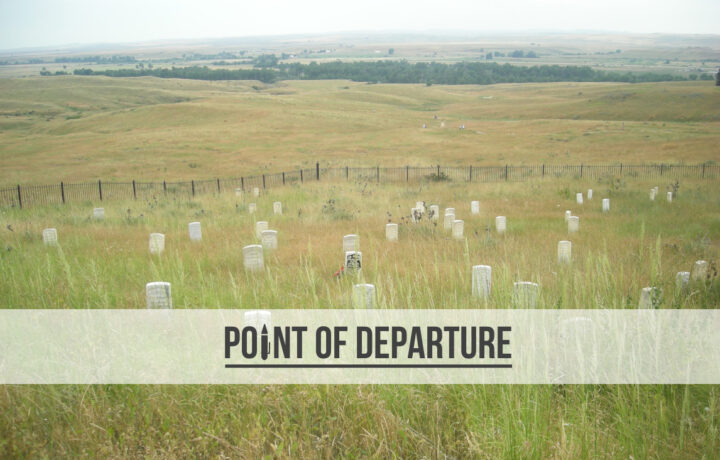
In the early morning hours of June 27, 1876, Brigadier General Alfred Terry cautiously, the commander of the Department of the Dakota, led a column of infantry and cavalry into the valley of the Little Bighorn River in the Montana Territory. Smoke swirled across the rolling hills and the air reeked of decaying flesh. Debris, dead and wounded animals, discarded possessions, and abandoned lodge poles littered the area.
It was all that remained of the largest gathering of Native Americans ever witnessed on the Great Plains of North America. Then his chief of scouts reported the discovery of the bloated, mutilated corpses of more than 200 officers and men of Lieutenant Colonel George Armstrong Custer’s 7th Cavalry.
In all, 257 troopers of Custer’s command fell that day: 210 with the flamboyant “boy general” and another 47 four miles upstream with Major Marcus Reno and Captain William Benteen. For the 15,000 Sioux and Cheyenne gathered in the valley, the battle represented the zenith of the Indian Wars, and would eventually bring a tragic, anticlimactic end to one of the most colorful periods in American history.
Custer’s Luck
For decades, historical analysis of the battle tended to remain blame focused. Some people put the blame on Custer and his reputed insatiable zeal for glory. Others blamed Reno for retreating under fire – leaving Custer alone to face the full brunt of the Native assault – or Benteen for not leading a rescue effort. Others still wrote off the defeat to the unprecedented size and ferocity of the force arrayed against Custer.
However, Custer’s demise at Little Bighorn was the fault of no single event or individual in particular, except maybe his own. Custer possessed what has often been referred to as “Custer’s luck,” an uncanny ability to always be in the right place at the right time. At Little Bighorn, Custer’s luck had run out.
Custer, like so many others serving on the frontier, held his enemy in rather low regard and viewed success on this campaign as a mere formality. That perspective – underestimating his opponent – sealed his fate. Custer’s defeat was as inevitable as the setting of the afternoon sun over the grassy hills surrounding the meandering Little Bighorn.
Decision in Battle
With Custer, decisions were made based largely on intuition, drawing on his experiences in war, coupled with an audacity and bravado typical of a cavalry commander of the period. For a man who had never lost a battle, however, those experiences were extremely limited in scope and, as such, resulted in a recklessly myopic disregard for the unpredictable nature of battle.
More than any other single factor, intuition is fundamental to human decision making. For a man like Custer, however, intuition was a fatal flaw. Custer’s previous experiences did not shape his instincts and intuition for battle under such circumstances. He was incapable of recognizing and adapting to the dynamic nature of his environment.
His experience as a veteran cavalryman accustomed him to simple cause-and-effect relationships: when he made a decision, he could witness the results without significant delay. The notion that the effects of his decisions could be delayed by hours – or even days – was completely foreign to him. Similarly, he would not have accepted the suggestion that the effects of his decisions could spin out of control without his knowledge.
But that’s exactly what happened when he turned his horse and descended into Medicine Tail Coulee, where the wrath of the Lakota Nation awaited.
Lessons from the Greasy Grass
Custer wasn’t a victim of disobedience, cowardice, or even his own zeal for glory. Instead, he was a victim of his own limited experience, his legendary past, and his renowned luck. His intuition, flawed and imperfect, led him to make decisions that assured his destiny, the very place in history he had so diligently sought.
150 years after the Battle of Little Bighorn, the lessons are still as relevant and resonate as deeply. The echoes of history impart five timeless and irrefutable lessons.
1. Intelligence is only valuable when it’s shared.
After being thoroughly bloodied by a unified, aggressive force led by Crazy Horse at Rosebud Creek on June 17, Brigadier General George Crook, commander of the Department of the Platte, declared victory and withdrew, filed a misleading after-action report, and made no effort to warn Terry. The lesson here isn’t merely about communication’ it’s about human behavior. Ego, embarrassment, competitive instincts — they can all cause leaders to suppress critical information. Crook’s silence wasn’t malicious; it was the silence of a man who didn’t want to admit defeat.
2. The enemy gets a vote… and sometimes changes the rules.
The Lakota didn’t just fight differently at the Little Bighorn, they fought in a way that no prior encounter had prepared anyone to anticipate. Crook got a preview at the Rosebud; Custer never even received a warning. Treating any competitor, enemy, or disruptive force as predictable based on past behavior is precisely how leaders walk into ambushes — in business, policy, and war.
3. Pattern recognition is a gift… until it becomes a trap.
Custer had never lost. That record didn’t make him confident; it made him incapable of modeling a world in which he could. Leaders who have built their resumes on a string of successes are the most vulnerable to catastrophic failure, precisely because success has never forced them to stress-test their assumptions. Winning can be a very poor teacher.
4. No plan survives first contact.
Terry’s operational design was conceptually sound — a hammer-and-anvil campaign with Gibbon, Terry, and Custer converging on a confined enemy at a known location. What it lacked was any provision for what happened when the enemy didn’t cooperate with the plan. The lesson — one that resonates from corporate crisis response to military operations — is that what you plan on paper is less important than ensuring that your intent is thoroughly understood and your team is well enough trained to operate independently when the plan goes out the window.
5. Character under pressure is the ultimate leadership test.
Benteen’s personal integrity in the most adverse circumstances may well have saved what remained of the 7th Cavalry. He organized Reno’s shattered position under fire, in full view of the enemy, without hesitation. And he was court-martialed for his efforts. The lesson is uncomfortable but honest: the system doesn’t always reward the right people. What endures is the conduct itself, not the recognition.


