“Oh, man, this stuff tastes like toilet paper!” – Fred Ward, Tremors II: Aftershocks
When it comes to dining on fine military cuisine, I often share a story about a noteworthy – and educational – moment in my career. On an otherwise unremarkable night during the Gulf War, I pulled my HMMWV into our Forward Operating Base and parked it near the festival tent that served as our battalion headquarters. It was late and I was tired, having just completed the 500-mile drive from Dammam, the industrial port city on the Arabian Gulf, to our base camp outside Rafha. I was also hungry. So, I did what anyone else in my situation would do – I went in search of an MRE.
There’s a common term used to describe the scene I found. Every case was opened as were many of the meals. Accessory packets were strewn about and the only intact meals remaining – what we euphemistically called “the no meal left behind program” – were the really bad ones. Meals Rejected by Everyone.
Unsurprisingly, meals left were all the same: Menu No. 9, Chicken à la King. I had never been able to stomach the entrée, which had the consistency of baby vomit if not the flavor. Heating it didn’t help. Salt and pepper did little to improve the taste. My only saving grace could be the little bottle of McIlhenny Tabasco sauce that could be found in some meals. But even that didn’t help – adding Tabasco sauce only made it taste like spicy baby vomit.
Before the Sauce
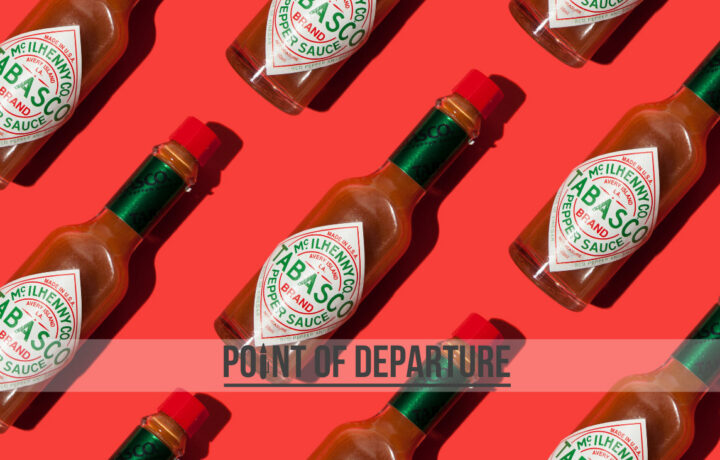
For decades to come, I carried those little bottles everywhere I went, but never once stopped to consider their history. The story behind that Tabasco sauce and how it made its way onto the military deployment menu is simply incredible. Edmund McIlhenny was born in 1815 in Hagerstown, MD. Around 1840, he made his way to New Orleans, where he built a career in banking that eventually made him an independent bank owner with a comfortable fortune. In 1859, he married Mary Eliza Avery, joining a family whose plantation sat on Avery Island, a salt-rich outcrop rising out of the Louisiana marsh southwest of New Orleans. It was, by most accounts, a good match for an ambitious business leader.
Until the Civil War arrived and undid nearly everything he had built.
When Union forces pressed into Louisiana, McIlhenny fled with the Avery family to Texas, where he served the Confederacy in a civilian capacity rather than as a soldier. When the Confederate economy collapsed, so did his banking career. By the time the war ended in 1865, the fortune he had spent two decades amassing was gone. The family returned to a wrecked Avery Island, its buildings and fields damaged by the fighting that had passed through the region.
McIlhenny, now in his fifties and dependent on his family’s land rather than his own bank, needed a new way to make a living. What he found, over the next several years, was not banking – it was a bottle of pepper sauce. He would spend the rest of his life – until his death in 1890 – running the operation that grew out of that postwar improvisation, though he did not live to see how far it would eventually travel beyond Avery Island.
Crafting the Recipe
How McIlhenny came by his peppers is genuinely contested. Company tradition credits him with growing them himself from seed around 1868; a rival account, resting on 1922 court testimony, holds that Louisiana planter Maunsel White – who had reportedly been making his own pepper sauce for years – gave McIlhenny pods and a recipe during a visit to White’s plantation.
Either way, McIlhenny mashed the ripened Capsicum frutescens peppers and mixed the pulp with rock salt drawn from the salt dome beneath Avery Island, a deposit substantial enough to have supplied the Confederacy during the war. He aged the mash in barrels, later blended it with distilled vinegar, and strained the result through cloth. To judge exactly when a pepper was ready for the mash, workers relied on le petit bâton rouge, a small red stick used to match the fruit’s color before picking — a practice still used at Avery Island today.
For bottling, McIlhenny relied on what was readily available in the postwar South, where specialty glass manufacturing had essentially stopped – small cologne-style bottles fitted with sprinkler tops, corked and sealed in green wax. The sprinkler was ideally suited for sauce meant to be dashed rather than poured. In 1869, he shipped 658 bottles to Gulf Coast grocers at a dollar apiece and demand outpaced supply almost immediately. He secured a patent in 1870, and the recipe — peppers, Avery Island salt, aged mash, distilled vinegar — has changed remarkably little in the past 150 years.
Into the Breach
Tabasco’s path into military kitchens proved equally serendipitous. Walter S. McIlhenny, Edmund’s great-grandson and a Marine Corps brigadier general who had fought in the Pacific during World War II, took over the family company in 1949. But like so many other Marines, he never really left the Corps behind.
By the mid-1960s, with American troops eating their way through the Vietnam War on C-rations, Walter had the company produce a two-ounce Tabasco bottle wrapped in waterproof, camouflage-printed packaging and bundled it with a slim pamphlet called The Charlie Ration Cookbook: “No Food Is Too Good For The Man Up Front.” It worked. Troops carried the little bottles into the field, and Tabasco’s reputation as the condiment that made bad food edible started to harden into military folklore well before Washington made it official.
In 1987, the Department of Defense introduced Tabasco sauce on an experimental basis, then the following year expanded its inclusion more broadly. In 1990, the 1/8-ounce glass bottle we all know and love was standardized. General Norman Schwarzkopf wrote in 1991 that the sauce “has always been in demand by troops in the field,” while officials from the DOD Combat Feeding Program put it more bluntly, warning planners that whatever else changed about the ration, they should never touch the Tabasco. In 1992, the Department of Defense formally added Tabasco to the Meal, Ready-to-Eat lineup alongside the crackers and freeze-dried entrées.
Tabasco sauce is, by a wide margin, the most successful product to emerge Avery Island. But no matter how wonderful it might be, it couldn’t save Chicken à la King. Some entrées just can’t be salvaged.


