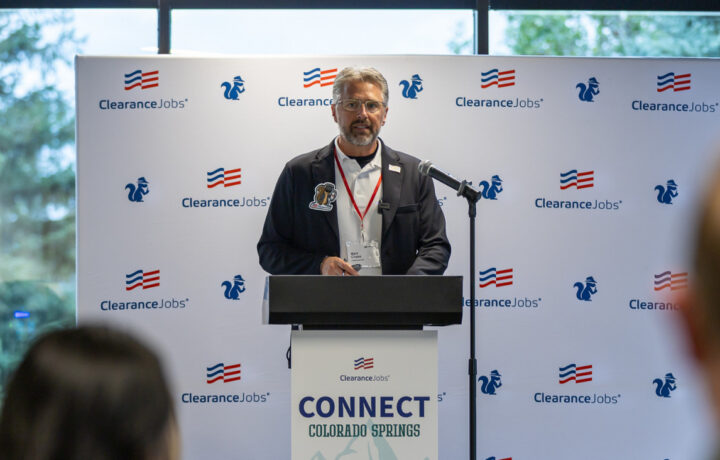
At Connect Colorado, Mark Chase, ClearanceJobs’ Head of Product and Engineering, delivered a stark message to recruiters working in the defense industrial base: a bad hire in this space isn’t just a bad hire, it’s a potential access vector into classified systems and programs.
Chase opened with the threats reshaping cleared recruiting. Deepfake and synthetic identities are increasingly hard to detect, with more than 300 companies having unknowingly hired people using stolen identities, and roughly one in four candidates on major platforms suspected to be fake. He pointed to the notorious $40 million gold bar case, where a fraudulent hire went undetected for years despite numerous warning signs, and to recent FBI action shutting down 13 fake company websites built specifically to target security-cleared professionals through phony consulting and speaking offers.
Yet Chase was careful not to frame AI as the enemy. Citing data showing 43% of HR teams now use AI in recruiting and 88% use it for screening, he argued the technology is essential for handling administrative “mechanics,” but must never replace human judgment. That distinction matters because of what he called the “trust paradox”: 70% of hiring managers trust AI-driven hiring decisions, while only 8% of job seekers do.
His solution was the Clear Recruiter Playbook: Clarify the mission, Locate with precision, Engage like a human, Accelerate the decision, and Review and improve — a practical, five-step framework recruiters can put to use immediately. He closed with concrete Monday-morning actions: know the red flags, automate one admin task, humanize one interaction, and remove a day of delay from the hiring process.
Chase’s core message resonated throughout the room: recruiters are the first human checkpoint candidates encounter, often long before any security team gets involved, which makes judgment and trust part of the employer brand itself.


