Ouster’s (OUST) recent technological breakthrough, along with its strong revenue growth and impressive customer list, indicates that the company, which specializes in developing and selling lidar sensors, will perform very well over the longer term. Also boding well for OUST stock are the Pentagon’s use of its products and the fact that multiple investment banks are upbeat about its outlook.
On the other side of the ledger, OUST stock has a very high valuation, the company is facing significant competition, and a number of its employees have sold a significant number of its shares in recent weeks.
Taken together, these points suggest that OUST stock could be worthwhile for patient, risk-tolerant growth investors.
An Important Technological Breakthrough and Powerful Revenue Growth
In the past, lidar sensors have been unable to perceive colors. Ouster recently developed lidar sensors, called Rev8, that can perceive colors, apparently eliminating the need for separate cameras. When cameras and lidar are used simultaneously, multiple problems arise, including “calibration errors, latency, and spatial mismatches.” These issues become critical when autonomous vehicles and robots are moving very quickly.
In addition to enabling robots and autonomous vehicles to move more safely at high speeds, Ouster’s product should make it easier for vehicles to obey traffic signs and for robots to follow instructions. Finally, Ouster’s innovation is likely to make autonomous robots and self-driving vehicles cheaper and less bulky. Given these positive attributes, demand for the product should be strong.
Turning to revenue growth, Ouster’s top line soared 56% in the second quarter versus the same period a year earlier to $55 million. Excluding the firm’s acquisition of Stereolabs, which it completed in February, sales still jumped 44% year over year.
Top-Notch Customers, Pentagon Utilization, and Bullish Investment Banks
Among the firms that intend to adopt Rev8 are Google (GOOG), Japanese mining giant Komatsu, Volvo Autonomous Solutions, and Lucid (LCID). Also noteworthy is that the latter EV maker is slated to provide 35,000 autonomous vehicles to Uber (UBER) over six years, so Ouster appears poised to benefit materially from Uber’s major foray into driverless vehicles.
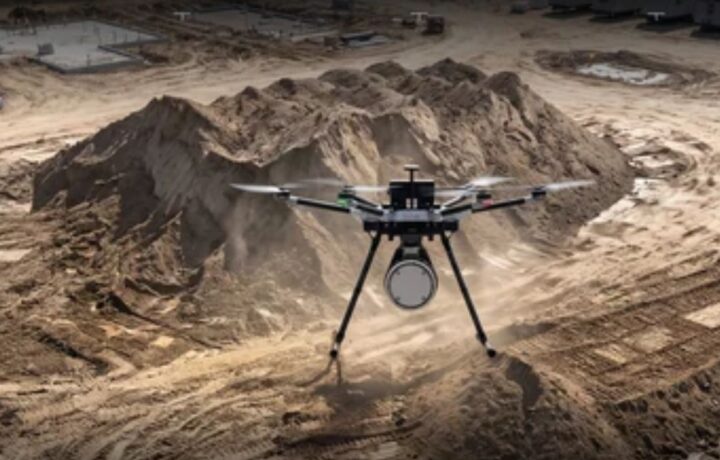
Meanwhile, Georgia, Utah, and Chattanooga, Tennessee have adopted the firm’s traffic-management offering, and the Pentagon has deployed its technology in drones, robotic combat vehicles, and other modes of transportation.
In May, investment bank Roth/MKM started coverage of Ouster with a Buy rating, citing the company’s ability to benefit from “increased physical AI autonomy adoption.” More recently, Oppenheimer raised its price target on the name to $57 from $42 in July while keeping an Outperform rating on the shares. In March, the investment bank contended that Ouster was improving its software capabilities, leading more customers to adopt it. Oppenheimer added that the company’s technology could support agentic AI.
Ouster’s Weaknesses
Ouster is trading at a high price-to-sales ratio of 11.8 times, and several other major players compete in the lidar space, including Microvision (MVIS), Aeva Technologies, and China’s Hesai Group.
Finally, in recent weeks, several company employees have sold sizable amounts of OUST stock. Most prominently, CEO Angus Pacala unloaded $1 million of the shares on September 16. And CFO Kenneth Gianella disposed of $532,000 worth of units on September 16, while CTO Mark Frichti parted with $637,000 worth of shares on September 17, and COO Darien Spencer sold $434,000 of OUST stock on September 16.
This article is intended to be informational only; it is not financial advice.


