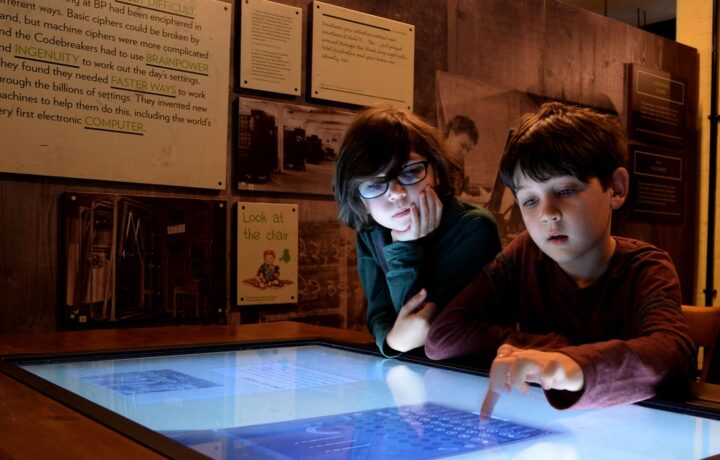
Alisha Jordan, education director at the National Cryptologic Foundation chats with ClearanceJobs about the role of the Foundation and their current efforts to help attract young people into cybersecurity and codebreaking careers. The National Cryptologic Foundation recently hosted a Cyber Saturday and will bring together young people, mentors, and cybersecurity pros to help inspire the next generation. Learn more about the foundation and the history of cryptology.
Lindy Kyzer:
Hi, this is Lindy Kyzer with ClearanceJobs.com and we love to talk about all of the niche arenas and areas where you can get involved as someone who works in and around national security. And that’s one of my favorite things about the industry is the big tents that we have around so many different issues. I’m always coming across interesting organizations doing work around the world’s secrecy apparatus, but it’s no secret that the Cryptologic Foundation is a really interesting organization in this arena. I’m really excited today to have their director of education, Alisha Jordan, on with us today to talk about some events that they have coming up in particular. And I also just want to have her talk a little bit more about the Cryptologic Foundation. If it’s an organization that you haven’t heard of before, welcome to your introduction to it today. You can learn everything you need to know.
So again, thank you so much, Alisha, for being on the show and taking the time to chat with me today. I really appreciate it.
Alisha Jordan:
Thank you for having me.
Lindy Kyzer:
I’m going to admit even myself. So I worked for the army. I didn’t have a strong IC connection until I really started working for ClearanceJobs. The Cryptologic Foundation is not an organization I was familiar with until a few years ago. Even coming to know them, I think about it as coding maybe, but I feel like you do a lot more than just coding. But what is the Cryptologic Foundation? And maybe talk about what your organization does.
Alisha Jordan:
Okay. So the National Cryptologic Foundation was established in 1996 as the National Cryptologic Museum Foundation. Originally it was founded to help support the National Cryptologic Museum. But over the last 20 years, our mission has evolved and a name change occurred. And so now we’ve dropped museum from the name and it’s now just the National Cryptologic Foundation. We are a nonprofit organization whose vision is really just to advance the nation’s interests in cyber and cryptology, through leadership, education, and partnerships. We have varied educational programs, and with those educational programs, we try to work with youth to engage them in the areas of cybersecurity and cryptology. And then we also have various partnerships because we want to convene to act on these new ideas of cyber and cybersecurity.
Lindy Kyzer:
I’m so glad that I have a director of education on the line here because I’m going to need some schooling in this podcast. So when I think cryptology, I definitely go back to World War II era, am I the only one that has that kind of misconception? Do you think as an organization, is that a common thing? Do you think folks realize the cryptologic, what it actually means?
Alisha Jordan:
You’re absolutely on target. Cryptology goes far beyond World War II. The idea of coding and secret passing of notes and things of that nature, that has evolved way before World War II, and we encourage all the people that we come in contact to visit the museum. The museum has a host of artifacts that you can actually open and touch, and actually engage with to really figure out how important cryptology was for our national security, how important it was for our Army, our Navy, our Air Force.
Without cryptology, a lot of things would not have happened. And so the evolution of it, you can find all this information at the museum. The evolution of cybersecurity has happened because of cryptology. If there wasn’t cryptology, we wouldn’t be talking about cybersecurity.
Lindy Kyzer:
I love that. ‘Eat that’ cyber. You have to go back to the cryptology to get some code breakers on there. Well, and that makes sense because we do talk a lot about code breaking. That’s a STEM skillset that we’re trying to develop. I think it’s interesting to look at the history of it.
So talk about the museum a little bit. I think a lot of folks would be surprised to know that the museum would actually be open to the public or that it’s so many entities within the IC space that are like the CIA museum if there’s a museum, but you have to have the access to get in. So talk about the museum that you guys have and access to that.
Alisha Jordan:
So the museum is owned and operated by the National Security Agency. So we do not own the museum, but the museum is open to the public and I believe it’s open five days a week. You can sign up, you can go for tours. Schools can sign up to bring their classes, and they have a lot of educational programs there. However, the National Cryptologic Foundation, we do support them in efforts of bringing people to the museum, but we are not directly connected to the museum.
Lindy Kyzer:
Well, that’s another one. It’s so useful. So I love that. I think it’s great to see organizations like the Cryptologic Foundation partnering with the NASA to get the word out about an entity, about a resource like that. I love any kind of times we can have collaboration that meets the private sector, the public sector, our national security, what our industry is doing. I think we need more people working in cyber careers, in cryptologic, I think career sets. So anything we can do to educate and like you mentioned, the resources for students, young people schools, I think that’s fantastic.
Alisha Jordan:
We definitely need more people looking at the workforce because currently there are over 700,000 jobs unfilled in the area of cybersecurity. And so it is a big need and it needs to be a big push so that we can ensure that the workforce is being met with the demands.
Lindy Kyzer:
I love that. And so talk about Cyber Saturday.
Alisha Jordan:
Yes, Cyber Saturday. So we are partnering with the Maryland Innovation and Security Institute for Cyber Saturday. It is going to be a fun. I’ll repeat, fun-filled day for current and rising fifth through ninth graders who are interested and want to learn more about cyber, data care, and how to really stay safe online. So many of our youth are online, whether it’s social media, shopping, and so we want to prepare them and educate them on how to remain safe. During Cyber Saturday, it’s going to be fun, interactive games and activities to challenge, teach and stimulate their minds. We have activities such as finding the imposter, a part of Among Us, as well as solving clues to escape the cyber challenge. We have an escape room on site. We are so excited about this inaugural Cyber Saturday that we’re going to be hosting on June the 10th from 10:00 to 2:00.
Lindy Kyzer:
Okay. I love it. And you talk about this as a inaugural event. I know that there are a ton of different cyber events, resources, content, which I always love. So how does Cyber Saturday fit into the bigger picture, what the Cryptologic Foundation is really doing to advance that education piece on cyber careers and cyber?
Alisha Jordan:
Under our mission, our goal is to educate and engage our citizens to be cyber smart individuals, and also develop pathways for future cyber and cryptologic workforce. So through Cyber Saturday, the engagement piece is huge. We want the youth to come out to really understand what cyber is in data care. Through the engagement we are also going to be educating, we have engineers that are going to be on site talking about their career paths and how they’ve gone on to careers in either cyber or technology. The students or the youth will be able to actually engage with activities so that they can see how, if they are solving puzzles, the analytical part of that, how that leads to maybe a career in cybersecurity.
Lindy Kyzer:
I love it. And so it’s for the Cyber Saturday event, I know that’s geared towards students, but parents can come along as well. Is there a certain age that’s really targeted by that event?
Alisha Jordan:
We’re geared towards rising fifth through ninth graders, but parents are welcome and we are highly encouraging that they attend. They too will be able to take part in some of the activities and we have an escape room that we hope that the parents will take part in. They may get trapped in the escape room, they may need their student to help them after the student has learned all of these skills throughout the day. So yes, parents are welcome. We have things set up for parents as well as the youth.
Lindy Kyzer:
I love that. I know as a parent, I definitely learn a ton from my kids. Don’t be fooled parents. There’s definitely something that you can learn from that as well. I imagine even parents that are in the cyber career field themselves, I think it’s a great way for them to get involved, for adults to get involved. And seeing adults that are in this industry, I think is one of the great ways to help get the next generation of young people involved.
But I also appreciate events like this because they can take folks that if you have no idea what a cyber career might look like, or you don’t even know what cyber is, I think reaching out to folks who haven’t considered it before is a great thing. So that’s why we’re excited here at ClearanceJobs and on this show to help get the word out about it. Because again, I think the more seeds we can plant for folks to just consider the different pathways to a career. And again, I love the code breaking and cryptologic aspect of it too, because a lot of us look at cyber as a really intimidating career field, but when you break it down to the building blocks, I think you can see how there are a lot of entryways for a lot of different types of thinkers, a lot of different types of brains to come around these issues. There’s not just a one brain approach, if that makes sense.
Alisha Jordan:
No, no, you’re absolutely right. I can just give a sneak peek. One of the activities is using Outsmart Cyberthreats booklet, which talks about a day in the life of cyber. From the time you wake up in the morning, you may hit your cell phone, the components and the gadgets within your cell phone that’s cyber related. And so there’s a kit that the students are going to be working on that looks like a house, and it imparts on all the parts of cyber that they touch that they don’t even realize.
Lindy Kyzer:
I love that.
Alisha Jordan:
I am so, so excited about this event.
Lindy Kyzer:
Okay, so Cyber Saturday is definitely coming up, June 10th. Be sure to sign up, to check it out, to get involved. But beyond that, if folks are listening to this and are like, “Man, I missed Cyber Saturday.” What are other kind of events that the Cryptologic Foundation was working with? You’ve already mentioned the museum. I think that’s definitely a resource to check out year round and to be connected with. But are there other events, partnerships?
Alisha Jordan:
We also have a podcast. We have a live podcast that they can listen to. It’s called CyberChats and it’s available on all streaming platforms as well as YouTube. And they can go back and listen to the CyberChats. It has a youth professional and as well as an adult professional. At the end of each podcast episode, there’s a challenge that they can try to solve and if they get the correct answers, we send out prizes and all of that. So please log in and check out our CyberChats. That is one sure way that they can get involved with the National Cryptologic Foundation.
Lindy Kyzer:
I love that. I love the focus on information and resources as a pathway to learn about these things. Again, I think the pathway to a career is not generally applying to a job description these days. I think the more we can educate and inform is really key. We know that there’s a huge hiring push across the NASA and I think organizations like the Cryptologic Foundation are really helping to lay the talent pipeline again as early as fifth through eighth grade for folks to consider what these careers look like.
So talk to me again just a little bit more about the foundation. Beyond events, you exist to just provide information, resources. I’m sure you’re a donor based organization, you rely a lot on probably other partnerships. Can you talk about that realm or world within the Cryptologic Foundation?
Alisha Jordan:
Yes, we do have a host of donors as well as partners. We partner with Start Engineering. We partner with Teach Cyber. All of these partnerships are to really get the word out about cyber and cybersecurity, and also cyber education. We want to bring an awareness about just data care and data safety. We also want to make people aware that it’s not just your day-to-day responsibility to worry about yourself, but also worrying about the nation. Our focus is really to advance the nation and to make sure that they’re safe in our digital ecosystem.
We want to make sure that we are providing resources and we want to be the go-to people, the people that we convene to talk about these topics in cybersecurity. We bring people together to figure out how can we combat some of the issues that we’re currently facing. I mean, the pandemic has shown us, especially being in a schoolhouse at the time I was a principal, the Zoom bombings, all the things that were happening to our young people while they were on the internet and trying to be more proactive versus reactive to some of these things.
So the foundation has decided to take on that leap and work with others through partnerships. We have partnerships with big corporations such as Booz Allen, as well as Lockheed Martin because we all want to ensure the safety of our citizens.
Lindy Kyzer:
Again, you’re talking my love language with partnerships. Again, I love to see this. I think it’s so important. And if you go to the cryptologicfoundation.org website, you break it down there in a really important way, you can learn about the organization. There’s pathways for educators, students, or the broader community as well as information on how to support the Cryptologic Foundation in the work that they do. And again, it’s just one of those organizations. I think in the IC, there’s so many great resources that are under the radar. So the more that we can spotlight them, because again, from your CyberChats to Cyber Saturday, it is just a really great resource for educators, for students, for parents, for just people coming alongside, maybe the next generation considering these careers to be able to know what’s out there.
And again, you’re talking my love language with content education and partnerships because I really think that’s the secret sauce to getting excitement and enthusiasm around this topic.
Alisha Jordan:
Thank you so much for having the opportunity to speak about some of the things and resources that we offer at the National Cryptologic Foundation. If you haven’t had the chance, please register. You can register on our website for Cyber Saturday.
Lindy Kyzer:
Thank you again so much, Alisha. I’m so appreciate your being a part of the show, a part of the program, and for the amazing work that the Cryptologic Foundation does. I also appreciate your giving us a little bit more insight into your background. I love to find out folks who have, again, different pathways into supporting the national security space. So going from being a principal and working in education there, it’s really helping this important education mission.

