Aurora Innovation (AUR) is continuing to progress towards becoming one of the world’s top self-driving companies, information recently shared by the firm strongly indicates.
More specifically, the company’s technology and overall business are advancing quickly, while its partners appear to be very pleased with its performance. Moreover, AUR ‘s journey to profitability may very well be relatively rapid.
Given these points, along with the firm’s low market capitalization compared to its opportunity, I continue to believe that growth investors should consider buying AUR stock.
Aurora’s Continued Technological Upgrades
On the technological front, the company was able to program its self-driving system, Aurora Driver, to slow down and, if necessary, pull over during dust storms, CEO Chris Urmson stated on the company’s third-quarter earnings call, held on October 30. In my view, this achievement bodes well for Driver’s ability to cope effectively with rain and snow in the future, since the trucks will likely also be able to respond to those adverse weather conditions by either slowing or pulling over, depending on the severity of the conditions.
Speaking of rain, the CEO suggested that its upcoming January 2026 software update would allow Driver to function effectively in the rain and “heavy winds.” Urmson reported on the earnings call that, “We also continue to make progress validating driverless operations in rain and heavy wind conditions, which will also be part of our January 2026 software release.” Since CFO David Madlay in September had said “Timelines for rain…still is by the end of the year.” I believe that AUR likely plans to enable its trucks to navigate on their own in rain in January.
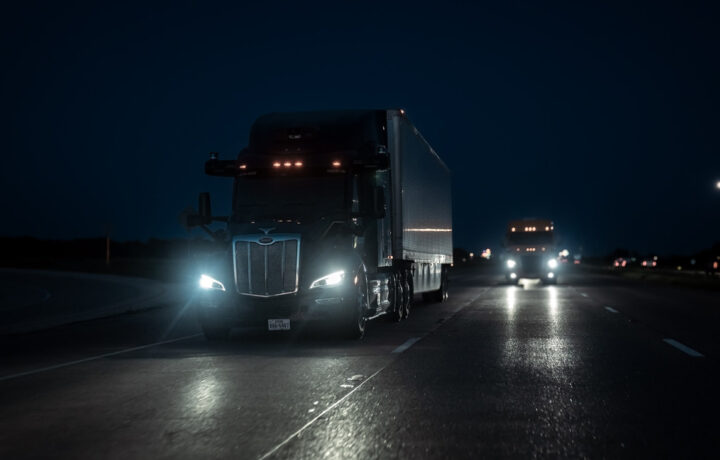
Also importantly, Urmson reported that trucks equipped with Driver will be able to operate without anyone in the vehicles in the second quarter of 2026. Currently, at the request of Paccar, the maker of the trucks that Aurora is using, human “observers” ride in the drivers’ seats of the vehicles without doing any driving. The launch of vehicles that will operate without human observers will likely significantly increase confidence in Driver, Aurora, and AUR stock.
Finally, the CEO noted that the next generation of Driver will enable the system to detect objects that are 1 kilometer away,, “double the distance of (Driver’s) current generation .” According to Urmson, “This will further enhance the Aurora Driver’s performance and set a new standard for safety in the industry.”
Aurora’s Business Advancements and Encouraging Praise From Its Partners
The company launched a new route from Fort Worth to El Paso and will “soon” kick off an El Paso to Phoenix route, the CEO stated. He noted that the Fort Worth to El Paso journey “is notoriously hard to staff and challenging for traditional drivers to complete within a single day.” Driver’s ability to easily complete this route without stopping “demonstrates (its) significant efficiency and value potential,” Urmson noted. What’s more, he suggested that, on the Fort Worth to Phoenix route, “Driver has the potential to more than double revenue and deliver several-fold higher profit per truck for (Aurora’s) customers.”
In 2026, the company is aiming to have its trucks travel from Dallas to Atlanta and from Dallas to Laredo, TX.
Further, AUR now has five trucks regularly operating on its Dallas-Houston and Fort Worth-El Paso routes, and it intends to expand to “hundreds” of trucks at the end of 2026.
Meanwhile, Jim Stewart, the safety manager of trucking company Werner Enterprises, praised Driver for identifying a merging vehicle that he himself did not see while he was riding in the Driver-powered vehicle.
And, after agreeing to market Aurora Driver, Tom McLeod, the CEO of McLeod Software, which specializes in selling software used in transportation, said the partnership “underscores our dedication to providing cutting-edge technology for our customers, empowering them to optimize their operations and embrace innovation with confidence.”
Also importantly, Hirschbach, another trucking firm, agreed to expand its use of Driver by utilizing the new Fort Worth to El Paso route, while two new carriers began using Driver.
Moving Relatively Quickly Towards Profitability
Aurora plans to generate positive gross profit by the beginning of 2027. In other words, the revenue on each Driver sold will surpass the “direct costs” of producing it. But the company overall will still lose money due to indirect costs, such as sales and administrative costs and R&D.
The firm is taking a number of steps in an effort to reach the gross profit milestone. For example, the next generation of its hardware will cost only about 50% of the current product. Additionally, Aurora says that it is “well on its way” to having a single employee “operating and supporting multiple vehicles.”
Once the company reaches the gross profit milestone, it will simply have to expand the number of trucks on which Driver is used to become profitable overall. And, given Driver’s ability to save trucking firms large amounts on labor and insurance costs, along with the fact that the system tremendously increases the amount of time that each truck can utilized, it should not be too difficult for Aurora to rapidly expand Driver’s utilization.
Valuation and the Bottom Line on AUR Stock
As I noted in September, “Aurora appears to be one of the most advanced companies in the U.S. when it comes to autonomous driving, and many trucking companies are likely to be eager to utilize its system within the next few years. Consequently, the…market capitalization of the shares meaningfully undervalues the firm’s medium-to-long term outlook.”
AUR’s market capitalization is now $8.36 billion, down from $11 .3 billion when I wrote the previous article. As a result, I’m even more convinced of the stock’s strong value at this point.
*This article is intended to be informational only; it is not financial advice.


