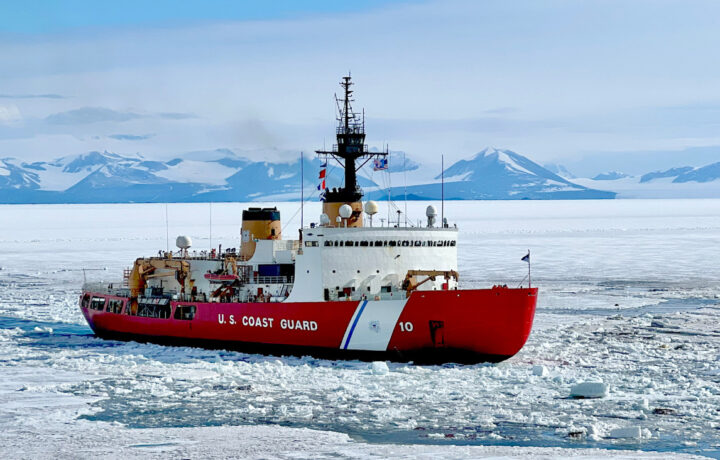
The United States Coast Guard (USCG) currently operates just three polar icebreakers, and one of the ships is heading south for the winter months. That might seem like a strange decision, but the USCGC Polar Star (WAGB 10) departed Seattle on Thanksgiving Day, commencing its 29th deployment to Antarctica in support of Operation Deep Freeze.
In other words, it is actually going so far south that it will carry out icebreaking duties. Although it is technically late spring and will be summer in just a matter of weeks in the southern hemisphere, operations at the various Antarctic bases take place then. The icebreaker clears a channel in the sea to escort supply ships to the McMurdo Station, the largest Antarctic station and the logistics hub of the U.S. Antarctic Program.
Since 2010, when the USCGC Polar Sea (WAGB-11) was retired, USCGC Polar Star (WAGB-10) has remained the service’s only heavy icebreaker.
With each Operation Deep Freeze, WAGB-10 serves a vital role in ensuring surface access for fuel and supply ships through the Ross Sea to resupply the U.S. Antarctic bases. The mission of Seattle, Washington-based USCGC Polar Star directly protects the security, freedom, and prosperity of the U.S., our allies and partners, the Coast Guard explained.
“Polar Star‘s crew does remarkable work maintaining and operating this ship,” said Capt. Jeff Rasnake, commanding officer of USCGC Polar Star. “Each year brings unique challenges, and I’m proud to say this crew has risen to meet them all. The way we’ve come together over the course of maintenance and our logistical preparations is exciting as we enter the operational phase of our annual deployment cycle.”
The USCGC Polar Star was commissioned in 1976. The icebreaker displays 13,500 tons and is 399 feet in length with a 34-foot draft. Despite reaching nearly 50 years of age, USCGC Polar Star is reported to be the world’s most powerful non-nuclear icebreaker, capable of producing up to 75,000 shaft horsepower.
The icebreaker will continue to support Operation Deep Freeze until new Polar and Arctic Security Cutters enter service in the coming decade.
Operation Deep Freeze
The United States Coast Guard plays a key role in Operation Deep Freeze, the annual joint military mission to resupply the United States Antarctic stations in support of the National Science Foundation (NSF), the lead agency for the United States Antarctic Program (USAP).
“Historic investment in the Big Beautiful Bill of nearly 25 billion, $9 billion of which is specifically for icebreakers and infrastructure in the high latitudes,” the Coast Guard announced last month, noting that the massive investment in icebreakers will further secure U.S. access, security, and leadership in the polar regions.
The first Operation Deep Freeze mission began in 1955-56. Since then, it has come to be used as the general term for U.S. operations on the continent, notably the regularly scheduled resupply missions. Active, Reserve, and Guard members of the U.S. Coast Guard, Air Force, Navy, and Army continue to support the USAP by air and sea lift of supplies to McMurdo Station.
More Icebreakers Needed
Icebreakers aren’t just needed for Operation Deep Freeze; they’re also increasing in the Arctic region. Even as the ice has been melting in the Great White North, icebreakers are still required for America to maintain year-round access to what is likely to be an increasingly contested region.
At the end of October, the medium icebreaker USCGC Healy (WAGB-20) completed her annual missions to the Arctic. The vessel returned to Seattle, Washington, on October 26, following a 129-day patrol.
The Pentagon has been warning since 2022 that the United States desperately needed more icebreaker ships. As a stopgap, this summer, the former oilfield supply ship and icebreaking offshore tug Aiviq was re-commissioned in a ceremony in Juneau, Alaska, as the USCGC Storis (WAGB-21).
It is the first polar icebreaker added to the fleet in 25 years. It will serve as a stopgap to support Coast Guard operations until the service receives the three still-in-development Polar Security Cutters, which are currently on track to enter service later this decade. The first Polar Security Cutter, USCGC Polar Sentinel (PSC-1), is now under construction at Bollinger in Louisiana and is scheduled for delivery in 2028. In addition, the Trump administration approved a budget measure that will allocate $300 million towards improving Coast Guard facilities in Juneau, Alaska. Construction has yet to begin.


