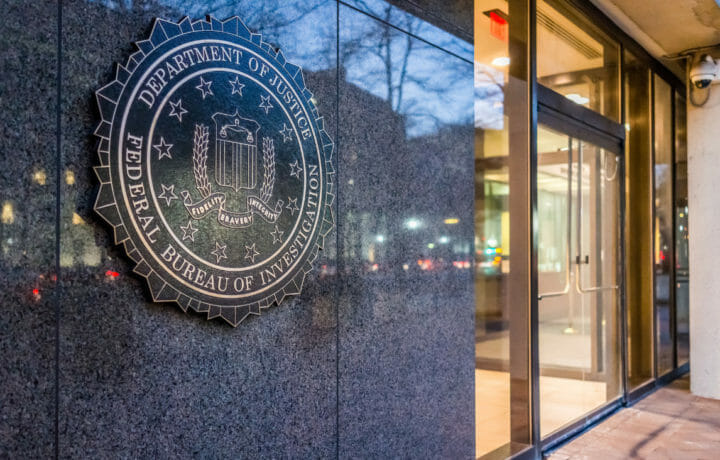
The Federal Bureau of Investigation (FBI) will be moving out of the famed J. Edgar Hoover Building in Washington, D.C., Director Kash Patel confirmed in a post on X on Friday.
“After more than 20 years of failed attempts, we finalized a plan to permanently close the FBI’s Hoover headquarters and move the workforce into a safe, modern facility. Working directly with President Trump and Congress, we accomplished what no one else could,” Patel wrote on the social media platform.
Patel, who had previously suggested the building, known for its “brutalist” style architecture, would be turned into a museum of “deep-state,” but he made no mention of such plans. It is unclear what will happen to the building named for the original director of the national security organization.
Relocating to a Vacant Workspace
Some of the FBI’s workforce will be relocated to the Ronald Reagan Building and International Trade Center in Washington, D.C., notably the former offices of the U.S. Agency for International Development. It was dismantled as part of the Trump administration’s downsizing efforts this year.
Patel had also been critical of plans to relocate the FBI’s HQ to Maryland, stating that the move would have cost taxpayers around $5 billion and wouldn’t have been completed until 2023.
“We scrapped that plan,” Patel explained in his post. “Instead, we selected the already-existing Reagan Building, saving billions and allowing the transition to begin immediately with required safety and infrastructure upgrades already underway. Once complete, most of the HQ FBI workforce will move in, and the rest are continuing in our ongoing push to put more manpower in the field, where they will remain.”
Prior to being named to head the FBI, Patel had claimed the bureau’s “footprint” was too large and that its workforce was overly concentrated in the nation’s capital.
In 2023, the now-head of the FBI told podcaster Shawn Ryan that he would relocate much of the workforce of around 7,000 employees and “send them across America to go and chase criminals.”
It is unclear how many of those employees will relocate to the Ronald Reagan building, and how many others could be sent to various field offices.
“This decision puts resources where they belong: defending the homeland, crushing violent crime, and protecting national security. It delivers better tools for today’s FBI workforce at a fraction of the cost,” Patel continued.
History of the J. Edgar Hoover Building
Designed in the 1960s, the building’s brutalist architecture has been criticized since its 1975 opening for departing from the style of other federal buildings. FBI Director Hoover was not a fan, calling it “the greatest monstrosity ever constructed in the history of Washington.”
The low-rise office complex’s “raw concrete” exterior has also been described as “Orwellian” by some critics, while its interiors have been likened to a “drab factory” with harsh lighting and endless corridors.
The site was selected in 1963, and design work began the same year.
Construction began in March 1965, but delays in Congressional funding meant that only the building’s three-story substructure was complete by 1970, and work on the superstructure did not begin until 1971. As a result, the cost of the project grew from $60 million to $126.1 million – or more than $1.05 billion in 2025 dollars.
The building was officially named for Hoover, following the director’s death in 1972.
Construction was completed in 1975, and then-President Gerald Ford dedicated the facility on September 30 of that year.
Although the building has approximately 2.8 million square feet of internal space, including three floors below ground and a secure underground parking garage, the FBI had outgrown the concrete structure.
Many of the Bureau’s employees rarely set foot in the building.
The process of relocating thousands of FBI agents and other officials began in 2005, following the Asset Management Plan’s recommendation for a new headquarters. It found that deteriorating conditions, cramped workspaces, and security concerns in the post-9/11 world necessitated an upgrade.
Some headquarters functions have already relocated.
The Criminal Justice Information Services Division is located in Clarksburg, WV, while the Laboratory Division, Operational Technology Division, and FBI Academy are located in Quantico, VA. In addition, other specialized facilities, such as high-tech computer forensics centers, are now located across the country.
Discussions for a new headquarters gained momentum in 2011, following the release of a Government Accountability Office (GAO) report concluding, “The FBI has outgrown its main headquarters facility, the J. Edgar Hoover Building.”
The report added, “Headquarters staff who cannot be accommodated in the Hoover Building are dispersed in over 40 leased annexes, the majority of which are located in the National Capital Region. FBI officials report that the dispersion of staff, combined with condition deficiencies at the Hoover Building and site, affects security and creates operational inefficiencies.”
Money Saved, Or Not?
In November, Maryland lawmakers sued the Trump administration after it cancelled plans to relocate the FBI HQ to the state. The lawsuit noted that Congress had already appropriated $555 million for relocation.
“These actions flouted Congress’s explicit direction to choose a site from the three specified sites, as well as other specific statutory directives concerning the selection of the site and the use of the funds,” state attorneys wrote in the federal lawsuit.
Even as Patel suggested the decision to keep the FBI in D.C. would save taxpayers money, he came under fire for his use of the FBI airplane, including for personal travel with his girlfriend. Last week, it was also reported that Patel ordered the bureau to purchase four BMW X5s for departmental use, replacing the Chevrolet Suburbans that the FBI previously used. Patel argued that the foreign-made BMWs would be “less conspicuous.”


