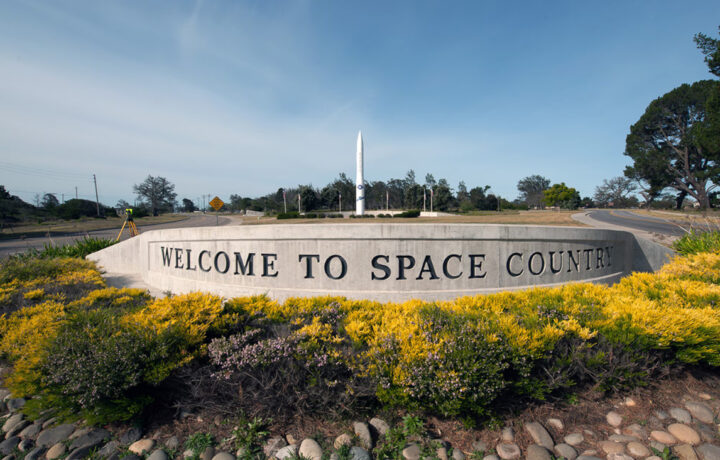
Just before the New Year, the United States Space Force’s Space Launch Delta 30 (SLD-30) at Vandenberg Space Force Base (VSFB), CA, issued a Request for Information (RFI) to solicit industry interest in increasing the facility’s capabilities. SLD-30 is calling upon the American “launch service providers” currently engaged in transportation services to determine how to develop “heavy or super-heavy vertical space launch vehicle” capabilities at Space Launch Complex-14 (SLC-14), located at the southernmost point of VSFB.
“Launch Service Providers (LSPs) are invited to respond if they are interested in obtaining a real property use agreement (lease) at SLC-14 to finance, design, construct, operate, and maintain space launch infrastructure,” SLD-30 explained.
The goal is to maximize assured access to space in support of national security objectives, the RFI explained. It will provide space launch services to the Department of Defense (DoD), non-DoD federal, and other commercial entities.
“The Department of the Air Force (DAF), USSF, and SLD 30 are committed to ensuring the best use of this property,” the RFI noted.
SLD-30 also stated that selected respondent(s) would be responsible for developing the infrastructure required to support the launch capabilities.
Heavy and Super-Heavy Launch Vehicles
The RFI calls for the development of a new site that does not currently have launch infrastructure in place. It is several kilometers from established utilities and other infrastructure.
Once developed, the new SLC-14 will be used to launch heavy and super-heavy-class vehicles. Those are defined as launch vehicles with payload capacities of 20,000 to 50,000 kilograms and greater than 50,000 kilograms, respectively, for low Earth orbit.
“A heavy/super-heavy launch capability at VSFB offers a strategic advantage to the USSF, enabling the deployment of larger, more capable military satellites and facilitating rapid response missions during national security emergencies,” the RFI stated. “Adding heavy/super-heavy launch capabilities at VSFB enhances resilience, diversifies the government’s portfolio, and accelerates satellite constellation reconstitution due to increased lift capacity.”
The RFI required launch service providers to demonstrate “sufficient financial maturity” to complete development and operate the launch site.
“It is imperative that SLC-14 be actively developed; a well-funded LSP offers the greatest assurance of successful vehicle and site operations, safeguarding against potential setbacks due to financial constraints. To demonstrate the ability to meet this criterion, respondents should provide documentation of current financial resources and funding status and provide inputs on developing SLC-14 infrastructure to support heavy/super-heavy launch and/or recovery operations at SLC-14,” the RFI stated.
Launch Diversity From VSFB
The USSF has called for greater “launch diversity” from VSFB, and the RFI states that the “nation benefits from diverse launch systems at VSFB to mitigate the impact of vehicle/infrastructure anomalies, work stoppages, and supply chain disruptions.”
It is unclear what companies would meet the criteria, but only a few companies could make the shortlist. SpaceNews.com suggested, “[The] factors would appear to favor SpaceX’s Starship. The vehicle falls into the super-heavy class as defined in the RFI.” The company, owned by tech billionaire Elon Musk, certainly would meet the financial maturity requirements.
SpaceX’s Falcon 9 rockets currently launch from SLC-4, while efforts are now underway to redevelop SLC-6 for the Falcon 9 and Falcon Heavy missions.
According to SpaceNews.com, “United Launch Alliance is finishing work to convert SLC-3, formerly used by the Atlas 5, for Vulcan Centaur.”
Launch safety analysis and compliance with the National Environmental Policy Act (NEPA) regulations must also be satisfied before the DAF issues a lease for SLC-14.
About VSFB and SLD-30
Established as Camp Cooke, a U.S. Army garrison in August 1941, the installation was used for tank, infantry, and artillery training during World War II and again during the Korean War in the early 1950s. In 1957, the installation property was transferred to the recently established U.S. Air Force.
It covers approximately 99,604 acres and operates approximately 16 launch facilities and complexes. In addition, VSFB maintains the DoD’s second-largest airfield runway, nearly 15,000 feet long.
VSFB has served as the largest launch facility on the West Coast since the “Space Race” with the Soviet Union began with the launch of Sputnik in October 1957.
SLD-30 is one of the two space launch wings for the U.S. Space Force and is responsible for executing military, intelligence, civil, and commercial space launches. It serves as the host wing for VSFB. It also provides support to non-Space Force units, including the United States Air Force’s 532d Training Squadron and 576th Flight Test Squadron; Space Command’s Combined Force Space Component Command and Combined Space Operations Center; and elements of the Missile Defense Agency, the National Reconnaissance Office, and NASA.


