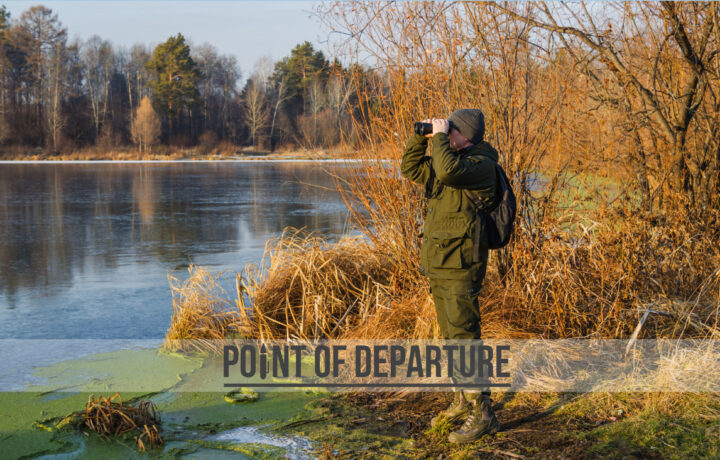
“Go afield with a good attitude, with respect for the wildlife you hunt and for the forest and fields in which you walk.” – Fred Bear
Growing up in northern Idaho, hunting and fishing were as routine as taking out the trash – just normal parts of life. The skills you learn along the way stick with you. They’re life skills in the truest sense of the term. How to move through the woods. How to read the terrain. How to communicate with simple hand and arm signals.
By the time college rolled around and I was spending weekends training with my fellow cadets in the wilderness, it was impossible not to see the parallels between the tactics we were learning and the hunting skills I’d developed as a boy. It wasn’t just knowing how to move stealthily through the brush, it was understanding that you needed all of your senses alert and active to be successful.
When I arrived at my first duty station, I was like every other lost second lieutenant – drinking from the firehose as I tried to learn as much as I could as fast as I could. But when we went into the field for training or onto the range for weapons qualification, all of that changed. I was back home.
As I told my platoon sergeant – tongue in cheek – one cold November morning as our troops were digging in, “Everything I know about warfare, I learned from hunting.”
The Bear
In my own way, I was serious. I’d long since drawn those parallels between hunting and maneuvering – the fundamentals of fieldcraft apply universally. And although I haven’t hunted in close to 30 years, those fundamentals stick with you.
Sometime between elementary school and junior high, I learned about Fred Bear. In the hunting community, he was a legend, a man who defined what it meant to pursue game. His hunting days were largely over by the time I was learning the sport, but his reputation was still unmatched.
Fred Bear didn’t just elevate the sport of hunting, he transcended it. Like most hunters, he started out with a rifle as a young man. But that wasn’t enough of a challenge. As he said in a later interview, “You can learn more about hunting deer with a bow and arrow in a week than a gun hunter might learn all of his life.”
When he passed away in 1988, Fred Bear owned six bowhunting world records and had redefined an entire branch of the sport of hunting. He designed and patented the composite bow. And the odds are good you can’t visit the Bass Pro Shop in Springfield, MO, and not take note of his influence on the Archery Hall of Fame.
The Commandments
But Papa Bear’s influence on me had less to do with archery – a skill I’ve never mastered – than his Ten Commandments of Hunting. Like Bear’s own career as a hunter, his commandments transcended the sport. Today, you can find his commandments on garage walls and in hunting lodges, in tree stands and rifle bags. They’re fundamental to hunters everywhere, a reminder of the tenets of an activity as old as mankind itself.
The influence of his wisdom shaped not just my approach to hunting, but my thinking as a military leader as well. They served as metaphors for a different kind of hunting, one where the stakes were a lot higher and the risks ever greater.
1. Don’t step on anything you can step over.
Keep your feet on the ground and your head on a swivel. This is as much about stealth as it is about ensuring that you maintain a firm and steady platform – your feet – for movement.
2. Don’t look for deer, look for movement and remember that it’s what they’re looking for, too.
Wisdom that any good scout will share. As a hunter, you learn to let your peripheral vision work for you. Don’t focus on any one thing – relax your eyes and allow movement to reveal itself.
3. Always approach from downwind.
In the cool of the day, move uphill; in the heat of the day, move downhill. Everything travels upwind – sights, sounds, smells. Hunt (and work) smarter, not harder.
4. The best camouflage pattern is called, “Sit down and be quiet!”
Your grandpa hunted deer in a red plaid coat. Think about that for a second. Camouflage is only as good as your sound and movement discipline. The best camouflage pattern won’t do you much good if you can’t hold still.
5. Take only the gear to the field that allows you to hunt longer, harder, smarter.
As someone who spent a few tours with light infantry units, this is sacrosanct. “We Fight Tonight” sounds cool, but “We Fight Light” has a lot more operational reach.
6. A rainstorm isn’t a reason to quit the hunt, it’s the reason to stay.
This was Papa Bear channeling his inner Sun Tzu. People hunker down when the weather gets cold and wet. That’s the best time to attack.
7. Camouflage your appearance, your sound and your scent.
You’re quiet as a church mouse and almost invisible to the eye, but animals – and people – can smell your Axe body spray a mile away. Camouflage is a full body experience.
8. Be sure of your shot.
Nothing is more expensive than regret. Bad habits are a plague on trigger pullers. Shooting at the range is not the same as shooting on the move, in the bush, when you’re tired, hungry, and cold. Train as you fight. Train the fundamentals.
9. Hunt where the deer actually are, not where you’d imagine them to be.
Or want them to be. Your prey – human or otherwise – gets a vote. Learn to think like them.
10. Next year’s hunt begins the minute this season’s hunt ends.
The ride back after a hunt always turned into an after-action review. What went right, what went wrong, what are we doing next? You consolidate on the objective and begin preparing for the next mission. You don’t wait for that mission to show up on your doorstep.


