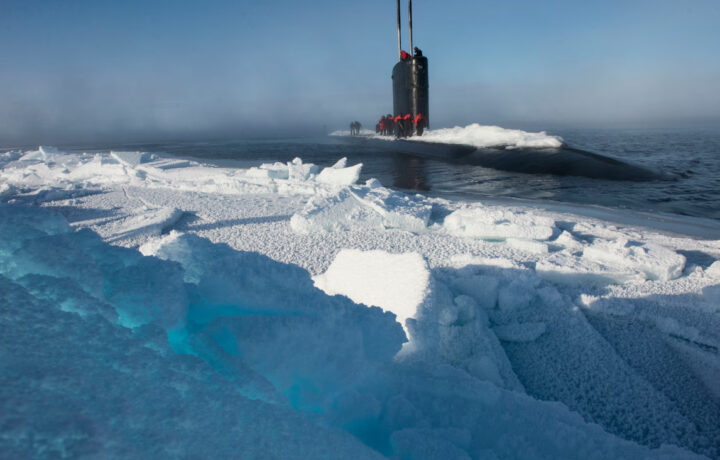
President Donald Trump has repeatedly said that Greenland is vital to the United States security. However, he has since stated a deal is being worked out with Denmark that will allow Washington to expand its military footprint on the semi-autonomous territory. The U.S. will enhance its presence on Greenland, which could include the construction of facilities tied to the highly touted Golden Dome for America.
However, there are several other factors at play, and it isn’t just Greenland that is critical to the USA’s security, but also to the greater Arctic region.
The Geostrategic Location: The GIUK Gap
As President Trump argued that Denmark couldn’t adequately protect Greenland, he claimed that Russian and Chinese warships regularly operated off the island’s coast. Geopolitical analysts have disputed the claim, yet Greenland lies within the “GIUK Gap,” the area in the northern Atlantic Ocean that serves as a naval choke point. It consists of the waterways between Greenland, Iceland, and the UK (GIUK), which separates the Norwegian Sea and the North Sea from the open Atlantic Ocean.
The significance of these choke points was noted during World War II, when German warships operating from occupied Norway were often unable to carry out raids on Allied shipping convoys.
During the Cold War, the GUIK Gap also provided the only route for the Soviet Navy to reach the Atlantic Ocean from bases on the Kola Peninsula.
The United States and the UK recognized the threat posed by Soviet submarines and installed a chain of underwater listening posts across the gap in the 1950s.
As tensions between Russia and the West continue to rise, the GUIK Gap has once again become a potential flashpoint. The Russian Navy’s Northern Fleet can only access the open sea during the winter months via the gap.
New Shipping Routes, With Greater Competition
Due to climate change, the Arctic has seen a significant decline in sea ice, which is opening new shipping routes. During the summer months, the Northeast Passage (NEP) now provides a shorter shipping route between the Atlantic and Pacific Oceans for Russia and Europe.
To ensure the route remains open longer each year, Russia has built a fleet of nuclear-powered icebreakers. The Kremlin has increasingly viewed these routes as its own, especially as they require transiting close to Russian territory.
Protecting U.S. interests may require deploying warships to the Arctic – and while the ice is melting, it returns in the winter, necessitating more icebreakers, which the United States doesn’t have enough of at present.
Another concern is that Russia is partnering with China, including in the Arctic, where Beijing has sought to extend its influence.
“We are seeing more and more activity where Russia and [the] PRC are working together, and the Arctic is the most recent area that we’re seeing that,” explained Chairman of the Joint Chiefs of Staff Gen. CQ Brown ahead of a trip to Iceland in October 2024 to attend the Arctic Chiefs of Defence Conference, USNI News reported. “It’s something we all need to be paying attention to and to understand what they’re doing together, and is it for some type of positive benefit to the collective whole, or is that something they’re doing to challenge other nations and other interests?”
Access to Untapped Resources – And Cold War 2.0
The melting ice has also made access to the region’s vast oil, natural gas, and mineral resources easier. That has prompted a race among the world’s “Arctic nations” to gain economic advantage.
In 2009, the U.S. Geological Survey estimated that the Arctic held 13% of the world’s undiscovered oil and 30% of the world’s undiscovered natural gas. This wasn’t surprising; until recently, it was too complicated and expensive to extract fossil fuels.
Thanks to climate change, that is no longer the case.
Eight nations have a presence in the Arctic, including Canada, Denmark, Finland, Iceland, Norway, Sweden, the United States, and Russia. All of those nations, except Russia, are now members of NATO.
As noted, China is also eyeing the region, even as it has no Arctic territory.
Beijing has recognized the strategic economic and geopolitical opportunities, including shorter shipping routes and the “Polar Silk Road,” as it is known. In addition, with its growing economy, China seeks access to the natural resources, and has proclaimed itself a “near-Arctic state.” As a result, Beijing has invested in energy projects, specifically Russian liquefied natural gas (LNG), and in mining opportunities, including those in Greenland.
What The Arctic Means for the USA
A 2020 report from the Government Accountability Office (GAO) addresses the opportunities arising from greater access to the Arctic, as well as the environmental and safety risks.
“As Arctic waterways become more accessible, the region has attracted increased shipping activity in the U.S. Arctic (which includes the Bering Strait and regions surrounding Alaska), and greater international competition for its economic opportunities. At the same time, climate change has created challenges for the people living in the Arctic and the ecosystems upon which many of them rely,” the watchdog warned.
Among the issues is that more than 70 of approximately 200 Alaska Native villages face significant threats from erosion, flooding, or thawing permafrost.
The U.S. Coast Guard will have to play a greater role, necessitating the construction of more icebreakers and possibly other vessels.
“As more navigable ocean water emerges in the Arctic and human activity increases, the Coast Guard expects to face expanding responsibilities in the region. Icebreaking vessels can ensure year-round access to the Arctic—which is critical to protecting U.S. economic and national security interests,” the GAO added.
The Pentagon’s 2024 Arctic Strategy called for continued service-specific, joint, interagency, and combined exercises, as well as war games, simulations, and tabletop exercises focused on the Arctic. The U.S. military services must also conduct training in the Arctic to build experience operating there, the report stated.
Russia and China have also dispatched warships and aircraft to the region, with patrol flights near Alaska.
The Arctic could be at the center of a second Cold War, and this time, the U.S. will once again have allies on its side should it turn hot.


