Last year, the United Air Force’s Air Education and Training Command (AETC) announced a partnership with academia to test a new Initial Pilot Training (IPT) model. AETC’s mission is to “recruit, train and educate Airmen to deliver air power for America.” It signed deals with the University of North Dakota Aerospace Foundation Flight Training Program in Mesa, AZ, and the Brunner Aerospace Flight Training Program in Georgetown, TX.
The U.S. Air Force is now seeking contractors to help train foreign pilots.
ATEC and the Air Force Security Assistance Training Squadron (AFSAT) released a Request for Information (RFI) last month to “identify potential sources and gather information on capabilities related to the aircrew, maintenance, and support services training for commercial and demilitarized aircraft.”
The Information will be used to update AETC’s and AFSAT’s market research library and inform future procurement strategies.
“This Request for Information (RFI) is issued solely for market research purposes and does not constitute a solicitation. Responses to this RFI will be treated as informational only and shall not be considered as proposals,” the RFI added.
Responses are due March 4.
International Training
According to the RFI, AFSAT oversees and facilitates the training for more than 9,000 students from more than 142 nations. The training focuses on flying but also includes technical, medical, and professional education.
The AFSAT portfolio was valued at $10.2 billion.
It was initially established as the Foreign Military Training Affairs Group in April 1976 and activated on June 1 of that year. It was redesignated as the Air Force Security Assistance Training Group on October 1, 1990. Just two years later, it was redesignated again to the AFSAT Squadron.
It has been stationed at Randolph Air Force Base (AFB), Texas, now Joint Base San Antonio-Randolph, since 1976.
Examples of Training
The RFI indicated that this wasn’t about fighter training or anything similar. Instead, the focus is on cargo handling, passenger transport, flight planning, and navigation. It also includes training on loading and unloading procedures, weight and balance calculations, and emergency protocols.
The AETC also seeks training in intelligence, surveillance, and reconnaissance (ISR) that emphasizes sensor operations, data collection, and analysis. Includes training on operating surveillance equipment, interpreting data, and coordinating ground units. Other types of training include search and rescue (SAR), maritime patrol, electronic warfare and intelligence gathering, VIP transport, utility and Medevac, reconnaissance and observation, and combat support and light attack.
Aircraft Types
The RFI listed several types of aircraft across multiple categories; some are older and simpler to fly than the U.S. military trains on, likely because these older aircraft still operate in the developing world. It includes everything from basic prop trainers and jet trainers to large cargo and passenger aircraft.
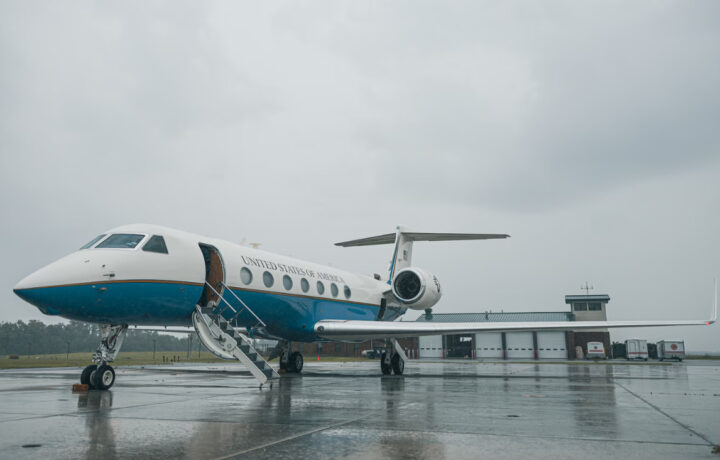
The list of aircraft includes the C-150, C-172, AT/T-6, PC-9, T-39, L-39, F-5, C-209, C-145, KA-350, KA-1900, Gulfstream, Lear Jet, C-500, B-707, B-737, UH-1N, B412 and Mi17, and others.
Pilots receiving specialized training will be current and qualified in the respective aircraft. However, the RFI noted, “Due to foreign disclosure regulations, the Government is unable to provide details regarding United States-specific technical orders, publications, or instructions at this time,” the RFI added.
Interested bidders will need to demonstrate an understanding of the current market landscape and the ability to meet the needs of the international partners. Companies will also be required to describe their training methodologies, use of simulators, maintenance and technical training procedures, and experience with culture considerations.


