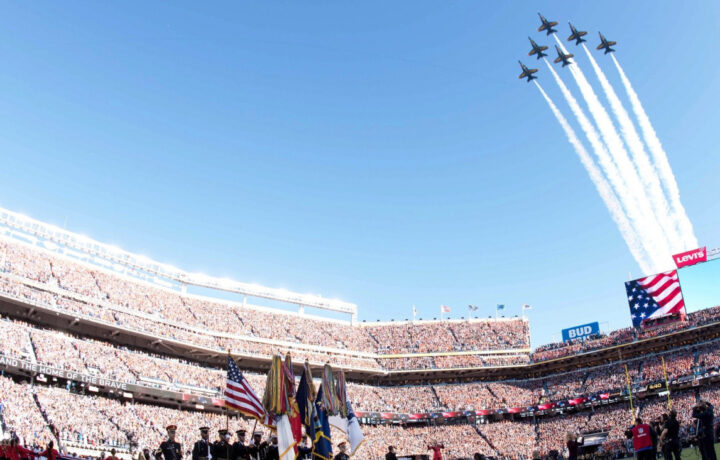
The Seattle Seahawks and New England Patriots will take the field at Levi’s Stadium in Santa Clara, CA, on Sunday for Super Bowl LX. The two teams, which last competed in the big game in 2015, remain intense rivals. However, there will be no inter-service rivalry in the skies over the stadium, as United States Air Force and United States Navy aircraft will conduct a joint flyover.
The formation, which will honor America’s 250th birthday this year, will feature two Air Force B-1 Lancers from Ellsworth Air Force Base, South Dakota, and two F-15C Eagles from Fresno Air National Guard Base, California, alongside a pair of Navy F/A-18E Super Hornets and two F-35C Lightning IIs from Naval Air Station Lemoore, California.
“While this flyover features the Air Force and Navy, a powerful symbol of America’s airpower and maritime strength, it symbolizes the entire joint force — Army, Marine Corps, Navy, Air Force, Space Force and Coast Guard — working together across every domain to defend the nation, safeguarding 250 years of American independence,” the Pentagon announced.
A Major Undertaking
The preparations for the flyover, which lasts less than a minute, began last summer when it was announced that the U.S. Navy would join the Air Force in the flyover. Final planning has been underway for weeks, requiring careful coordination and timing to the second.
“When you think of combat operations, where you have to be over a certain point of time and things have to go just right, that’s exactly how it is at an event like the Super Bowl or any sporting event,” U.S. Air Force Sports Outreach Program Manager Katie Spencer, who has overseen planning for six Super Bowl flyovers, told Military.com. “You have to hit your time over the target of ‘Home of the Brave’ at that moment, and nothing duplicates something that is high stress, high stakes like the Super Bowl.”
In advance of the big game, Air Force and Navy personnel have spent the week participating in numerous community outreach events, including public displays of aircraft, VIP backseat flights in F/A-18 Super Hornets, and a search-and-rescue demonstration.
The Weather is Always a Factor
Current forecasts call for clear skies and cool weather, ideal for a flyover. However, it was only last month that it rained on the Rose Parade, preventing a planned flyover by a Northrop B-2 Spirit bomber. It was only the second time since the 2023 event, when the entire Spirit fleet was grounded following a mishap a month earlier, that the flying wing aircraft missed the parade.
Although the B-2 Spirit missed the parade this year, it demonstrated true U.S. Air Force team spirit by performing a flyover during the Rose Bowl football matchup between Indiana University and Alabama, soaring over the famed stadium at about 3 pm PT.
For the B-2, it was also a highly coordinated, precisely timed event. For the flyover of the parade and game, the B-2 doesn’t fly to the Golden State ahead of time. Instead, the aircraft takes off from Whiteman Air Force Base (AFB), Missouri, and flies across country in some of the busiest airspaces in the country, passes over the parade route on Pasadena’s Colorado Boulevard, and then makes the return flight home.
This year’s Super Bowl posed some challenges, notably the stadium’s proximity to three major airports in Oakland, San Francisco, and San Jose.
More Than a Century of Flyovers
It is now common at high-profile sporting events for U.S. Air Force, U.S. Marine Corps, and U.S. Navy aircraft to participate in flyovers. It is now expected—along with the National Anthem—at such events as the Rose Bowl, the Super Bowl, NASCAR races, and Major League Baseball’s World Series.
However, this isn’t a new tradition.
According to Blue Sky News, the first military aircraft flyover took place on September 15, 1918, during World War I, with 60 aircraft making a low-level pass over Game One of the World Series at Comiskey Park in Chicago. Among those who saw the flyover was Babe Ruth, then pitching for the Boston Red Sox against the Chicago Cubs.
That flyover was less than 20 years after the first manned flight, and for many of the 20,000 attendees it may have been the first time they saw an airplane.
Although not as an uncommon a sight, this year’s flyover at the Super Bowl will still be noteworthy for the inclusion of so many aircraft from two different branches of the U.S. military.


