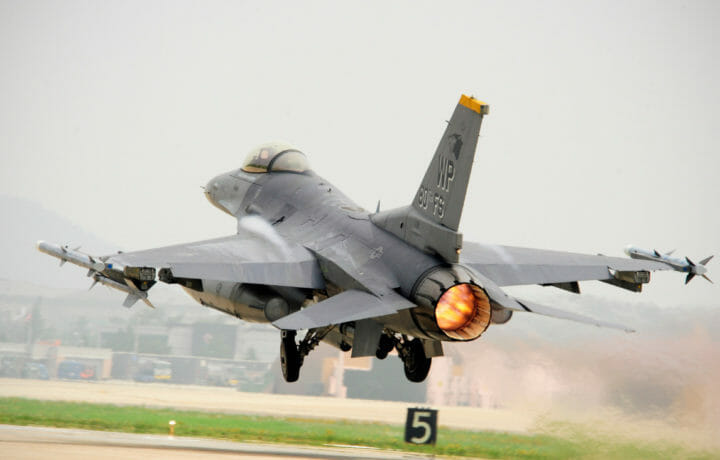
According to a report from the Mitchell Institute for Aerospace Studies, the United States Air Force needs to increase the number of combat aircraft in its fleet. In a policy paper, “Strategic Attack: Maintaining the Air Force’s Capacity to Deny Enemy Sanctuaries,” experts at the think tank called for the U.S. Air Force to acquire at least 300 sixth-generation Boeing F-47 fighters and at least 200 Northrop Grumman B-21 Raider long-range bombers.
That many aircraft would be needed to counter China in a major war, warned Heather Penney, a former F-16 pilot and the Mitchell Institute director of research.
Current Air Force acquisitions call for just 185 F-47s and around 100 B-21s.
Lessons From History
When the United States entered the Second World War, it had fewer than 200 B-17 Flying Fortresses, but it went on to produce more than 12,000. As the “Arsenal of Democracy,” the United States produced vast numbers of B-17s and other combat aircraft.
The development of many fighters occurred at a record pace, enabling the United States to introduce better and more capable weapons. However, the situation is very different today.
Designing, testing, and further developing the latest aircraft takes years, and current production of the most advanced fighter, the Lockheed Martin F-35 Lightning II, reached just 191 in 2025. That was also a record-setting year, surpassing the initial goal of 156.
Production of the Lightning II is actually running five times faster than that of other allied fighters, but this could hardly keep pace with wartime attrition.
The U.S. Air Force would need to have a large arsenal at the outset because production won’t be anywhere close to losses.
Penney noted that if the Air Force is unable to strike enemy bases and other sanctuaries quickly, it could fall into a war of attrition. Russia has been unable to gain air superiority in Ukraine even after four years of fighting. It has had to move its bombers and other aircraft to remote bases, but even then, some of its aircraft have been destroyed in daring drone attacks.
“China is deliberately building the capabilities and the posture to make the entire western Pacific their sanctuary effectively,” Penney told Defense News. “But we know from history that allowing an adversary that kind of sanctuary allows them to win, and it’s a recipe for our own defeat.”
China could be more dangerous than Iran, in that it has better air defenses and aircraft to counter a U.S. attack. That could result in the U.S. refraining from striking out of fear of losing aircraft that can’t be easily replaced.
“The inability to hold [Chinese] targets at risk really provides a singular reward to a first mover, to an aggressor,” Penney added. “So if China doesn’t see any risk to their homeland, to their population, to their infrastructure, they can afford to lose some of those assets on the edge, because they know that they can hold us at bay. So it really erodes our ability to keep them from taking that kind of aggressive action.”
Too Few Bombers
The U.S. is one of only three nations, along with China and Russia, that still operate long-range strategic bombers. There has been less demand for the aircraft, at least until there is. Such was the case last June, when the Pentagon carried out Operation Midnight Hammer, which struck Iran’s nuclear program.
However, as the Mitchell Institute noted, it required the entire fleet of available B-2 Spirits, which seven flying 37-hour, non-stop missions from Whiteman Air Force Base (AFB), Missouri, to Iran and back. Each dropped two GBU-57 bunker-buster bombs, resulting in the largest B-2 operational strike in history. Six of the Spirits hit the Fordow facility while the seventh struck the Natanz facility. The remaining B-2s served as decoys flying to the Pacific.
Not a single B-2 was lost in the operations, but if any of the seven had taken damage, it might have impacted the U.S. Air Force’s ability to conduct a follow-up strike if needed.
The U.S. operates just 19 B-2s and 45 Rockwell B-1B Lancers, after the fleet was reduced from 62 to 45 aircraft in 2021 as part of an ongoing modernization plan. Both the B-1Bs and B-2s have been pushed hard in recent years and will be retired as the B-21 enters service.
The new Raiders will be supported by a fleet of approximately 76 Boeing B-52 Stratofortresses. Current plans call for the bombers to continue to be upgraded, including with new crew workstations and engines, to allow the Stratofortress to remain in service through the 2050s.
The Mitchell Institute called for the U.S. to halt further retirement of its bombers until the B-21 Raiders enter service, and then expand the numbers. The think tank called on Congress and the Pentagon to provide the air service with the resources, including funding, to expedite the acquisition of the B-21.
In addition, the authors of the report stated that the Air Force needs more F-35A fighters, complemented by the Boeing F-15EX Eagle II, and to develop autonomous drones that can serve as loyal wingmen to support the manned fighters.
“The Air Force must reverse its fighter crisis and procure F-35s and F-15EXs at maximum rates: No more ‘divest to invest,'” Penney suggested, addressing the Air Force’s strategy that called for the retiring of older airframes to free up funds to develop new aircraft. “The Air Force must recapitalize its fighters with at least a one-for-one rate [replacing each retired jet with a newly procured tail], while also augmenting its force with collaborative combat aircraft.”


