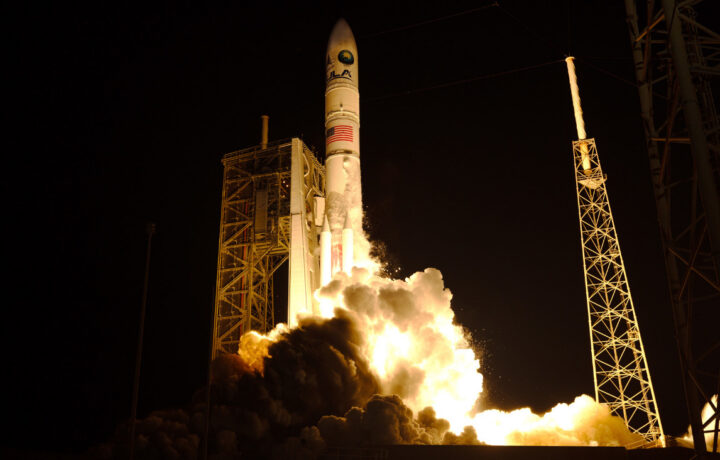
On Thursday, a United Launch Alliance (ULA) Vulcan Centaur rocket carried the United States Space Force 87 mission into orbit from Space Launch Complex (SLC)-41 at Cape Canaveral Space Force Station, FL, using a ULA Vulcan Centaur for this National Security Space Launch program. It was the second National Security Space Launch (NSSL) to employ the Vulcan rocket.
The rocket launched at 4:22 am, roughly an hour into its two-hour window, flying in a high-performance configuration with four strap-on solid rocket boosters, which burned for roughly 90 seconds before separating from the rocket’s core stage. Eight hours after liftoff, ULA confirmed the Centaur upper stage had completed its planned burns and deployed the payloads directly into geosynchronous orbit.
“We’re proud of everyone and the work they’ve done to make today’s launch a success and increase America’s warfighting capability,” said Stephen Burke, Vulcan System Program director.
The Mission Overcame an ‘Anomaly’
Early in the flight, an anomaly occurred with one of the four solid rocket motors. Still, the United States Space Force’s Space Systems Command Delta 80 (SYD 80) team worked with ULA prior to the mission to ensure space flightworthiness.
“Early during flight, the team observed a significant performance anomaly on one of the four solid rocket motors. Despite the observation, the Vulcan booster and Centaur performed nominally and delivered the spacecraft directly to geosynchronous orbit,” said Gary Wentz, ULA vice president of Atlas and Vulcan Programs. “The integrated U.S. government and contractor team is reviewing the technical data, available imagery, and establishing a recovery team to collect any debris. We will conduct a thorough investigation, identify root cause, and implement any corrective action necessary before the next Vulcan mission.”
SYD 80 executes the U.S. Space Force’s core function of Space Access, performing space lift and range control missions in close partnership with the 30th and 45th Space Launch Deltas (SLD 30, SLD 45). It has worked with ULA, which has served as a “launch backbone” for past national security space missions, including more than 100 critical missions for the U.S. Space Force and the National Reconnaissance Office (NRO) since the company was founded in 2006.
Mission Payload
According to Space Systems Command, the USSF-87 mission included a variety of payloads that will advance space technology and benefit current and future programs of record.
“The Geosynchronous Space Situational Awareness Program (GSSAP) space system is a capability supporting U.S. Space Command’s space surveillance operations as a high-performance, dedicated Space Surveillance Network sensor,” SSC explained.
The maneuverable satellite, built by Northrop Grumman, was deployed approximately 6.5 hours after liftoff. Although GSSAP satellites had previously launched in pairs, Space Systems Command confirmed only that the payload included a single GSSAP system.
Beyond the GSSAP, USSF-87 also delivered additional research, development, and training systems to orbit, as Space News reported, consisting of “a propulsive ESPA ring hosting additional spacecraft.” The report added that the “ring-shaped structure [was] originally developed to carry secondary payloads on military launches.”
U.S. Space Force guardians will employ the ring to refine tactics, techniques, and procedures for precision on-orbit maneuvers. It will also enhance and validate resiliency and protection in geosynchronous orbit.
The payload was delivered to orbit by ULA’s Vulcan in the “VC4S” configuration. It featured a Centaur V upper stage, four Graphite Epoxy Motor (GEM) 63XL solid rocket boosters (SRBs), and a standard payload fairing. The rocket leveraged ULA’s industrial base to deliver highly capable solutions that achieve space dominance for national security.


