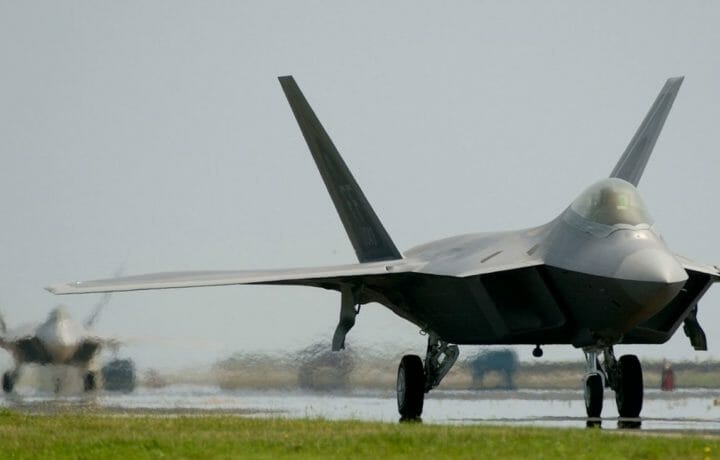
Six United States Air Force Lockheed Martin F-22 Raptor air superiority fighters arrived at Royal Air Force (RAF) Lakenheath on Wednesday. The fifth-generation stealth aircraft crossed the Atlantic Ocean using TREND call signs, typically associated with such deployments, Air & Space Forces magazine reported.
Additional F-22s are expected to deploy to the region, while 12 Lockheed Martin F-35A Lightning II multirole aircraft were also dispatched to bases in the Middle East last weekend.
The conventional takeoff and landing (CTOL) variants of the Joint Strike Fighter took two routes to Europe.
All F-22s and F-35s are headed to, or have arrived at, U.S. military bases in the Middle East, part of the massing of U.S. forces in response to heightened tensions with Iran.
Despite being an RAF station, Lakenheath currently hosts only United States Air Force units and personnel, including the 48th Fighter Wing, which operates F-15E Strike Eagles and F-35As. The base is a common stopover for U.S. aircraft en route to other bases in Europe and the Middle East. U.S. Air Force bombers regularly conduct Bomber Task Force (BTF) missions from Lakenheath, which is located in Suffolk, England.
Alongside the Raptors, multiple Boeing KC-46A Pegasus and Boeing KC-135 Stratotanker aerial refuelers were also being moved into place. The tankers supported the F-22s in the transatlantic crossing and could be ready for operations against Tehran if needed.
The aerial refuelers were routed to RAF Mildenhall, according to open-source flight tracking data.
Fighter Build-up
There are now upwards of 50 U.S. Air Force fighters deployed to the Middle East, with more on the way. In addition to the F-22s and F-35s, there are already F-15Es, F-16 Fighting Falcons, and A-10 Thunderbolt II close air support (CAS) aircraft deployed to the region.
U.S. Air Force F-22s and F-35s were sent to the Middle East last year, during the lead-up to Operation Midnight Hammer in June. The fighters were employed in taking out the Islamic Republic’s air defenses before seven Northrop B-2 Spirit bombers flew from Whiteman Air Force Base (AFB), Missouri, and back to strike Iranian nuclear sites at Fordow and Natanz. The B-2s dropped bunker-busting bombs, with the U.S. claiming that Tehran’s nuclear program was totally obliterated.
Raptors had previously conducted ground attack missions against Islamic State assets in Syria. Despite being described as the world’s premier air superiority fighter, the F-22 Raptor has never engaged in a manned adversary aircraft in combat. An F-22 did shoot down the suspected Chinese spy balloon in February 2022.
Eyes in the Sky
Two Boeing E-3 Sentry Airborne Warning and Control System (AWACS) aircraft are also reported to be en route to the Middle East, along with an unclear number of E-11 BACN airborne communication relay aircraft. Those aircraft will help U.S. Central Command (CENTCOM) monitor the movements of Iranian assets.
A Boeing RC-135 Rivet Joint signals-intelligence aircraft has also been dispatched. It can be used to intercept, analyze, and geolocate signals intelligence (SIGINT) in near-real time. The aircraft was reportedly relocated from Al Udeid Air Base in Qatar to Crete, likely to ensure it is beyond the range of Iranian air defense systems.
U.S. Navy Assets Also Moving Into Place
A United States Navy aircraft carrier strike group is now operating in the Arabian Sea, with a second on the way. The United States Navy’s Nimitz-class nuclear-powered supercarrier USS Abraham Lincoln (CVN-72) and her escorts arrived in the region last month. President Donald Trump ordered the USS Gerald R. Ford (CVN-78) to the region last Thursday.
The USS Abraham Lincoln has an embarked carrier air wing comprising F-35Cs, F/A-18 Super Hornets, and EA-18 Growlers for electronic warfare (EW). CVN-78 will bring additional aerial assets, including Super Hornets and Growlers. Despite being decades newer than CVN-72, the USS Gerald R. Ford has yet to be certified to operate with the F-35C during a deployment. F-35C integration remains a key future milestone for the Ford-class supercarriers.
The USS Gerald R. Ford was set to transit the Straits of Gibraltar into the Mediterranean Sea. The U.S. Navy’s newest and most capable warship, which began her deployment in June, had been in the Caribbean supporting U.S. operations when President Trump redirected her back to European waters. It could be May before her current deployment finally ends.


