
If you want to understand the health of the national security workforce, you have to start with a simple distinction that often gets overlooked: the difference between clearance eligibility and clearance access.
The cleared workforce is not a single pool. It’s really two overlapping populations:
- Eligible – In Access: Individuals who currently hold a clearance and are actively using it in a position that requires access to classified information.
- Eligible – No Access: Individuals who have a valid determination of eligibility but are not currently occupying a cleared role.
That distinction matters more than ever as we look at recently released personnel data from the Department of War and provided in the Performance Accountability Council’s most recent quarterly progress report.
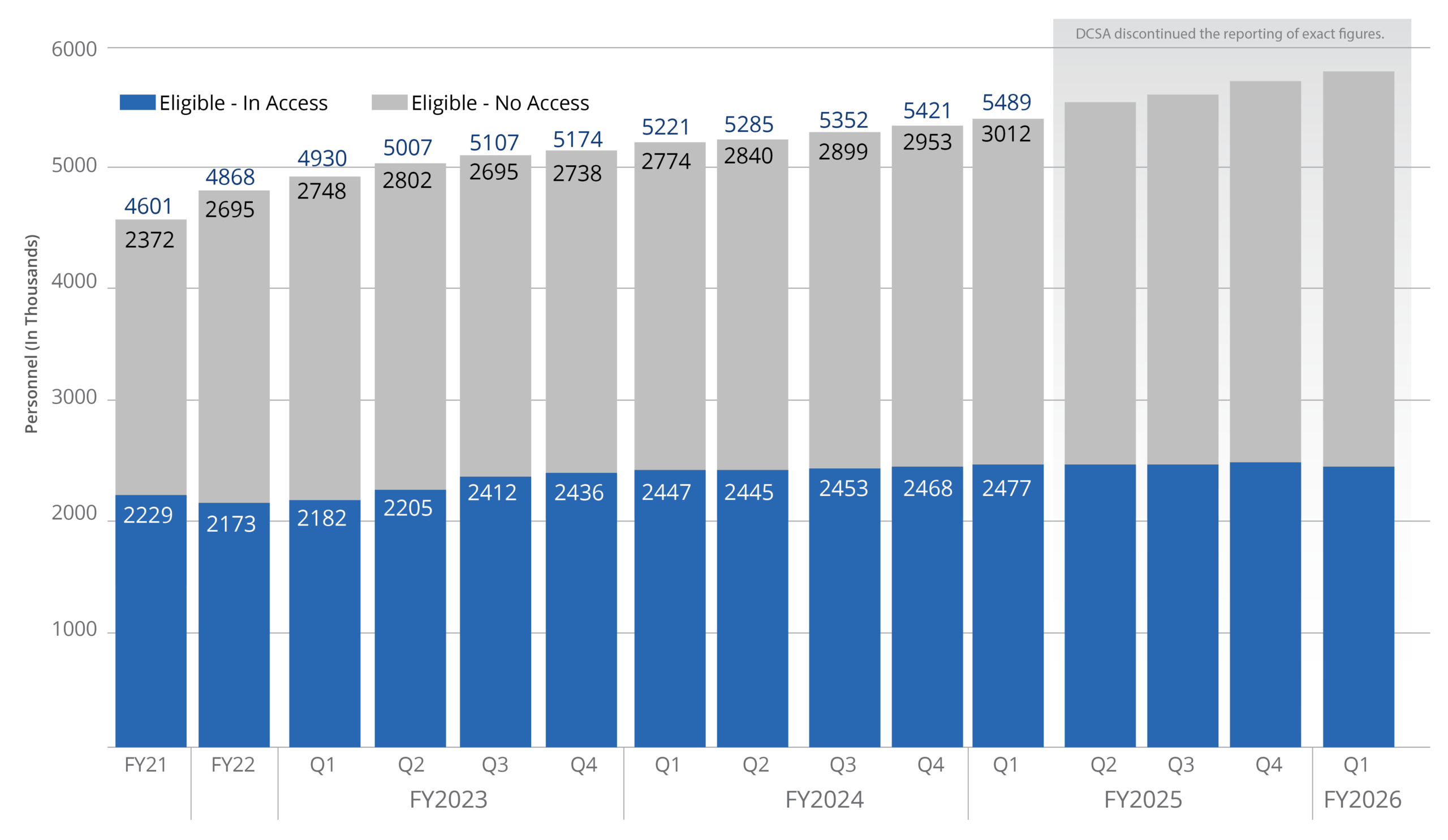
The Cleared Population Continues to Expand
Over the past several years, the total population of individuals determined eligible for a clearance has steadily increased. In FY2021, the total eligible population sat at roughly 4.6 million. By early FY2026, that number had climbed to roughly 5.5 million eligible individuals.
But the interesting story isn’t just growth. It’s where the growth is happening.
The number of individuals in access has remained relatively stable, hovering in the 2.2–2.4 million range over the last several years.
The “eligible, no access” population, however, has grown more significantly. In recent reporting periods, that group has crossed 3 million individuals.
In other words, the cleared workforce is growing — but a growing share of that workforce is not actively using their clearance.
Why the Eligible Population Is Growing
Several structural factors likely explain the current increases.
1. Military End Strength Adjustments
Recent defense priorities have included modest increases in military end strength, particularly in cyber, intelligence, and technical roles. When service members are cleared during their time in uniform, they remain eligible for a period even after leaving their position.
That means each military accession cycle can create a trailing population of individuals who retain eligibility but are no longer counted in the “in access” workforce.
When thousands of service members transition each year, the result is a large pool of cleared talent entering the civilian labor market – and the transitioning military pool is generally where the greatest influx of already cleared talent comes from.
2. Federal Workforce Turnover
Federal hiring and restructuring also plays a role. When employees transition out of cleared billets but retain eligibility, they move into the eligible but not in access category.
This is particularly relevant during today’s current period of:
- Agency restructuring
- Budget shifts
- Changes in mission priorities
- Early retirements or workforce transitions
Those shifts may temporarily expand the population of eligible personnel who are not currently occupying cleared roles.
3. A Stronger Vetting Pipeline
Another factor is simply that the personnel vetting system is processing cases more efficiently than it did several years ago, creating a more fluid, and overall increasing, cleared population.
When the system moves faster, more people move through it — and the overall eligible population increases.
The Hidden Workforce Opportunity
For employers, the eligible-but-not-in-access population represents one of the largest untapped talent pools in the national security ecosystem.
These individuals:
- Have already passed background investigations
- Have recent adjudications
- Understand the clearance process
- Often have mission-relevant experience
But because they are not currently in a cleared position, they can easily be overlooked.
For defense contractors and government agencies facing hiring shortages, this population is critical.
The reality is that the cleared workforce shortage is not always a clearance shortage. In many cases, it is a matching problem between cleared talent and cleared opportunities.
The Clearance Ready Reserve Concept
This dynamic is one reason concepts like a Clearance Ready Reserve is one I actively advocate for.
The idea is simple: rather than allowing experienced cleared professionals to drift out of the system when they leave a cleared job, we maintain a mechanism to keep them engaged, visible, and rapidly deployable when mission needs increase.
Given that the eligible population already exceeds 5.4 million individuals, the challenge isn’t necessarily building a larger cleared workforce. It’s ensuring that the workforce we already have remains connected to mission needs.
The Cleared Workforce Increase
The data tells a clear story.
The United States has a large and growing population of cleared professionals, but a significant portion of them are not currently working in cleared roles.
That gap presents both a challenge and an opportunity.
For policymakers, it raises questions about workforce planning and clearance portability.
For employers, it highlights the importance of finding and engaging professionals who may already have the eligibility needed to start work quickly.
And for cleared professionals themselves, it underscores a reality of the modern national security workforce: clearance eligibility has become a career asset that can persist even as roles and missions evolve. As one opportunity closes, the doorway of eligibility remains open, at least for a season.
Understanding the difference between eligible and in access isn’t just a technical distinction.
It’s the key to understanding where the cleared workforce is headed next.


