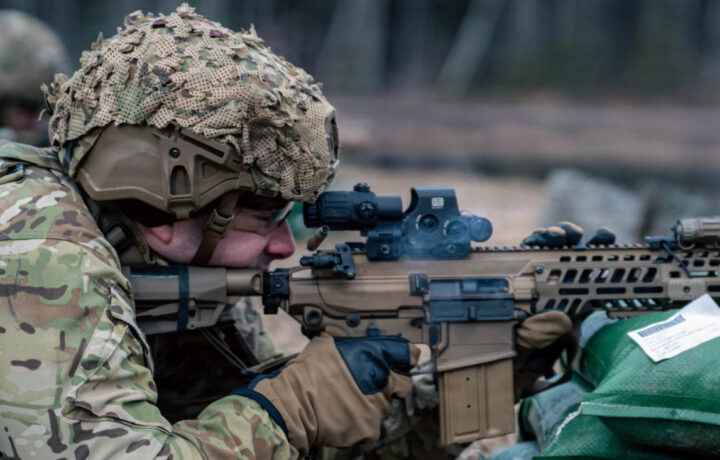
The United States Army’s “Next-Generation Squad Weapon” (NGSW) was intended to replace the legacy M4 Carbine and M249 light machine gun, also known as the squad assault weapon (SAW). Following a lengthy competition, the Sig Sauer MCX-SPEAR was selected as the basis for both the XM7 and the MX250, with the weapons to undergo further testing.
That included a rigorous 27-month prototyping and evaluation period, after which the Virginia-based Sig Sauer was awarded a 10-year, firm-fixed-price follow-on production contract to manufacture and deliver two NGSW variants.
However, the U.S. Army has since opted to expand what weapons the future warfighter might carry, and this month, another version of the M7 rifle is now being developed.
It is the XM8, a slightly shorter, lighter carbine version that shares the M7’s firing components. The exact rationale for adding a third version of the NGSW into the mix hasn’t been stated, but it is likely to accommodate the need for a compact weapon for urban combat.
As Task & Purpose reported, this follows the adoption of the M4 Carbine, a shortened variant of the ubiquitous AR-15/M16 family of select-fire rifles.
“A carbine is a compact, lightweight version of a rifle, designed for enhanced maneuverability and ease of handling in confined spaces or vehicles,” a U.S. Army spokesperson told Task & Purpose.
Compact Version
The differences between the M7 and the XM8 are minor, with the former measuring 37 inches in total length and featuring a 13-inch barrel. The carbine model cuts the overall length to 32 inches with an 11-inch barrel.
The external suppressor – what the public often calls a “silencer” – was reduced from seven to six inches.
The carbine model weighs 7.33 pounds, a full pound less than the M7’s 8.36 pounds.
That is even more significant than the 13 pounds of the M250 light machine gun, which is also 41.87 inches in length.
“The carbine also has a softer butt pad and a more rigid handguard for optics and other mounted equipment,” reported Task & Purpose, citing information from Sig Sauer product manager for rifles and suppressors Joshua Shoemaker.
“The new XM8 variant delivers an enhanced capability, particularly for roles where a more compact, maneuverable system is advantageous.”
All three weapons, including the M7, M250, and XM8, will be chambered for the newly developed 6.8x51mm Common Cartridge, also known as .277 Fury. The cartridge was developed to be “midway” between the 5.56x45mm NATO and the 7.62x51mm NATO in bore diameter, even though it is dimensionally similar to the latter round.
Addressing Criticism
The carbine model may also be an attempt to address criticism the M7 received just under a year ago, when U.S. Army Captain Braden Trent presented findings from his research on the NGSW at the Modern Day Marine exhibition in Washington, D.C.
Trent was especially critical of the XM7 at the time, and went so far as to suggest it was “unfit for use as a modern service rifle.”
Although the U.S. Army and Sig Sauer disagreed with Trent’s conclusions, it is worth noting that the United States Marine Corps opted not to adopt the M7, and instead will continue to employ the M27 Infantry Automatic Rifle, an update of the M4.
Heavier Hitting MG in the Works?
In addition to the compact version of the NGSW, the U.S. Army may continue to explore options for a heavier-hitting machine gun. It was just a year ago that the Army Contracting Command-New Jersey at Picatinny Arsenal announced it was “conducting a market survey/sources sought notice on behalf of the Project Manager Soldier Lethality (PM SL) for a dual caliber machine gun that fires both .338 Norma and 6.8x51mm ammunition.”
The .338 Norma Magnum was originally developed as a long-range sport shooting cartridge by Swedish ammunition maker Norma. It is used in long-range precision sport shooting, and the U.S. military previously considered the round for its Modular Sniper Rifle (MSR), developed and produced by Remington Arms for the U.S. Army as the Mk 21 Precision Sniper Rifle.
It would have a greater range than the M240B and even the M250. However, as the round is heavy and expensive, being able to use the 6.8x51mm still would be more cost-effective for training and missions where the longer range isn’t required.


