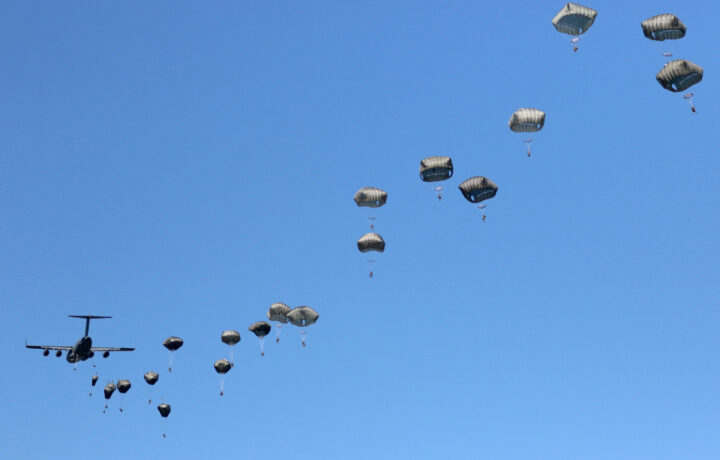
Last week, President Donald Trump ordered elements of the famed United States Army’s 82nd Airborne Division to be deployed to the Middle East. According to reports, somewhere between 1,000 and 3,000 of the division’s personnel could be sent to the region.
The division comprises two parachute infantry brigades, one air assault brigade, an aviation brigade, and an airborne field artillery regiment. As an elite rapid-deployment unit, the 82nd Airborne maintains brigade combat teams of 4,000 to 5,000 soldiers at the ready to deploy worldwide within just 18 hours.
The first group of soldiers will come from the 1st Brigade Combat Team.
The last time that elements of the 82nd Airborne Division were deployed was in November 2023, when a task force was sent to the Polish/Romanian border to reinforce NATO allies during the Russia-Ukraine war.
The 82nd Airborne Division is currently based at Fort Bragg, NC, and serves as the U.S. Army’s rapid-response force and is often among the first units sent to respond to emerging crises. The unit’s Immediate Response Force was established in 2018, and its first deployment was to Iraq in January 2020 following an attack on the U.S. embassy in Baghdad. It was later employed in the 2021 Afghanistan evacuations.
The All-American Division
The 82nd Airborne Division traces its origins to the First World War, when it was formed in the National Army in August 1917 as the 82nd Infantry Division. As it drew members from all 48 states, Major General Eben Swift, the division’s commanding general, gave it the nickname “All American” to reflect its unique composition.
The unit’s square insignia, approved in 1918, features an arched red banner embroidered with the letters “AA” on a blue background. An Airborne tab was added to the top when the sleeve insignia was redesigned and authorized in August 1942.
Over There
The 82nd Infantry Division was among the first U.S. Army divisions to deploy to Europe and fight in France during World War I. However, it wasn’t the rapid response force it is today. The 1st Infantry Division “The Big Red One” was the very first U.S. unit to land in France in 1917.
The 82nd was part of the first wave of later-arriving divisions in 1918 as part of the American Expeditionary Forces (AEF). It embarked from U.S. ports in April 1918 and was first assembled in the UK before training with the British military in Picardy in May 1918.
The division moved to the Lorraine sector in the summer of that year, taking part in the Saint-Mihiel Offensive from June to September. It then took part in the Meuse-Argonne Offensive, the final Allied campaign on the Western Front and the largest offensive in U.S. military history, involving 1.2 million American soldiers, sailors, and marines. It was also the deadliest campaign in the history of the U.S. Army.
The 82nd Infantry Division suffered 995 killed and 7,082 wounded, for a total of 8,077 casualties in the First World War.
From Infantry to Airborne Division
The 82nd Infantry Division remained in France following the November 11, 1918, armistice, and finally returned to the United States in February 1919. It was demobilized and deactivated at Camp Mills, NY, on May 27, 1919.
Just two years later, pursuant to the National Defense Act of 1920, the unit was reconstituted in the Organized Reserve. In February 1942, it was placed under the command of Major General Omar Bradley, and later that year, it was redesignated as the 82nd Airborne Division, the first dedicated paratrooper unit in the U.S. Army’s active service, under the command of Major General Matthew Ridgway.
In addition to paratroopers, the 82nd Airborne also included glider infantry, which were used in World War II operations.
The first regimental-sized combat parachute assault conducted by the United States Army was employed during the Allied invasion of Sicily in April 1943. Units of the 82nd All-American also arrived in Italy later that year in the amphibious assault at Maiori, Naples, and Salerno.
The 82nd Airborne Division took part in the D-Day landings in Normandy, France, in June 1944. Major General Ridgway’s post-battle report stated that the unit took part in “33 days of action without relief, without replacements. Every mission accomplished. No ground gained was ever relinquished.”
The unit later took part in the Operation Market Garden attack in the Netherlands in September 1944, where it conducted its fourth and final combat of the Second World War. Elements of the division conducted a river crossing to capture the Nijmegen Bridge, as depicted in the 1977 film A Bridge Too Far.
The 82nd Airborne saw combat during the Battle of the Bulge in December 1944 and, following Germany’s surrender in May 1945, entered Berlin for occupation duty. The unit was scheduled to participate in the planned Allied invasion of Japan, but Japan surrendered in August 1945.
The 82nd in the Cold War
The 82nd Airborne Division was held in strategic reserve in the early stages of the Cold War, with both President Harry S. Truman and President Dwight D. Eisenhower worried that the unit would be needed in the event of a Soviet ground attack. As a result, the airborne division wasn’t deployed during the Korean War.
It saw service in Operation Power Pack, the U.S. intervention in the Dominican Republic in April 1965.
The All Americans were then deployed to Vietnam, taking part in the 1968 Tet Offensive.
The unit was also among the forces deployed in the 1967 Detroit riot, and then in the 1968 riots in Washington, D.C., and Baltimore.
The 82nd Airborne Division remained a ready-to-respond unit in the latter stages of the Cold War, and it was deployed as part of October 1983’s Operation Urgent Fury, the invasion of Grenada, and then in December 1989’s Operation Just Cause in Panama.
The All-Americans and the Middle East
As the 82nd Airborne Division is being sent to the Middle East, it could be suggested that it will be familiar territory for the famed unit. The division took part in the 1991 Operation Desert Storm, which liberated Kuwait after Iraqi forces invaded six months earlier.
After taking part in operations in Haiti, Bosnia, and Kosovo in the 1990s, the All Americans were deployed to Afghanistan and later Iraq during the Global War on Terror (GWoT). The 82nd played an essential role in the final U.S. withdrawal from Afghanistan in August 2021. Major General Chris Donahue, commander of the 82nd Airborne Division, was the last American service member to leave, boarding the final C-17 aircraft on August 30, 2021, marking the end of the 20-year war.


