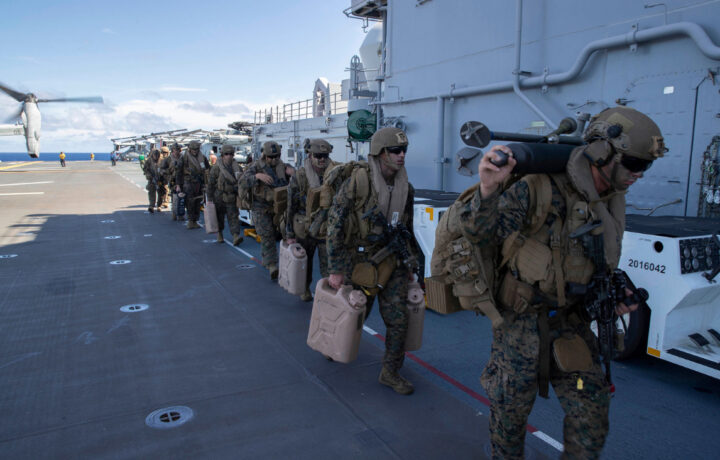
Last month, the San Diego-based Wasp-class amphibious assault ship USS Boxer (LHD-4) began her 2026 deployment, with 2,200 Marines from Camp Pendleton. LHD-4 was joined by the Whidbey Island-class dock-landing ship USS Comstock (LSD-45) and the San Antonio-class amphibious transport dock USS Portland (LPD-27). The vessels are now headed to the Middle East.
The U.S. Navy has also confirmed that the America-class amphibious assault ship USS Tripoli (LHA-7) is now operating in the U.S. Central Command area of responsibility. The flagship of the Tripoli Amphibious Ready Group is carrying units of the 31st Marine Expeditionary Unit (MEU), a rapid-response force of 2,200 personnel based on Okinawa, Japan.
The MEU is the Smallest Element of an MAGTF
USS Boxer routinely carries a MEU, either the 11th, 13th, or 15th. The MEU is the smallest and most mobile Marine Air-Ground Task Force (MAGTF) and can serve as a self-sustaining, rapid-response force.
The MEU has its origins in the early 1980s, when it evolved from the “Marine Amphibious Units” (MAUs), which were officially redesignated in 1988 to reflect the evolving role of the Marines and the MAGTF. The units can be deployed aboard U.S. Navy ships and then serve as forward-deployed, sea-based combatants ready to respond to crises, provide humanitarian aid, and engage in combat operations worldwide.
“The MEU is uniquely equipped and forward-deployed to respond to any threat, protect any American or ally, or squash any menace at any place in the world, often within hours. With its complement of fully-integrated air and ground forces, working closely with its Navy brethren, the MEU is a powerful, expertly-trained, and superbly-equipped force that has proven itself time and again in recent years,” the USMC explained.
The Four Elements of an MEU
Each MEU consists of approximately 2,200 Marines and Sailors embarked aboard several amphibious ships. The service noted that prior to deployment, the Marines undergo a rigorous 26-week training program designed to prepare them for any eventuality.
The MEU is further composed of four key elements that include:
- Command Element – Serves as the headquarters for the entire unit and allows a single command to exercise control over all ground, aviation, and combat service support forces.
- Ground Combat Element – Provides the MEU with its main combat punch. Built around a Marine infantry battalion, the GCE is reinforced with tanks, artillery, amphibious vehicles, engineers, and reconnaissance assets.
- Aviation Combat Element – The ACE consists of a composite medium helicopter squadron containing transport helicopters of various models and capabilities, attack helicopters and jets, air defense teams, and all necessary ground support assets.
- Logistics Combat Element – Providing the MEU with mission-essential support, such as medical/dental assistance, motor transport, supply, equipment maintenance, and landing, is the LCE’s mission.
A MEU is also the vanguard or “entry force” in operations around the globe. It also follows the USMC’s shifting focus to conventional conflicts in the Indo-Pacific, where it is designed to operate within contested areas. As the smallest MAGTF unit, the MEU is commanded by a colonel and is supplied for 15 days of independent operations.
MEB and MEF
A Marine Expeditionary Brigade (MEB) is the “middleweight” rapid-response MAGTF, numbering between 4,000 and 16,000 Marines and sailors. It is a scalable, task-organized force, larger than a MEU but still smaller than a Marine Expeditionary Force (MEF).
It is designed to handle crisis response, regional security, and power projection. Its composition includes a Regimental-size Ground Combat Element, an Aircraft Group, and a Combat Logistics Regiment.
The MEB is commanded by a brigadier general and is supplied for 30 days.
The MEF is the U.S. Marine Corps’ largest, most powerful, and principal warfighting organization. A lieutenant general leads it, and typically consists of over 47,000 to 60,000 personnel, combining ground, aviation, and logistics forces to act as a rapid-response, forward-deployed force. It is supplied for 60 days.


