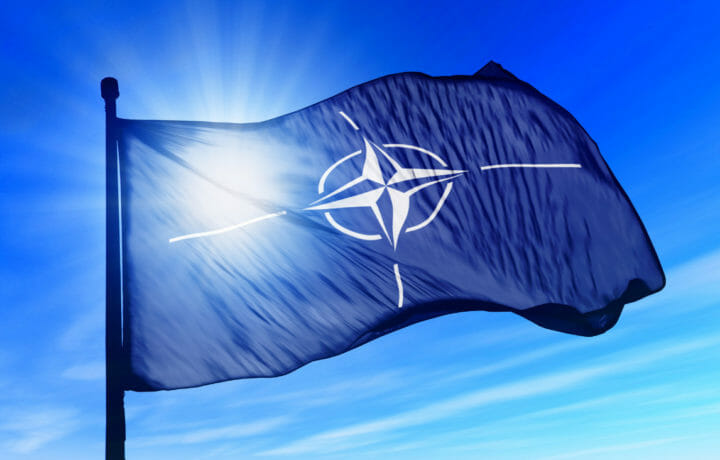
The North Atlantic Treaty Organization (NATO) isn’t the longest-lasting military alliance in history, as that distinction goes to the Anglo-Portuguese Alliance, which began as a treaty of friendship in 1373. It was reinforced by the Treaty of Windsor in 1386, and despite the changing political landscape of Europe over the past six and a half centuries, it has never been formally broken.
That doesn’t mean that the Anglo-Portuguese Alliance hasn’t been strained at times. It was effectively suspended during the Iberian Union in the late 16th and early 17th centuries when Portugal was under Spanish rule. There was also a diplomatic crisis when Britain issued an ultimatum forcing Portugal to abandon its territorial claims in Africa.
NATO has also faced strains, yet the alliance endures.
NATO’s Origins
Although NATO was established 77 years ago this month, on April 4, 1949, in Washington, D.C., it was rooted in the 1941 Atlantic Charter. That joint declaration issued by U.S. President Franklin D. Roosevelt and British Prime Minister Winston Churchill on August 14, 1941, outlined eight shared principles for a post-World War II world.
It promoted self-determination, economic cooperation, freedom of the seas, and disarmament of aggressors.
The Atlantic Charter also formed the basis for the modern United Nations.
Even as the goal was to ensure lasting peace, Soviet expansion in the early Cold War was seen as a concern. However, that was just part of what led to the creation of NATO. Equally important was an attempt to deter the revival of nationalist militarism in Europe through a strong North American presence and the encouragement of European political integration.
Thus, in April 1949, the North Atlantic Treaty was signed by Belgium, Canada, Denmark, France, Iceland, Italy, Luxembourg, the Netherlands, Norway, Portugal, the United Kingdom, and the United States. The core tenet is Article 5, which states that an attack on one member is an attack on all.
The alliance expanded following the Korean War in the 1950s, when a formal military command structure was created that included the Supreme Headquarters Allied Powers Europe (SHAPE).
In addition, NATO saw its first expansion, with Greece and Turkey joining in 1952, followed by West Germany in 1955. In response to West Germany’s joining NATO, the Soviet Union created the Warsaw Pact with its satellite states in Eastern Europe, further solidifying the Cold War divisions that lasted until the 1990s.
Stopping World War III
The alliance system of the late 19th and early 20th centuries directly led to the escalation that triggered the First World War. It had pitted the Triple Alliance nations of Germany, Austria-Hungary, and Italy against the Triple Entente bloc of France, the UK, and Russia, transforming a regional Balkan crisis into a global conflict, where secret treaties and military planning set off a domino effect that triggered World War I.
By contrast, NATO has been largely credited with preventing a Third World War.
This was due to its unique, highly durable, and adaptable security framework. Of course, the threat of mutually assured destruction from the use of atomic weapons also played a significant role.
It is also important to note that NATO is more than a treaty. It was, and still is, a deeply integrated military organization that includes a permanent command structure, shared military planning, and standardized procedures.
The alliance was also built on shared democratic values and the rule of law, which has been seen to strengthen its unity.
Following the dissolution of the Soviet Union at the end of the Cold War, NATO also successfully transitioned to peacekeeping and launched its first major operations in the Balkans after the breakup of Yugoslavia.
Continued Expansion
NATO has continued to expand, a point that has earned praise and criticism. Until the end of the Cold War, Spain was the last nation to join NATO, which it did in 1982. At that point, it wasn’t even expected that NATO could expand further.
Then the Cold War ended.
Although its original purpose was to counter the Soviet Union and the Communist Bloc, the alliance continued to exist even after the Soviet Union ceased to exist. Instead of discontinuing, several former Warsaw Pact nations and Soviet-bloc states joined NATO.
It began with the reunification of Germany in 1990, but later included Poland, Hungary, and the Czech Republic in 1999. That was followed by Bulgaria, Romania, Slovakia, and Slovenia in 2004. That same year also saw the three former Soviet Republics and now independent Baltic States of Estonia, Latvia, and Lithuania join NATO.
Albania and Croatia joined in 2009, followed by Montenegro in 2017. North Macedonia joined in 2020, and even then, there was criticism that eastward enlargement was provoking Russia.
Yet, it was Russia’s unprovoked invasion of Ukraine in February that spurred historically neutral and non-aligned Finland and Sweden to join NATO, and to see the member nations agree to increase their respective defense spending.
About Article Five
A point about NATO’s role in supporting military operations has been in the news of late, as NATO has refused to support the U.S. military’s operations in the Middle East. However, it should be noted that NATO’s Article 5, which states that an armed attack on one is an attack against all, is a defensive agreement.
It has only been invoked once, and that was following the 9/11 attacks on New York City’s World Trade Center and the Pentagon.
NATO didn’t play a role in the various conflicts fought by its members during the Cold War, notably France’s involvement in Indochina and Algeria in the 1950s, and the British involvement in the Falkland Islands War in 1982. In the latter case, the islands were outside of NATO’s scope, which is limited to north of the Tropic of Cancer.
Moreover, the UK did not formally invoke Article 5, likely because it was viewed as unnecessary and a potential sign of weakness; instead, the British military managed the conflict independently.
Other Key Alliances
It should also be noted that NATO is just one of several alliances the United States is part of, all considered vital to national security.
Lasting nearly as long as NATO, the “Treaty of Mutual Cooperation and Security between the United States and Japan,” or more commonly known as the U.S.–Japan Security Treaty, was first established in June 1960, replacing an earlier version that was ratified in 1951. That treaty permits the presence of U.S. military bases on Japanese soil, and commits the two nations to defend each other if one or the other is attacked “in the territories under the administration of Japan.”
However, the U.S. had been a member of the Southeast Asia Treaty Organization (SEATO), a collective defense alliance formed in 1954, aimed at blocking communist expansion in Southeast Asia. Members included the U.S., the UK, France, Australia, New Zealand, the Philippines, Thailand, and Pakistan.
It dissolved in 1977 following internal disagreements and a lack of participation in multiple conflicts, and historians deem it a failure.


