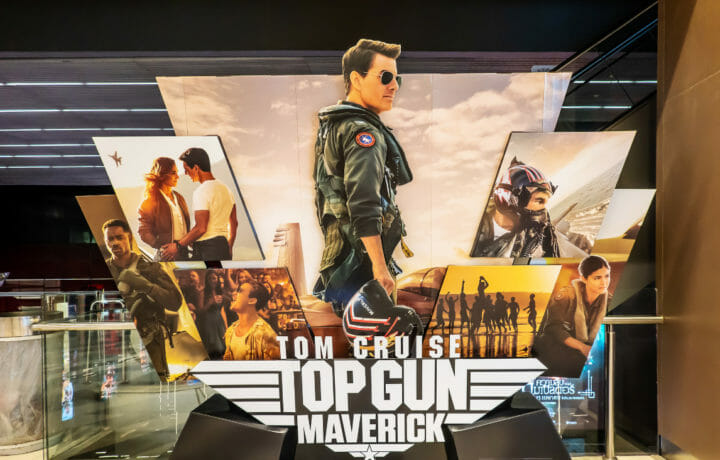
It’s that time of year again, when we all gather around the keyboard, generate a callsign, and celebrate the redemption of Pete “Maverick” Mitchell. We sing along to the Righteous Brothers, imagine ourselves flying down the highway on a Kawasaki, and wonder how one person can make so many career-ending decisions and still come out on top.
Top Gun Day is here again.
May 13 is a special day, a celebration of the film that forever changed how the world imagined naval aviation and the aviators who represented the best of the best. Born from the 1986 original’s release date, Top Gun Day has grown into an annual salute to the enduring mythology of Miramar and the pilots who define it. And there is no better occasion to reflect on the leadership lessons embedded in its long-awaited sequel: Top Gun: Maverick.
Thirty-six years after Maverick first defied orders and flew inverted over a MiG-28, he returned to the screen not as a symbol of youthful recklessness, but as something altogether more compelling: a reluctant mentor forced to confront his own legacy. Top Gun: Maverick was not merely a sequel. Where Top Gun delivered redemption for a brash young pilot learning to believe in himself, Maverick gave us a seasoned leader learning to let go – of control, of guilt, of the past. The sequel leaves behind the lessons of arrogance and youth. hotshot recruit. These are the lessons of command.
The Words of a Maverick
As a film, Maverick a meditation on leadership, purpose, sacrifice, and the responsibility that comes with experience. Thirty-six long years in the making, the film became one of the highest-grossing movies of all time – not on the strength of nostalgia alone, but because its narrative resonated with something deep and universal for audiences.
Like the original, Maverick struck a familiar chord with quotable dialog. Great films produce great lines. And Maverick delivered dialog that cut to the heart of leadership, courage, and purpose. Five quotes endured long after the final credits rolled:
1. “It’s not the plane. It’s the pilot.”
Tools, technology, and resources matter – but they don’t define the outcome. Leadership is the irreducible human factor. The best-equipped team in the world underperforms without a leader who can think, adapt, and inspire. Maverick’s reminder is timeless: invest in people, not just platforms.
2. “Trust your instincts. Don’t think. Just do.”
Preparation and training exist so that instinct drives execution. The leader who puts in the hard work – drilled the fundamentals and stress-tested the plan – acts and decides with confidence in the moments. Overthinking in the critical moment is the enemy of decisive action. Trust your preparation. Move.
3. “I’m where I belong.”
Organizations often spend enormous energy trying to conform their most unconventional contributors, only to discover in the moment of greatest need that the maverick was their greatest asset all along. The leader’s job is not to smooth out every rough edge, but to shape and hone exceptional talent toward exceptional purpose.
4. “There’s more than one way to fly this mission.”
Superior skill doesn’t guarantee success. A wise leader knows when to attack and when to hold, that success is often about choosing when and where to fight and how to set their own terms. Knowing your limitations is not defeatism. It is wisdom.
5. “The Navy needs Maverick.”
Leadership carries a burden that weighs on every single decision. What you model, what you teach, and what you demand of yourself becomes the standard that others carry into their defining moments. The leader’s influence extends far beyond what they can see. That is both the gravity and the privilege of command.
The lessons of a maverick
Arguably, Top Gun was the premier military action film of the 80s. It had the flash, the swagger, and the machismo. It had the technology, the violence, and the breathtaking supersonic air combat sequences. But, beneath it all, was a great story. Maverick brought that story to a new generation, a narrative that – at its core – is about leading people you care about, having the courage to mentor, and possessing the humility to be accountable.
The film conveyed many of the same life lessons as the original, essential leadership truisms that leave a lasting impression, whether audiences realize it or not.
» It’s about the courage to lead, not just to fly.
Being the best sometimes means handing the baton to others. When called back to train the next generation of naval aviators for a near-impossible mission, Maverick is forced to step beyond the cockpit and lead. True leadership demands more than individual excellence. It demands the courage to invest in others, even when that might mean watching them fly into danger you cannot share.
» It’s about mentoring through humility.
Maverick has been humbled by loss, by time, and by the weight of Goose’s death – which still haunts him. The most powerful leadership lesson in the film is not delivered through arrogance or bravado, but through honesty, vulnerability, and accountability. Humility is not weakness. In Maverick’s case, it’s what makes him worthy of being followed.
» It’s about knowing when to break the rules, and when not to.
Maverick’s career has been defined – for good or bad – by his willingness to break the rules for the greater good. When Maverick breaks protocol during training to prove that the mission is survivable, he does so not for himself, but for his team. The leader who understands why the rules exist is the one best equipped to know when they must be bent.
» It’s about confronting the past to lead in the present.
Maverick’s arc is a masterclass in emotional courage: the courage to release what you cannot change and trust what you have prepared. To move forward, he has to release the ghosts. Great leaders do not allow the weight of past failures to distort present judgment. They reckon with loss, make peace with it, and lead forward.
» It’s about loyalty and emotional bonds.
In the film’s final act, Maverick is shot down and Rooster breaks formation to rescue him. Here, Maverick focuses on two of the most foundational tenets of leadership – selflessness and sacrifice. The best leaders do not ask their people to go where they themselves would not. And the best teams do not leave others – or their leaders – behind. Mission and loyalty, it turns out, are inseparable.
The Pattern is [Not] Full
Maverick spent thirty-six years being, well… Maverick. But, when it mattered most, he found himself home again – quietly, painfully, and completely. Top Gun Day is a reminder that the truest measure of leadership isn’t the afterburners, the barrel rolls, or the climactic canyon runs. It’s the person strapped into the seat, and the leaders standing behind them on the flight deck.
And that’s what makes Maverick’s story worth telling. Again. Because we haven’t heard the last of Pete Mitchell.


