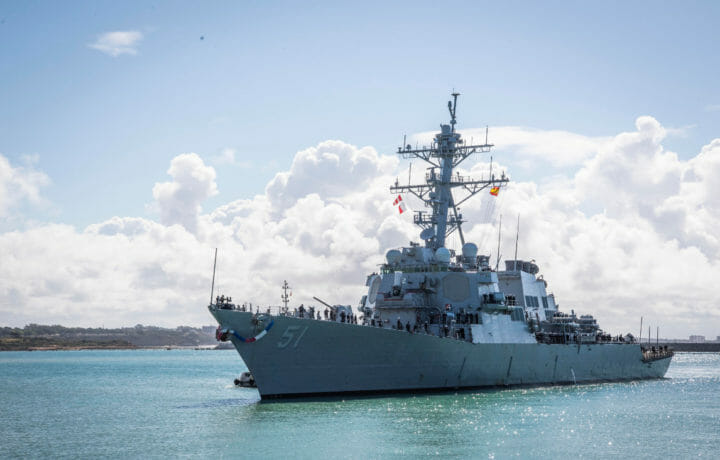
The United States Navy’s Arleigh Burke-class guided-missile destroyers remain the backbone of the surface fleet. Often described as the “Swiss Army knives” of the sea due to their versatility, the warships combine multi-mission lethality, advanced missile defense, and unmatched adaptability into a single, highly survivable hull.
The vessels can serve as an airborne shield, protecting aircraft carriers and allied vessels from aircraft and cruise missiles. The same guided-missile destroyers can employ towed sonar arrays, anti-submarine rockets, and embarked helicopters; they hunt down underwater threats; and even engage enemy ships and shore targets using naval guns and cruise missiles.
The Arleigh Burke-class destroyers are warships the U.S. Navy can’t live without, and because it now fills the role once employed by the Ticonderoga-class cruisers, the service doesn’t have enough of them.
Two Shipyards Building Them
The guided-missile destroyers are built primarily at just two U.S. shipyards: General Dynamics Bath Iron Works (BIW) in Bath, Maine, and Huntington Ingalls Industries (HII) Ingalls Shipbuilding in Pascagoula, Miss. The U.S. Navy had split production contracts evenly between the two yards, intended to maintain a steady fleet of surface combatants.
The U.S. Navy had set a target rate of two ships per year, but due to supply chain constraints and shipyard labor shortages, actual delivery rates have fallen short. BIW and HII have been averaging about 1.5 ships per year. The U.S. Navy also requested just one destroyer in its recent budget submissions.
Lawmakers are now trying a course correction to increase production.
On Tuesday, the House Armed Services Committee called for authorizing $500 million in incremental funding to allow the U.S. Navy to procure a second Flight III Arleigh Burke-class destroyer in fiscal year 2027 (FY27). As USNI News reported, the incremental funding authorization for a second destroyer could address concerns from Maine lawmakers, “who during recent hearings voiced concern over the Navy’s decision to request one destroyer in the budget submission.”
Yet, because of the way the contract is split, it would be HII that would build the future DDG-150, rather than BIW. The U.S. Navy has purchased three guided-missile destroyers annually in recent years, but opted to scale back as it focuses on other programs.
“I heard just yesterday from General Dynamics … that this weak demand signal – if approved by Congress – would trigger layoffs at Bath Iron Works as soon as next year,” Rep. Jared Golden (D-Maine) said May 14 during a HASC hearing on the Navy budget.
Maine’s Republican Senator Susan Collins, who chairs the Senate Appropriations Committee and sits on the panel’s defense subcommittee, shared the concerns.
“Such a reduction would send a troubling signal to the industrial base at a time when the Navy continues to emphasize the need for greater fleet capability and resiliency,” Collins said during the service’s budget hearing. “Bath Iron Works in Maine – which is only one of the surface combatant shipyards in the country – has made real progress in workforce retention and accelerating production stability due to the steady demand signal.”
Backlog at Bath
Acting Secretary of the Navy Hung Cao responded to Collins in his testimony to the Senate Appropriations Committee that it is the backlog at BIW that was a factor in the U.S. Navy’s decision to seek just one destroyer for FY27.
“We will add the ships in future years. It’s just right now, I’m trying to give them the ability to catch up to the work, as of right now,” Cao told Collins.
It currently takes around 7.5 years for the U.S. Navy to build each Arleigh Burke-class destroyer. The issue has been securing long-lead items, including the propulsion system and its advanced SPY-6 radars. However, even after the first raw steel is cut and laid, it now takes 18 to 24 months to finish the primary hull and structure work.
Due to global operational needs, the U.S. Navy will likely need to extend the service lives of a dozen of the oldest hulls to keep them in the fleet longer.
The Arleigh Burke-class is now the longest-running surface combatant shipbuilding program in U.S. Navy history. It has been active for more than 40 years since procurement began in 1985, and it remains the backbone of the surface fleet with nearly 100 ships procured.


