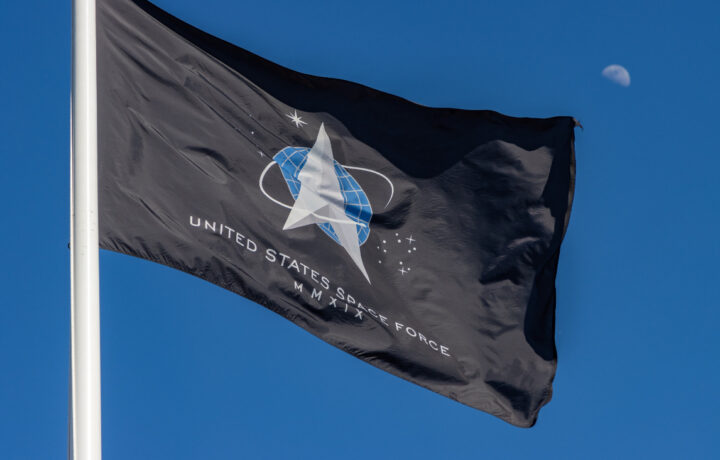
The United States Space Force is set to grow its footprint in Japan, adding upwards of 60 personnel and effectively quadrupling the operational troop strength. The major expansion for U.S. Space Forces-Japan (USSPACEFOR-JPN) will see it add its own headquarters at Yokota Air Base over the coming year.
It is part of increased bilateral ties between the sixth and newest branch of the United States military and Japan, as the U.S. ally continues its upgrade of space operations into a full command.
The Japan Aerospace Exploration Agency, commonly known as JAXA, was formed in 2003 through the merger of three separate Japanese space and aviation institutions.
The partnership will continue to serve to deter regional threats, including from potential adversaries in the Indo-Pacific, notably China and North Korea. The added personnel will focus heavily on monitoring objects in space, missile warnings, satellite communications, and the sharing of Space Domain Awareness (SDA) payloads with Japanese satellite operators.
The expansion further directly aligns with the U.S. and Japanese “2+2” security commitments to integrate cross-domain operations that can enhance joint alliance responsiveness from peacetime to contingencies as needed.
Big In Japan
The U.S. Space Force’s Space Systems Command Japan launched its first bilateral space effort in February 2025, when a U.S. space domain awareness payload hosted on Japan’s Quasi-Zenith Satellite 6 (QZS-6) successfully launched on a Japanese H-3 launch vehicle from the Yoshinobu Launch Complex at JAXA’s Tanegashima Space Center (TNSC). The satellite is operated by Space Operations Command’s (SpOC) Mission Delta 2 (MD 2).
USSPACEFOR-JPN, the U.S. Space Forces sixth service component, was activated in December 2024, providing forces and space expertise under the U.S. Space Forces Indo-Pacific in direct support of U.S. Forces Japan. The first Space Force guardians arrived that month. It followed the activation of U.S. Space Forces Korea in 2022.
At the time of USSF-JPN’s activation, there was just a staff of 10 guardians, all of whom were stationed at Yokota Air Base, Tokyo.
USSF-JPN celebrated its first year of activation this past December, where it noted the growth that has already occurred in just 12 months.
“The activation ensures space forces can plan, integrate, coordinate and execute efforts in Japan on behalf of U.S. Space Forces Indo-Pacific to best support the U.S. partnership agreements with Japan, deepen integration with Japanese space counterparts and meet dynamic regional challenges to ensure a free and open Indo-Pacific,” the Space Force explained.
New Space Force Commander in Space Forces Korea
Last week also saw a leadership change of U.S. Space Forces – Korea (USSPACEFOR-KOR), the theater space component assigned to U.S. Space Forces Indo-Pacific. Col. Dorian C. Hatcher relieved Col. John D. Patrick at a change of command ceremony at Osan Air Base.
“The U.S. network of alliances and partnerships represents a tremendous asymmetric advantage in the Indo-Pacific,” said Brig. Gen. Brian Denaro, U.S. Space Forces Indo-Pacific commander, and the officiating officer for the ceremony. “The [U.S.-South Korea] alliance remains one of the strongest in the world because it is built on shared interests, interoperability, trust and readiness. And increasingly, that alliance is strengthened through integrated space operations.”
The new commander of USSPACEFOR-KOR, in a partnership with South Korean partners, will lead the unit during what Denaro suggested as “a critical period for both the Space Force and the alliance.”
Hatcher acknowledged that the USSPACEFOR-KOR will serve as the “single voice for space on the peninsula,” where its mission will remain focused on warfighting and joint integration.
“We are here to provide the space planning and employment expertise required to command and control space forces effectively in this theater,” said Col. Hatcher, an interservice transfer from the United States Army, who had served in South Korea in 1997 as a U.S. Army private first class. He now returns nearly three decades later to lead the guardians.
“By seamlessly weaving space combat power into shared operations, expanding our shared domain awareness and integrating deeply with our South Korean allies, we guarantee that the joint force remains ready to deter and defeat any threat to the U.S.-South Korea alliance, in, from and to space,” added Hatcher, who most recently had served as deputy commander for operations at Space Launch Delta 30, Vandenberg Space Force Base, California.
Col. Patrick, the USSPACEFOR-KOR’s outgoing commander, will assume command of the USPACEFOR-JPN at Yokota Air Base.


