
Every year, hundreds of thousands of Americans submit applications for security clearance, entering a process that can reshape careers, delay job starts, and create genuine financial risks – all while they wait in darkness about where they stand. The Defense Counterintelligence and Security Agency (DCSA) conducts the vast majority of background investigations for security clearances across the Department of Defense (DoD) and other federal agencies. DCSA publishes clearance processing time data; however, the way it presents the data leaves ordinary applicants largely in the dark. To estimate how long the case might take, applicants often rely on anecdotal information on internet forums. This unofficial information ecosystem exists largely because DCSA does not make its data publicly available.
What’s Available to Applicants Now
For years, DCSA has shared processing time data for contractor security clearances in the form of bar graphs presented at periodic security clearance stakeholder meetings, such as the National Industrial Security Program Policy Advisory Committee (NISPPAC). These presentations typically show average quarterly processing times by clearance level using bar graphs with details for application, investigation, and adjudication times. The data are not without value, but they do not adequately capture the real experience of applicants navigating the clearance system. By the time NISPPAC meeting reports are made public, the data is usually about four to six months old and only provides average processing times for contractor clearances. ClearanceJobs.com often publishes the DCSA bar graphs from the NISPPAC meetings in a timely manner.
The Security, Suitability, and Credentialing – Performance Accountability Council (PAC) publishes a “Trusted Workforce 2.0 – Quarterly Progress Report” that shows average security clearance processing time but conflates data across military, civilian, and contractor personnel. Because this data includes a very large number of military accessions, it yields significantly different averages from the contractor cases shown in NISPPAC reports.
Individual applicants may hear that “average end-to-end Top Secret processing time is around 150 days for the fastest 90 percent,” but that single number tells them little about their own likely experience. Are most people finishing close to that average, or is it an average dragged upward by a long tail of difficult cases? Without the shape of the distribution, the average is of limited use for individual planning. One applicant may receive clearance in 90 days, while another may wait 300 days due to potentially disqualifying issues and/or additional adjudicative steps to ensure procedural due process. By compressing all cases into one average figure, bar graphs fail to show the enormous variation that exists within the applicant population.
A better approach would be to post monthly bell curve graphs on a DCSA public webpage, showing the full distribution of end-to-end completion times for contractor Secret and Top Secret clearances. The case for making this change is compelling on grounds of fairness, utility, and institutional transparency.
Benefits of a Bell Curve
A bell curve, by contrast, illustrates the distribution of cases across time. Applicants will see how many investigations are completed within 10 weeks, 20 weeks, 30 weeks, and beyond. This would allow people to understand the most common outcomes and the likelihood of delays. A bell curve – more precisely, a distribution graph showing the full range of completion times – communicates something far richer than a bar graph showing averages. It allows an applicant to see not just where the middle of the distribution sits, but how spread out some outcomes are, where the bulk of cases cluster, and where the long tail begins. A bell curve is not merely a more technical chart; it is a fundamentally more honest representation of reality.
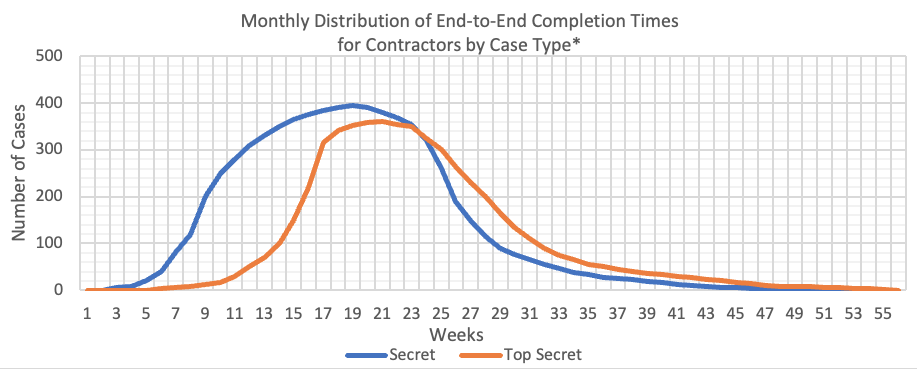
Consider the difference between knowing that the average Top Secret clearance took 22 weeks last quarter versus seeing a distribution showing 60 percent of cases closed between 17 and 26 weeks, with a tail extending beyond 50 weeks. This helps a jobseeker make better-informed decisions: negotiating a start date, planning finances during an interim period, or understanding when it might be reasonable to follow up with their security officer. The bar graph offers a landmark, whereas a bell curve is a map.
This is especially important because clearance timelines are not uniformly distributed. Cases involving potentially disqualifying financial problems, foreign involvement, criminal conduct, or substance abuse can take dramatically longer than “average” investigations. A distribution graph would naturally reflect this reality, showing a rightward skew that alerts applicants with eligibility issues in their backgrounds that their experience may diverge significantly from the average. That honest visual is far more useful than a single averaged figure.
Monthly Public Postings
The timing and venue of data release matter as much as the format. Presenting data at stakeholder meetings, even when those meetings are open or their materials are eventually posted at public websites, creates an inherent information lag and an audience skew. The people in those meetings are defense contractor security officers and government security officials. They are stakeholders, not the applicants themselves.
Posting updated distribution graphs monthly on the public DCSA website would democratize access to this information in a straightforward way. An applicant could visit the site at any point, pull up the most recent month’s graph, and get a current picture of the processing environment. Conditions shift – case backlogs grow and shrink, DCSA staffs up or faces hiring freezes, and external events can surge application volumes.
A Small Change With Large Returns
Security clearance processing touches some of the most consequential moments in an applicant’s career. People make decisions about job offers, mortgages, and family relocations based on their best guess about when a clearance will come through. Giving them current, distributional data – rather than a periodic average delivered to a room they’re not in – is a modest administrative change that would deliver substantial benefits to applicants. By moving beyond average-based bar graphs and embracing monthly distribution reporting, DCSA would demonstrate a commitment to transparency that matches the importance of its mission.
DCSA already collects this data; the question is only about its presentation and publication frequency. The marginal cost of converting existing data into a publicly posted chart is minimal compared to the benefit delivered to hundreds of thousands of applicants annually. In an era where data visualization tools are widely available and public expectations for institutional transparency continue to rise, there is little justification for limiting public reporting to occasional averages presented at stakeholder meetings. For applicants waiting anxiously for career-defining decisions, that clarity would make a meaningful difference.
Other Data
DCSA should publish separate graphs for DoD civilian and military cases. However, since processing time for DoD civilians and contractors should be fairly similar, conflating these cases into a single graph would probably provide fairly accurate data for both groups. The importance of interim (temporary) clearances cannot be overstated. DCSA has the ability to publish the percentage of DoD contractor applicants who receive interim clearances and the average length of time it takes DCSA to make an interim clearance determination for contractors. The interim clearance data, in addition to the bell-curve graphs for final clearances, would give most applicants a truly complete picture of their likely clearance-processing experience.


