“The devil is in the details, but so is salvation.” – Admiral Hyman Rickover.
When Sputnik reached low Earth orbit on October 4, 1957, the world took notice. So did President Dwight D. Eisenhower. The United States needed to respond, to demonstrate its own technological prowess. Ike had a plan.
The USS Nautilus, built under the direction of U.S. Navy Captain Hyman Rickover, launched in 1954 as the world’s first nuclear-powered submarine. But the existence of Nautilus wasn’t enough. He needed more. Something “that would prove the superiority of American might.”
Operation Sunshine was that something.
On July 23, 1958, Nautilus departed Pearl Harbor and, after transiting the Bering Strait, surfaced near Point Barrow, AK. On August 1, 1958, she left the north coast of Alaska and submerged to a depth of 500 feet below the Arctic ice cap. At 11:15 pm on August 3, Nautilus’s captain, Commander William Anderson, announced to the crew, “For the world, our country, and the Navy – the North Pole.” In that moment, Nautilus became the first vessel to reach – and navigate beneath – the geographic North Pole.
The success of Operation Sunshine was a strategic coup for Eisenhower. The Arctic Ocean had long been considered an impenetrable barrier between the Cold War adversaries. The Nautilus proved otherwise. The voyage was also the culmination of Rickover’s obsessive and sometimes contentious drive to build a nuclear navy. After Operation Sunshine, nothing – and no one – was going to stand in his way.
Unremarkable
Rickover was born on January 27, 1900, in the Russian-occupied Polish village of Maków Mazowiecki. He and his family fled the pogroms in 1905, eventually settling in Chicago where his father worked as a tailor. The household was poor, strict, and demanding – like most immigrant homes of the period – and the hardships were simply absorbed into discipline. Small, slight, and intensely bookish, Rickover knew his family couldn’t afford college tuition, so he pursued – and received – a congressional appointment to the United States Naval Academy.
When he graduated four years later, he wasn’t at all remarkable. He finished 107th in a class of 540 midshipmen and commissioned as an ensign. He didn’t receive honors, wasn’t celebrated as a future admiral, and wasn’t seen as a man of destiny. What he was, though, was thorough. A quiet outsider, earnest to the point of fault, and a young man who had already developed the habits that would come to define him: precision, discipline, and an unrelenting sense of duty.
Following graduation, he completed a master’s degree in electrical engineering from Columbia University and began a career in the silent service as a submarine officer. And, like a handful of future senior leaders across the services, he spent the interwar years acquiring the depth of technical knowledge that the Navy would eventually need more than it knew.
The Road to the Nuclear Navy
During a visit to Oak Ridge in 1946 – part of a project to develop nuclear energy for military and civilian use – Rickover had an epiphany. Nuclear-powered submarines were the future of the Navy. The notion defied convention. The Navy’s institutional thinking saw the potential for nuclear power, but in surface vessels. Not one to be deterred, he took his case directly to Admiral Chester Nimitz, the Chief of Naval Operations, with characteristic tenacity and almost total indifference to the opinions of others.
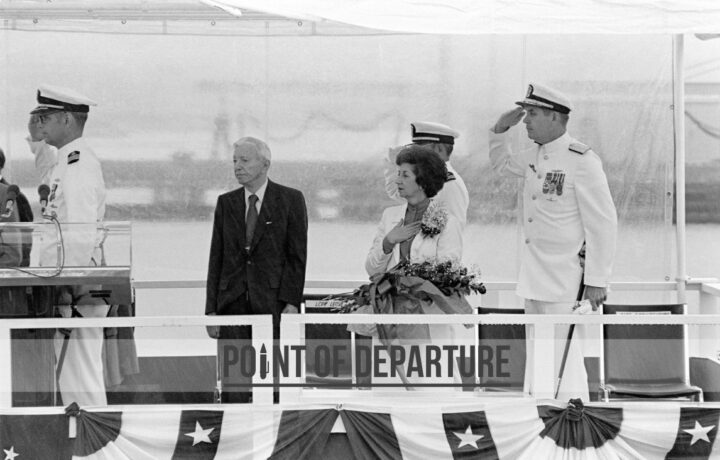
In 1948, the Navy created a new Nuclear Power Branch and chose Rickover to lead it. He attacked the role with fervent energy, frequently unorthodox methods, and the almost fanatical devotion of his team. Just four years later, on June 14, 1952, President Harry Truman laid the keel for Nautilus at the Electric Boat shipyard in Groton, CT. Eighteen months later, First Lady Mamie Eisenhower christened the Nautilus, heralding “a new era of the atomic age.”
An Uncomfortable Legacy
Rickover’s career can serve as an uncomfortable, if not cautionary, case study in leadership. He was abrasive, combative, and frequently contemptuous of the organizational and institutional norms he considered obstacles to innovation. In the mid-1960s, when Defense Secretary Robert McNamara froze the construction of nuclear-powered attack submarines – a budgetary decision prompted by his “whiz kids” that had no basis in national defense strategy – Rickover took his concerns to the public, warning that McNamara’s overemphasis on spreadsheets and cost-effectiveness models left America vulnerable to the Soviet Union.
That was classic Rickover. When institutional channels failed, he simply bypassed them – to Congress, to the press, to anyone who would listen.
But the lessons forged into his legacy are precisely the ones that comfortable organizations most need to hear.
1. Institutional resistance isn’t the same as being wrong.
Rickover was passed over for real admiral twice, nearly forced into retirement, and dismissed by the institutional naval bureaucracy. The lesson here isn’t that all outliers are right – they’re not. It’s that the organization’s assessment of someone and the quality of their work are separate and distinct; one does not always align with the other.
2. Technical mastery is a form of moral seriousness.
Rickover held his engineers to standards of performance – and precision – that bordered on fanatical. Why? Because a reactor error aboard a submarine in the North Atlantic is not a notation in a performance review. When the stakes are at their highest, the gap between “perfect” and “excellent” is where people die.
3. Build your political base where the power actually lives.
Rickover accumulated enemies in the Pentagon but made friends where it counted. He understood, with a clarity rare among senior military leaders of the era, that institutional survival requires cultivating stakeholders beyond the chain of command. His relationships were strategic – built years before he needed them.
4. Longevity is a form of power.
Rickover ran the Navy’s nuclear branch for thirty years, serving at flag rank from 1953 to 1982. He outlasted presidents, secretaries of defense, and chiefs of naval operations. Continuity of that duration is a reflection of accumulated expertise, relationship capital, and quality standards that were absolutely without parallel.
5. The problem with “good enough” is that it isn’t.
Rickover spent his career arguing that complacency with incremental mediocrity represented an existential threat to the institution. In a domain where failure meant a lost submarine and a crew of over a hundred men, he was right. The standard you accept is the standard you get – and Rickover set his before the institution was ready to meet it.


