The United States military’s Yokota Air Base in Japan is home to more than active-duty personnel, with a total base community of roughly 12,000 to 14,000 people, including civilian workers, contractors, and family members. It serves as the headquarters for both U.S. Forces Japan and the Fifth Air Force, and hosts personnel and elements from the U.S. Air Force, U.S. Space Force, U.S. Army, U.S. Navy, U.S. Marine Corps, and U.S. Coast Guard.
Getting all the different personnel on the same page is an ongoing challenge, but each branch of the military now has different fitness test requirements.
A newly developed fitness app could solve that latter issue by providing uniformed personnel with training programs tailored to their fitness test requirements.
“U.S. Air Force Capt. Zachary Hicks, a family medicine physician and emergency medical services medical director at Yokota Air Base, developed the app to turn fitness requirements into actionable training guidance that service members can use to improve or maintain their readiness,” the 374th Airlift Wing announced this month.
The new app provides traditional fitness information for each branch. It offers actionable guidance to help service members improve or just maintain their fitness. Still, it also assesses the member’s current level. Then it builds a starting program, which can be adjusted over time with an emphasis on improving weaker areas that require additional focus.
“There are apps for individual branches, but none that unify them into one app, and this was something I wanted to solve,” Hicks explained, noting that the concept for the app came four years ago as he first considered developing a more organized and actionable approach to fitness.
It was after the branches of the U.S. military released the updated fitness standards earlier this year that Hicks opted to focus on a solution. He is continuing to expand it, with the most recent update providing guidance for pregnancy and postpartum exercise. It will include nutrition guidance in its next update.
“If you are doing well and you want to do great, then this app will help you,” Hicks said. “If you are doing great and wish to maintain that greatness, then this app will help you retain your fitness.”
Official Standards
The new app was also developed with the different branches of the military’s official standards. That required Hicks to transcribe the scoring calculator directly from service-specific scoring charts.
In addition, Hicks built the training guidance using publicly available Pentagon resources, which included the U.S. Air Force’s Warfighter Fitness Playbook. The U.S. Navy offers a similar Warrior Toughness Playbook, with the U.S. Army’s physical core program outlined in its Physical Readiness Training (PRT) guidance.
“I did not feel the need to reinvent the wheel, but simply made it more accessible,” Hicks continued.
He noted that the app’s purpose remains simple: “give every member, regardless of branch or starting point, a clear path to becoming stronger, more prepared and ready to reach their next fitness milestone.”
Military Fitness Standards
It was nearly a year ago that Secretary of War Pete Hegseth ordered changes to the Military Fitness Standards to further “his mission of restoring the warrior ethos” within the U.S. military. Among the changes were to Body Composition evaluation, which aligns with medically validated, streamlined approaches, the Pentagon explained.
However, each branch of the U.S. military still designs and enforces its own distinct physical fitness tests, event types, passing scores, and body composition standards.
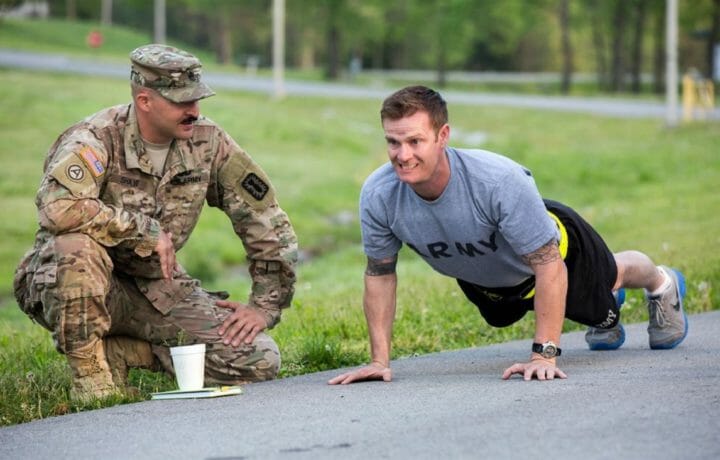
The U.S. Army employs the Army Fitness Test (AFT), which features a 3-repetition maximum deadlift, hand-release push-ups, a sprint-drag-carry, a plank, and a 2-mile run. Combat specialties may also require an additional Combat Field Test.
The United States Marine Corps currently requires an annual Physical Fitness Test (PFT) consisting of pull-ups (or push-ups), a plank, and a timed 3-mile run, alongside a separate Combat Fitness Test (CFT).
The U.S. Navy and United States Coast Guard evaluate members using push-ups, sit-ups (or modified core exercises), and a 1.5-mile timed run or a 500-yard swim. The Coast Guard rolled out new physical fitness testing requirements in May.
The U.S. Air Force and U.S. Space Force now require members to use push-ups, core stability measures like planks or sit-ups, and aerobic assessments like a 1.5-mile or 2-mile run (or the HAMR shuttle run).
Hicks’ app could help all servicemembers ensure they’re meeting the specific goals.


