In May, the United States Navy’s newest and largest nuclear-powered aircraft carrier, the USS Gerald R. Ford (CVN-78), returned to Naval Station Norfolk, VA, after being deployed for 326 days, or approximately 11 months. It marked the longest deployment for a U.S. aircraft carrier strike group (CSG) since the Vietnam War, and the longest-ever deployment of a nuclear-powered U.S. Navy warship.
The U.S. Navy’s Nimitz-class supercarrier USS Abraham Lincoln (CVN-72), now on its way back to Naval Base San Diego, California, also set a record of more than 250 days at sea without a port call, with much of its deployment in the Middle East.
It won’t just be the sailors who are seeing such lengthy time away from home. It was reported on Sunday that elements of the United States Army’s famed 82nd Airborne Division, “All American,” will be deployed into next year due to “operational requirements.”
“We now know that operational requirements will keep the Division Headquarters and elements of DIVARTY, ADSB, 3-4 ADA, and 307th Division Engineer Battalion forward for twelve total months,” Maj. Gen. Brandon R. Tegtmeier, commanding officer of the division, wrote in a letter to military families shared on an unofficial subreddit board. “Paratroopers of 1st BCT and the CAB will serve forward for up to twelve months in total as well. We do not share that lightly, and we understand that a longer tour weighs heavily on every household, including our own.”
Approximately 2,000 soldiers from the unit deployed to the United States Central Command’s (CENTCOM’s) area of responsibility in March as part of the U.S. military’s build-up of forces in the Middle East.
“They were part of a surge in infantry forces into the region after the war started, alongside members of a Marine expeditionary unit,” Task & Purpose reported. “They were sent as the U.S. military refused to rule out ground operations against Iran, although that has yet to happen.”
All-Americans in Israel
The Pentagon has not indicated the exact whereabouts of ground personnel in the Middle East due to operational security (OPSECT) concerns. However, in June, Military.com reported that many of the deployed 82nd Airborne Division personnel headed to Israel.
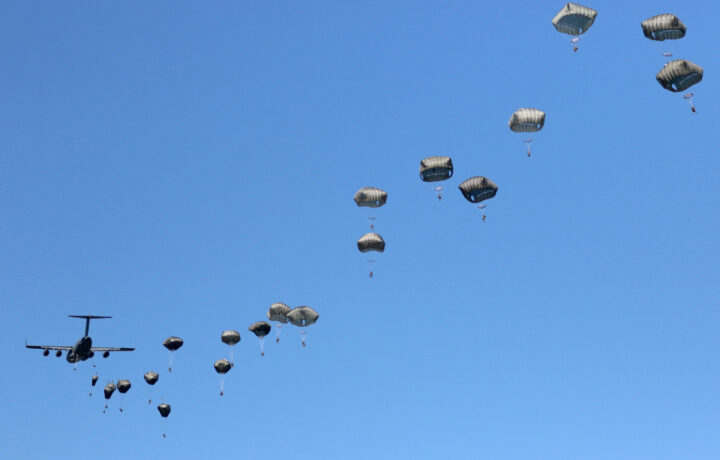
The division serves as the United States Army’s primary rapid-response force and is often one of the first likely to deploy to a crisis overseas. As the core of the U.S. Army’s Immediate Response Force, the unit can be employed to seize airfields, evacuate citizens, and conduct combat operations on short notice.
About The All-Americans
Although the division remains stationed out of Fort Bragg, North Carolina, today it acquired the nickname because its original members came from all 48 states when it organized on August 5, 1917, at Camp Gordon, Georgia. It was originally an infantry division and was deployed to the Western Front in France and fought in major campaigns, including the Battle of Saint-Mihiel and the grueling Meuse-Argonne Offensive in 1918.
Medal of Honor recipient Alvin C. York served in the 82nd Division’s 328th Infantry Regiment during the Meuse-Argonne Offensive. After the war, the division returned to the United States and was deactivated in May 1919.
The unit was later reactivated and converted into the U.S. Army’s first airborne division in August 1942 during World War II, and it participated in historic parachute drops during the invasion of Sicily, Italy; D-Day in Normandy, France; and in Operation Market Garden in the Netherlands. Units from the division also took part in the Battle of the Bulge in Belgium at the end of 1944, where the soldiers fought in sub-zero winter conditions, holding the critical northern shoulder of the American defensive line.
Soldiers serving with the 82nd are known distinctively for their maroon berets and their red/white/blue arm patches. The unit’s square insignia, approved in 1918, features an arched red banner embroidered with the letters “AA” on a blue background. An Airborne tab was added to the top when the sleeve insignia was redesigned and authorized in August 1942.
The berets serve as a traditional symbol of the elite airborne status, and it also honors the World War II ties to the British paratroopers who first wore such distinctive headgear. The 509th Parachute Infantry Regiment received honorary membership in the British First Airborne Corps, and its personnel were authorized to wear the maroon beret for the remainder of the conflict.
The division brought back the beret in 1973 to boost morale following the Vietnam War, although it was an unofficial uniform item for several years. Today, earning and donning the maroon beret is a deeply symbolic and significant milestone for a soldier in the 82nd Airborne Division, representing acceptance into an elite paratrooper culture.


