In his role as the “Commander-in-Chief,” President Donald Trump is older than anyone he leads in the United States Armed Forces. Trump turned 80 in June, but the presidency faces no age restrictions.
However, under U.S. federal law, 10 U.S. Code § 1253, United States military general and flag officers must generally retire the month after their 64th birthday.
There are exceptions to the rule.
The Secretary of War can defer a four-star officer’s retirement until age 66, and the president can even defer it until age 68.
By contrast, there is no age restriction for the Secretary of War (formerly Secretary of Defense), and Donald Rumsfeld has the distinction of being the oldest person to serve in that role under President George W. Bush, as he was 74 when he stepped down. It is noteworthy that Rumsfeld was also the youngest Secretary of Defense, having served in that role from 1975 to 1977 under President Gerald Ford. He was just 43 when he was appointed to the position.
Pete Hegseth, the current top civilian Pentagon official, is 46 and far younger than many of the U.S. military platforms. In 1980, the same year Secretary Hegseth was born, the United States military adopted the M1 Abrams main battle tank (MBT). That was after both the General Dynamics (now Boeing) F-15 Eagle and the McDonnell Douglas (now Lockheed Martin) F-16 Fighting Falcon entered service with the United States Air Force.
Still, the M1 Abrams, F-15, and F-16 are far from the oldest platforms the U.S. Armed Forces operate.
The Old Warships
The United States Navy’s Nimitz-class aircraft carriers are reaching the end of their 50-year service lives. The lead vessel of the class, the USS Nimitz (CVN-68), was commissioned in May 1975, just months before the aforementioned Rumsfeld became Secretary of Defense.
The nuclear-powered supercarrier is now on track to be decommissioned next March, after nearly 52 years in service with the fleet.
However, the oldest active aircraft carrier isn’t the oldest active warship.
Technically, the frigate USS Constitution, now preserved as a museum ship in Boston, was commissioned in 1798 and remains in service. So too does the Banner-class spy ship USS Pueblo (AGER-2), which was captured by North Korea in 1967 and never retired from the U.S. Navy rolls.
However, the oldest active warship is actually the USS Blue Ridge (LCC-19), the lead vessel of the U.S. Navy’s class of command ships. Commissioned in 1970, LCC-19 was present during the evacuation of Saigon, Vietnam, in April 1975. Current plans call for the warship to remain in service until 2039.
Even Older Aircraft
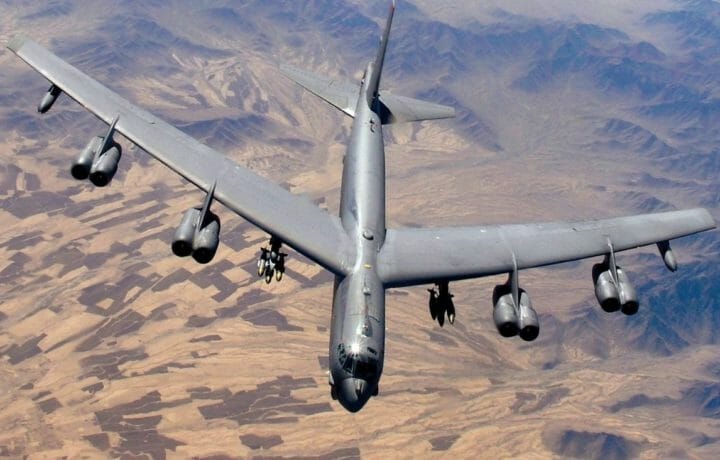
By the time that CVN-68 was commissioned, the United States Air Force was exploring replacement options for the Boeing B-52 Stratofortress, which made its maiden flight in 1952 and entered service in 1955. A total of 744 B-52s were built between 1952 and 1962, and there are currently 76 of the Cold War-era bombers still flying.
The U.S. Air Force is upgrading the remaining fleet, with the bombers receiving new engines and internal systems, to ensure the remaining fleet can remain operational until the early 2050s or later.
It isn’t just the B-52 that has been in service for more than seven decades, as the Boeing KC-135 Stratotanker also marked its 70th anniversary at Altus Air Force Base (AFB), Oklahoma, last month.
Although the United States Air Force’s bombers are what get the headlines for striking an adversary, the missions couldn’t be accomplished without the aerial refuelers, and the Boeing KC-135 Stratotanker does the job better than any other aircraft in service today. It can carry up to 200,000 pounds (90,719 kg) of fuel to thirsty warbirds, pumping 6,500 pounds of fuel per minute. The KC-135 uses a dual refueling system that includes a rigid “flying boom” for most U.S. Air Force jets and a trailing basket (or drogue) for U.S. Navy, USMC, and allied aircraft.
“The KC-135 is a true power-projection platform that allows us to overcome the tyranny of distance,” said retired Gen. Carlton D. Everhart II, former Air Mobility Command commander. “It remains essential to our global mobility, and its enduring legacy is a testament to the thousands of Airmen who have maintained and flown it over the decades.”
Individual Stratotankers are now being retired, replaced on a one-for-one basis as the newer KC-46 Pegasus enters service. Still, as with the B-52, current plans call for the KC-135 to remain the flying fuel station into the 2040s.
More Than The ARMY’S Abrams
As noted, the U.S. Army’s M1 Abrams is far from its oldest platform. That honor goes to the Boeing CH-47 Chinook twin-engine heavy-lift helicopter, which was officially adopted in August 1962. The rotary aircraft has been steadily updated, and the CH-47F employs a digital cockpit, powerful Honeywell T55 engines, and a strengthened airframe to handle extreme combat and high-altitude operations.
The Chinook is likely to remain flying even longer than the B-52, likely into the 2060s and beyond.
The Oldest Active Platform – The Browning M2
Within the United States military, the Browning M2 .50 caliber heavy machine gun remains the longest-serving weapon. Introduced in 1933, its development can be traced back to 1918 when famed gun designer John Browning sought to “supersize” his M1917 and later M1919 .30 caliber machine guns.
While working with the Winchester Arms Company, Browning helped develop the new .50 caliber BMG (Browning Machine Gun Round), which remains in use around the world today. After Browning died in 1926, development of the heavy machine gun continued.
Variations of the M2 saw use with every branch of the U.S. military in World War II, and it has since become one of the most widely used and longest-serving heavy machine guns in military history. It isn’t expected to be retired anytime soon, with gun experts arguing that it is impossible to improve on perfection!


