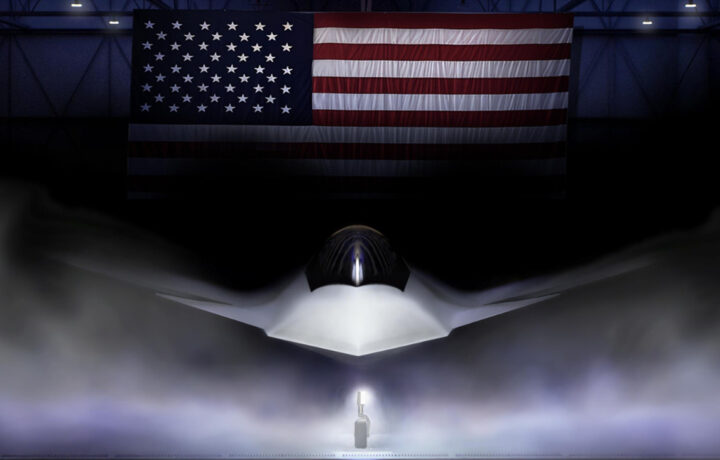
According to the United States Air Force’s official for major acquisition programs, work on the service’s sixth-generation fighter aircraft is progressing. Gen. Dale White, director of Critical Major Weapons Systems at the Pentagon and the first direct reporting portfolio manager (DRPM) for the United States Department of War, said in remarks this week that the service is working with aerospace giant Boeing to finalize the design elements of the F-47, the centerpiece system of systems of the U.S. Air Force’s Next Generation Air Dominance (NGAD) program.
“We are absolutely on [track] to be able to hit the mark of flying within this administration; we see no issues in front of us right now,” White said at the Air and Space Forces Association’s Air, Space & Cyber Conference. “As long as the team continues to execute … [we] will be on time [and] on target with that.”
White added that the program benefited from “many, many years in tech maturation and risk reduction,” and that the F-47 remains on track to make its maiden flight within two years. Several milestones still need to be accomplished in the meantime, the general noted.
Boeing was officially selected to build the fighter for the United States in March 2025, beating out a competing offering from rival Lockheed Martin. Another initial competitor for the contract, Northrop Grumman, had withdrawn from the NGAD program in 2023 to focus on the B-21 Raider, the U.S. Air Force’s next-generation stealth bomber.
President Donald Trump and Secretary of War Pete Hegseth officially announced that Boeing was awarded the contract, and also confirmed that the aircraft would be designated the F-47 – a possible nod to Trump being the 47th president.
Programs Are On Track
Just last month, it was announced that the F-47 and the B-21 Raider remain on track.
The F-47 will replace the aging Lockheed Martin F-22; the U.S. Air Force has indicated it would purchase at least 185 to 200 of the aircraft to make up for the Raptor fleet’s operational size. Original plans for the F-22 called for as many as 750 air superiority fighters, but that was significantly scaled back because of high costs, the end of the Cold War, and a lack of a clear mission.
The B-21 program is now in its low-rate initial production, and the first bombers are set to arrive at Ellsworth Air Force Base (AFB), SD, in 2027 – with the base being the initial primary operating base and the site of the Formal Training Unit for the Raider. Upgrades to the advanced bomber have required an estimated $2 billion investment in specialized facilities, secure communications, and support infrastructure.
The Northrop Grumman bomber will replace the aging fleet of Rockwell B-1B Lancers and Northrop B-2 Spirit bombers beginning in the late 2030s. Original plans called for retiring the older aircraft, but concerns about a capability gap mean both legacy bombers will undergo modernizations to keep flying until the full fleet of Raiders enters service.
Enter the Sixth-Generation Aircraft
The B-21 Raider has been described as the first sixth-generation aircraft, meaning the U.S. Air Force could operate two next-generation warplanes in the coming decade. However, the United States Navy has also sought to field a sixth-generation carrier-based fighter to replace its legacy Boeing-made F/A-18E/F Super Hornet.
Since early 2025, speculation has suggested the U.S. Navy would announce the contract award for that aircraft, currently known as the F/A-XX. Boeing and Northrop Grumman are the two companies competing for it after Lockheed Martin was eliminated from the U.S. Navy’s competition just weeks before the F-47 contract was announced.
Lockheed Martin has since suggested it would develop a “Ferrari” variant of its F-35 Lightning II, incorporating technology developed for the NGAD program. It may also include technology from the F/A-XX prototypes. Although it wouldn’t be a true sixth-generation fighter, Lockheed Martin CEO Jim Taiclet suggested it could deliver 80% of sixth-generation capabilities at half the cost, and thus be a “fifth-generation-plus” fighter as a bridge to the F-47.
Can The Pentagon Manage Two Sixth-Generation Fighters?
One reason the Pentagon hasn’t awarded a contract for the U.S. Navy’s F/A-XX may be concerns about managing two next-generation fighter programs at the same time. However, White downplayed any industrial base concerns.
“What we’re having to do is at some point we’re having to make some trade space in between some of these,” White said. “Right now, I see Boeing making smart investments. They have a lot of CAPEX they’re pouring in, but we have to get through the process of the design piece, getting that completed and closed out, then we’ll hit some major milestones with things like flight tests and software.”
There has been speculation that Boeing’s F/A-XX offering could be a “navalized” variant of the F-47, as analysts have noted similarities to the company’s renderings of the F-47 and its F/A-XX prototype.
Boeing has also downplayed concerns that it can’t handle developing and producing both fighters, even as it manufactures the F-15E/A Eagle II, a modernized variant of the Cold War-era fourth-generation air superiority fighter for the U.S. Air Force, and produces the final F/A-18 Super Hornets for the U.S. Navy.


