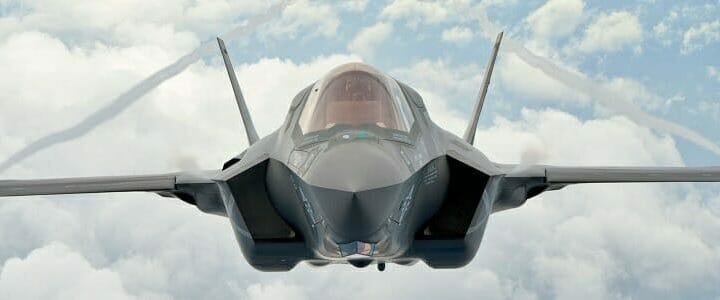
The Lockheed Martin F-35 Lightning II is one of the world’s most advanced aircraft, and significant effort has gone into ensuring potential adversaries can’t obtain details about it. Yet this month, some key components that could reveal details about the fifth-generation fighter’s stealth coating were misrouted and are now in the possession of the Chinese government.
Earlier this week, news circulated that a shipment of the cockpit canopy and weapons-bay door from Australia to the United States was misrouted to Hong Kong. It was akin to handing over classified details to Beijing, and it reportedly happened after a logistics company previously involved in F-35 freight projects partnered with a firm the United States had blacklisted for its ties to the Chinese military.
Damaged Parts Were Rerouted
According to a report from Politico.com earlier this week, the parts were being shipped from Australia to the United States for repairs or possible disposal. For reasons that remain unclear, the shipment arrived in South Korea and was then misrouted to Hong Kong. The Chinese government subsequently took possession of the parts, and as of Thursday, had not returned them to the United States.
The timing is notable as it coincided with Chinese President Xi Jinping’s arrival in the United States on Wednesday for a three-day state visit with President Donald Trump. It isn’t known whether the two heads of state will discuss the matter.
What Was in the Shipment?
The exact details of the shipment haven’t been fully disclosed. Still, it reportedly included a canopy, the cover for the aircraft’s cockpit, and other reports have suggested the shipment also included a weapons-bay door. Both components contain the “stealth technology that only the U.S. and its allies have access to,” Politico.com reported, citing two people familiar with the matter.
Security experts have warned that the issue isn’t the components, but the coatings and other materials.
The F-35 canopy, in particular, is made from a single stretched acrylic piece coated with highly classified, restricted radar-absorbing materials (RAM) that help alter the radar cross-section of the stealth fighter. The United States tightly controls the technical data and intellectual property (IP) required to apply or even fix the low-observable coating. A key concern is that a potential adversary – in this case China – could study the components and possibly even “reverse-engineer the prized technology.”
Shipments Get Lost – But Nothing Like This
The question after this incident is: if the parts contain such secrets, why weren’t they shipped by U.S. or Australian military transport? The short answer is that F-35 program parts are already routinely routed through commercial supply chains and third-party freight intermediaries managed by Lockheed Martin.
One issue is that the F-35 global enterprise spans numerous international partner nations, including Australia, Japan, and European allies, with regional maintenance hubs. For routine, non-urgent, or unserviceable component transfers, the program uses established commercial freight forwarders and standard global shipping lanes.
Prime contractor Lockheed Martin and its subcontractors oversee the day-to-day transport of repairable or unserviceable parts back to depots or facilities, utilizing commercial logistics networks rather than tying up limited U.S. military airlift and sealift assets.
It is simply more efficient, even if the parts are considered sensitive in nature.
The Chinese Connection
According to Australian Defence Magazine (ADM), CEVA Logistics is the primary logistics provider for Lockheed Martin, and it maintains distribution contracts with international shipments. The company seemed unaware of the missing parts.
“CEVA Logistics has not been contacted by any customer, regulator, audit agency, or government authority concerning these alleged activities. We are not aware of any facts indicating that CEVA Logistics had any involvement in the matter described,” CEVA Logistics told ADM in a statement.
The logistics firm, a wholly owned subsidiary of CMA CGM Group, a French logistics company, operates storage facilities at RAAF Base Williamtown, where Australian F-35s are serviced. It hasn’t been confirmed whether the missing components were shipped out of the base.
ADM also reported that one-third of CMA CGM Group’s operating revenue comes from China, and last month it signed a strategic framework agreement with China Communications Construction Company (CCCC), a Chinese government-owned firm. The U.S. government has listed CCCC as a Chinese military company since 2021 for its role in building military outposts in the South China Sea.
It hasn’t been confirmed that CEVA Logistics even oversaw the shipment, but its ties to Beijing should raise serious concerns.
Washington Has Sought to Protect F-35 Secrets
Security concerns about the F-35 Lightning II led NATO member Türkiye (Turkey) to be expelled from the program in 2018 after Ankara closed a deal with Russia to acquire the S-400 Triumf air defense system. Washington and NATO leadership warned that the F-35 isn’t compatible with the Russian-made anti-aircraft system and that operating both would threaten the aircraft’s security.
Türkiye has sought to rejoin the F-35 Joint Strike Fighter program, and has begun discussions that could see it sell the S-400 batteries, which it never activated.
Another ongoing concern is that, in 2023, the Government Accountability Office warned in a report that more than one million spare parts for the F-35 went missing over five years. The parts were worth millions of dollars, but more worrisome is that shortages of some parts have affected the mission readiness rates of the fifth-generation multirole fighter.


