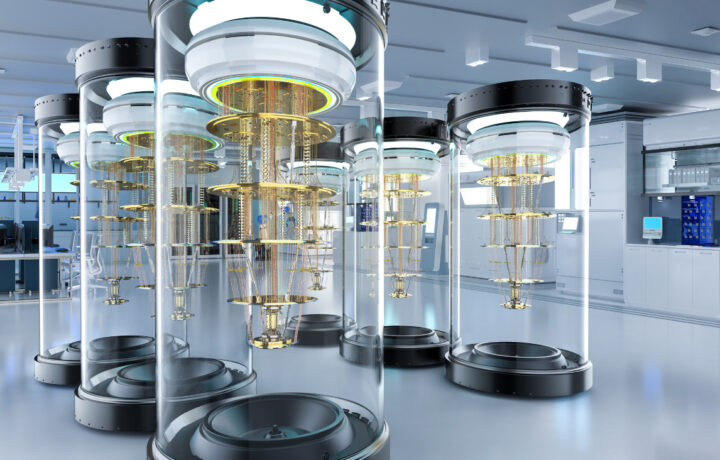
Quantum computing is a rapidly developing technology that uses the rules of quantum physics to solve complex problems much faster than normal computers. It isn’t the computing power that is expanding. A series of quantum computing centers has opened across the country to support the transition to quantum computing.
This month, aerospace giant Lockheed Martin announced at the Quantum World Congress in College Park, MD, that it is accelerating its quantum development with its new Quantum Innovation Center (QuIC), which it described as a unified hub to grow quantum research, development, and prototypes for critical national security missions of the future.
The QuIC will operate as a centralized, unified virtual and collaborative hub rather than a single standalone physical brick-and-mortar headquarters. It will empower the company to deliver quantum technology more quickly to the next generation of Lockheed Martin systems.
“The QuIC represents our ongoing commitment to develop and integrate the best of American technology in quantum to help ensure an advantage for our nation and allies in deterring future threats,” said Sarah Hiza, senior vice president of Technology and Innovation at Lockheed Martin. “The QuIC builds on our heritage of doing hard things with speed at scale, and is modeled after our 20 years of success developing artificial intelligence for national security through our Lockheed Martin AI Center, or LAIC.”
Quantum Efforts Around the Capital Region
The Lockheed Martin QuIC is just one of several quantum initiatives already underway. In January 2025, the state of Maryland and the University of Maryland announced a $1 billion “Capital of Quantum” program to establish the Old Line State as the “Silicon Valley” of the quantum computing industry. That proposed initiative with IonQ, a developer of quantum computing and networking technologies, was to fuel the growing quantum economy of the United States capital region.
The investment included incentives to help IonQ grow its corporate headquarters into a 100,000-square-foot facility with a data center, laboratories, and office space within the Discovery District at the University of Maryland (UMD), with the company doubling its workforce to at least 250 people in the region over the next five years.
Last week, Microsoft Quantum announced that it had opened a new quantum research facility with industry partners and UMD. It comes just a year after the software firm committed to building a quantum research center in Maryland, and it is now open in the Discovery District Maryland.
“With support from Governor Wes Moore’s Capital of Quantum Initiative, Maryland acquired and renovated the Discovery Center. Microsoft then worked with UMD and the Capital of Quantum Initiative to design our newest 15,000-square-foot quantum research center within that space,” Microsoft explained.
The company added that over the past year, the collaboration built dedicated areas for Microsoft’s proprietary research; space for DARPA’s topological system; and future prototypes, labs, and offices for partner companies; and a community-focused training laboratory. “This research center is capable of supporting quantum research, partner integration, workforce development, and government engagement.”
South of Washington, George Mason University (GMU) is also seeking to transform Virginia into a hub for quantum computing. In June, the university launched a new master of science in quantum science and engineering, the first program of its kind in the Old Dominion State.
“Designed to meet growing workforce demand in one of the world’s fastest-evolving technology sectors, the program prepares students to apply quantum technologies across disciplines including mathematics, physics, computing, engineering, cybersecurity, chemistry, and biology,” the school explained.
The degree was also developed in direct response to industry demand for a workforce that can bridge traditional disciplines with emerging quantum technologies.
“When we talked to industry, they told us they want experts in STEM fields who also have knowledge of quantum science and engineering,” said Jessica Rosenberg, professor in the Department of Physics and Astronomy and director of education for the Quantum Science and Engineering Center.
FIU Investment
In the Sunshine State, Florida International University (FIU) moved forward on its pledge to bring a new quantum computer to its campus to support research in environmental sustainability, drug development and security. By the end of next year, students and researchers at FIU will have access to advanced quantum computing hardware via a partnership with IonQ.
FIU will receive the Superion 256, a sixth-generation quantum computing platform launched by IonQ, which features a 256-qubit quantum processing unit (QPU). The system serves as the company’s foundational architecture for mass-manufacturable, fault-tolerant quantum computers.
“This key partnership with Florida International University represents a major milestone in expanding direct physical access to IonQ’s industry-leading, high-performance quantum hardware,” said Niccolo de Masi, Chairman and CEO of IonQ. “By housing our Superion 256 system directly on campus, FIU will lead the region in quantum research and training.”
The Superion 256 will allow FIU to accelerate research in three key areas: sustainability, security, and healthcare. Environmental researchers can focus on new materials and power supply; cybersecurity researchers can study encryption models to address potential threats in the quantum age; and health researchers can advance drug development.
“This partnership provides our more than 1,800 faculty members, 55,000 students, and countless industry partners with direct access to one of the most advanced computing architectures in the world,” FIU President Jeanette Nuñez said in a public statement. “It also puts the university in a privileged position to engage with key federal agencies to advance recently launched quantum initiatives that address national needs in the areas of sensing, cryptography, commercialization, and workforce development.”


