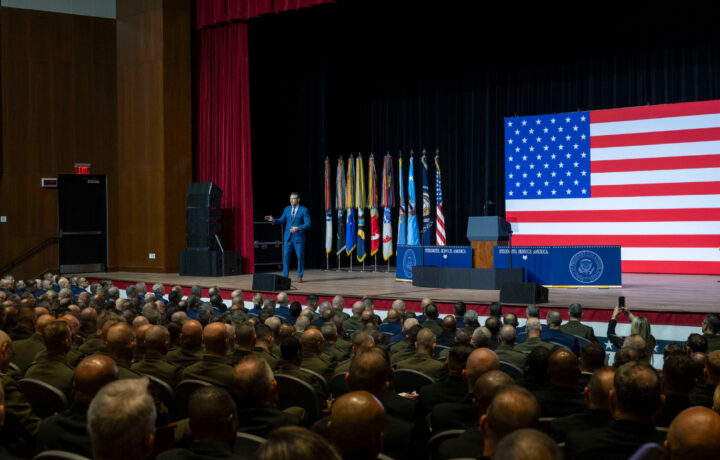
The branding has the sound of a TV reality series. Still, Secretary of War Pete Hegseth was serious on Wednesday when he called for a new nationwide competition among the states to host the “Next Great American Base” for the United States Armed Forces.
“We’re calling on every governor in the country and adjutant general, every tag across this great republic, to step up to the plate and bring us their best sales pitch,” Hegseth said during his “State of the Force” speech at Quantico, Va.
“If your state wants the honor of hosting 15,000 to 25,000 of America’s great troops, show us why and how you’re going to do it, cutting through the red tape, offering up the land, and rolling out the red carpet for our military families,” Hegseth added.
Not a Soulless Government Installation
According to the Pentagon, the project seeks to build a new military base that “rejects the legacy playbook of decaying military facilities,” and instead seeks to employ this bold initiative to build “a premier, world-class power projection platform from the ground up.”
No single branch of service was singled out, and instead, the future facility will be a “state-of-the-art installation” able to host elite troops across hundreds of thousands of acres. In addition, the project calls for it to be engineered to operate completely off the commercial grid, instead featuring independent power generation, autonomous systems, and advanced air defenses.
How the power generation will be accomplished isn’t clear. Still, the United States military has been exploring how microreactors can provide reliable power without relying on the local energy grid or trucking fuel to remote bases.
The primary driver is the U.S. Army’s Janus Program – a joint Army-DOE venture tasked with deploying commercially owned and operated advanced microreactors across domestic military installations. Under this framework, the Army expects to award up to $2.2 billion between fiscal years 2027 and 2031, aiming to bring more than 20 microreactors online.
A Big Beautiful Base
Besides the size of the base, location could factor in, not for strategic reasons but for its aesthetics. “In line with the President’s executive orders on Beautiful Civic Architecture, the base will feature timeless, classical designs, providing first-class facilities,” the Pentagon suggested in its memorandum announcing Hegseth’s new initiatives.
Current military bases vary widely in appearance.
Some facilities feature stunning natural landscapes, such as Marine Corps Base Hawaii, located on Kaneohe Bay. Fort Belvoir in Virginia is also noted for its manicured look, modern facilities, and resemblance to a peaceful gated community or small town.
Hegseth called for the Next Great American Base to feature first-class barracks, world-class training facilities, and top-tier housing, school, and childcare facilities. The cost hasn’t been addressed.
Still, the selection process is meant to be transparent.
“Rather than backroom deals, the Department is launching a transparent, merit-based competition, inviting governors and adjutants general to pitch their plans directly to senior leadership,” the Pentagon explained. “The state that cuts the most red tape and offers the best package of land and support will win the historic honor of hosting the most lethal, modern, and beautiful military installation on the planet.”
Governors and other state officials were invited to come to the Pentagon to pitch directly to Secretary Hegseth, Steve Feinberg, the Pentagon’s deputy secretary, and General Dan Caine, chair of the Joint Chiefs of Staff. President Trump may also be involved in the selection process.
“This project is about doing something bold, beautiful, and world-class for the great Americans who wear our Nation’s uniform,” Hegseth stated in his directive.
Approximately 335 Domestic Military Installations
There are currently approximately 335 domestic military installations across all 50 states and Washington, D.C. Still, more than a third of all domestic bases are located in just six states: California, Virginia, Texas, Florida, Maryland, and New York. California leads the country with 34 major installations.
Carlisle Barracks in Pennsylvania is the oldest continuously used military site in the United States, established in 1757 during the French and Indian Wars by the British Army. It now houses the United States Army War College. The United States Military Academy at West Point, which has operated since 1802, is the oldest continuously occupied regular U.S. Army post. The Norfolk Naval Shipyard is the country’s oldest naval facility, established in 1767.
Naval Station Everett in Washington State, which opened in 1994 and is home to several U.S. Navy guided-missile destroyers and U.S. Coast Guard cutters, is the newest U.S. military base. Although it was selected from 13 ports, including a site near the Port of Seattle, the decision to build the base in Everett was opposed by residents and the longshoremen’s union, as civilian dockworkers aren’t used at military bases and due to fears that it would add additional military warship traffic, disincentivizing commercial cargo traffic at the adjacent commercial Port of Everett. However, voters approved the base’s construction in a 1984 ballot measure.


