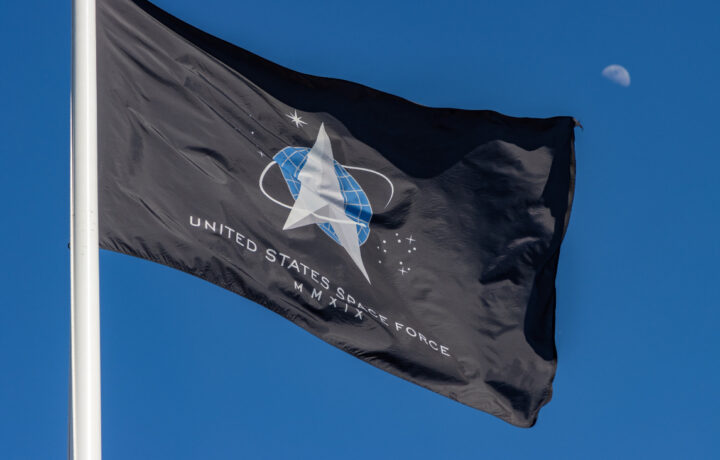
Last week, the sixth and newest branch of the United States Armed Forces conducted a second mystery launch from California. On November 11, a SpaceX Falcon 9 rocket (Booster 1103) flew for the seventh time from Space Launch Complex 4E (SLC-4E) at Vandenberg Space Force Base in California. It landed on the Of Course I Still Love You (OCISLY) autonomous spaceport droneship in the Pacific Ocean about 8.5 minutes after liftoff.
That mission followed the classified SpaceX USSF-432 mission, which lifted off from the same Vandenberg pad five days earlier, on November 6, 2026.
Industry observers have suggested that the two back-to-back rapid-fire launches may have carried batches of SpaceX’s Starshield satellites designed for the U.S. Space Force’s space-based sensing and targeting network.
The spaceport drone ship was named after the fictional sentient spaceship from Iain M. Banks’ sci-fi novel The Player of Games, part of The Culture series. Built in 2015 on a modified Marmac 304 barge, originally operated on the East Coast near Port Canaveral, it hosted SpaceX’s first-ever successful drone ship booster landing at sea during the CRS-8 mission in April 2016.
It was moved to the Pacific Ocean in June 2021. The OCISLY is currently based at the Port of Long Beach, California, where it conducts Falcon 9 polar and sun-synchronous orbit launches from Vandenberg SFB.
It is equipped with four azimuth thrusters for automated station-keeping, Starlink connectivity, and the Octagrabber robot to secure the booster after touchdown.
Addressing The Electromagnetic Warfare Threat
The United States Space Force also confirmed that it is modernizing its electromagnetic warfare (EW) command and control (C2) architecture through the Space Electromagnetic Warfare Operating Location (SEWOL) program. The newest branch of the U.S. military remains focused on its core mission: protecting U.S. and allied interests in, from, and to space; ensuring freedom of action in the space domain; and deterring aggression.
As part of the new initiative, it will replace its legacy tools with a cloud-native C2 application to unify space EW, where the new command will provide a unified operating picture with a common data repository and near-real-time visibility, and end-to-end tactical infrastructure for mission planning, automated/dynamic tasking, and monitoring.
This will allow the U.S. Space Force to transition from manpower-heavy, hardware-collocated setups to lean teams managing hundreds of global systems concurrently.
The development of the SEWOL program will be supported by three new agreements that will deliver a single cloud-native C2 application that will better align current space EW applications. It will also give operators access to a unified Common Operating Picture (COP) to orchestrate hundreds of remote EW systems, drastically reducing crew workload and accelerating decision-making.
Under Phase I, Space Systems Command (SSC) and Combat Forces Command (CFC) collaborated to award a three-month competitive prototyping phase valued at approximately $10 million to Anduril Industries, Booz Allen Hamilton, and Peerless Technologies Corporation. The contracts were awarded via a Space Enterprise Consortium Other Transaction Authority (OTA) and are part of a $60 million prototype program that seeks to modernize the country’s Space EW capabilities.
“Our SEWOL program leads the Space Force in acquiring modern, software-defined mission systems,” said U.S. Space Force Col. Bryon McClain, acting Portfolio Acquisition Executive for Space Combat Power. “By leveraging Other Transactions and a competitive prototyping phase, we break vendor lock and harness the full power of commercial innovation. Additionally, common interfaces and Modular Open Systems Approach (MOSA) standardization ensure we are building a system that is as agile as the threats it is designed to counter. This is a strategic win for the warfighter and a clear signal that we are serious about acquisition reform.”
The Space Force acknowledged that the SEWOL initiative made an agile pivot to the Software Acquisition Pathway (SWP), a modern approach designed to deliver capabilities to the warfighter at the speed of relevance. Under that strategy, it is moving away from traditional, single-vendor contracts and toward a competitive “fly-before-you-buy” model.
“In modern warfare, software is the decisive weapon, and we must be able to change our tactics at the speed of the threat,” explained U.S. Space Force Col. Angelo Fernandez, commander of CFC’s Mission Delta 3 – Space Electromagnetic Warfare. “By transitioning SEWOL to an agile software pathway, we are putting our Guardians directly in the driver’s seat alongside developers. This ensures that the capabilities we field aren’t just fast to deliver but are purpose-built to survive and win in a highly contested electromagnetic spectrum.”
The Space Systems Command (SSC) is the U.S. Space Force field command responsible for acquiring, developing, and delivering resilient capabilities to outpace emerging threats and protect the country’s strategic advantage in, from, and to space. It manages an approximately $15.6 billion annual space acquisition budget for the Department of War, working with joint forces, industry partners, government agencies, academia, and allied nations. That includes buying and building resilient satellite constellations and warfighting capabilities. It also controls and maintains U.S. space launch ranges—including Space Launch Delta 30 at Vandenberg Space Force Base, California, and Space Launch Delta 45 at Patrick Space Force Base, Florida – and handles military and commercial rocket launches.
The Combat Forces Command (CFC) is the U.S. Space Force’s Service Force Provider, responsible for generating, presenting, and sustaining combat-ready intelligence, cyber, space, and support forces. It evolved from the historic Air Force Space Command and is now headquartered at Peterson Space Force Base, Colorado, comprising roughly 12,000 personnel distributed across Deltas, squadrons, and units of action.
Minimum Viable Product
The selected vendors will have a three-month Phase I period to develop a Minimum Viable Product (MVP), a functional prototype of the core SEWOL framework, including the mission applications and Software Development Kit (SDK). The Space Force confirmed that each MVP will be evaluated in a hands-on environment with government technical experts and operational users.
“This is not a paper-based competition; we are paying these vendors to build working software so we can see what their teams are truly capable of,” added Maj. Dennis’ Nomad’ Sieber, SEWOL program manager. “At the end of three months, we will conduct a formal down-select to a single vendor that will proceed to build the first operational version of the system. This process ensures that by the time we bend metal, or in our case, write production code, we have already proven the architecture is sound and have the right long-term partner for the mission.”


