“If Cuthbert is giving you difficulty, have him eliminated.” – SOE Headquarters message to Virginia Hall, November 1942
The sardines were the key. Literally.
In the summer of 1942, a dozen agents from Great Britain’s Special Operations Executive (SOE) sat behind the wire at Mauzac, an internment camp near Bergerac in southwestern France. They’d been captured the previous October after walking into a police trap in Marseille – a meet-up that Virginia Hall sensed was wrong and refused to attend. Now she was one of the few SOE agents still at large in wartime France, the only one with a working line to London.
London’s advice was predictable: extraction was too risky. Hall ignored it.
Her inside man was a woman. Gaby Bloch, the wife of prisoner Jean-Pierre Bloch, visited Mauzac with parcels of food. Tucked among them were tins of sardines and a few small tools. Inside the camp, wireless operator Georges Bégué fashioned the tin into a key for the barracks door. A sympathetic priest smuggled a radio in under his robes, and Bégué soon transmitted to London from inside the wire. Outside, Hall coordinated everything a good prison break needs: safe houses, transport, friendly support, and two French police uniforms.
On July 15, the men slipped out into the night. They went to ground while the manhunt burned itself out, then made their way to Lyon, where Hall was waiting. Her network moved them over the Pyrenees to Spain and then home to England.
A Woman of Ambition
Virginia Hall was born in Baltimore on April 6, 1906, into a family with money and expectations. She was supposed to marry well and live a traditional life of means, but she had other plans. After Roland Park Country School, she studied at Radcliffe and Barnard, then finished her education in France, Germany, and Austria, learning French, Italian, and German along the way.
Her goal? The Foreign Service.
In 1931, she took a job as a consular clerk at the U.S. Embassy in Warsaw. A few months later, she moved to Smyrna, Turkey. There, in 1933, she tripped while climbing a fence on a bird hunt and shot herself in the left foot. Gangrene set in, and surgeons amputated her leg below the knee. She was fitted with a wooden prosthetic and, with the dark humor that would come to define her, named it Cuthbert.
She kept working – Venice, then Tallinn, Estonia. But in 1937, the State Department rejected her for a diplomatic post under an obscure rule barring people with disabilities. An appeal to President Roosevelt ironically went nowhere. In March 1939, she resigned.
A lesser person might have gone home. Hall went to war.
In February 1940, she became an ambulance driver for the French army. When France fell in June, she slipped into Spain, where a chance conversation with British intelligence officer George Bellows put her in contact with the Special Operations Executive. In April 1941, the woman the State Department wouldn’t trust with a diplomatic post became an agent of Churchill’s secret army.
The Most Dangerous Spy in France
Hall arrived in Vichy France on August 23, 1941, posing as a correspondent for the New York Post. Her cover was perfect: reporters ask questions for a living. She settled in Lyon and became the first woman SOE agent to take up residence in the war-torn country. London didn’t expect her to survive more than a few days.
Over the next fifteen months, she answered to a string of aliases: Marie, Germaine, Dian, and Bookworm among them. Her Heckler network was built around unlikely allies – among them a Lyon gynecologist who became one of her most trusted confidants and a brothel owner whose establishment provided refuge for fugitives and loosened the tongues of more than a few German officers. Hall moved money, radios, supplies, and people. She sheltered downed airmen and fed a constant stream of intelligence to London. When the agents she was assigned to work with proved careless or unreliable, she simply cut them off.
In November 1942, as the Allies landed in North Africa and German forces poured into southern France, Hall slipped away. She took a train to Perpignan, then walked over a snowbound 7,500-foot pass into Spain – on Cuthbert. Before leaving, she radioed that she was fine, but Cuthbert was giving her trouble. London, missing the joke entirely, told her to eliminate him.
SOE refused to send her back. So, she joined the Americans. On March 21, 1944, the Office of Strategic Services landed her by gunboat on the coast of Brittany. Code name: Diane. She dyed her hair gray, filed down her teeth, disguised her limp as an old woman’s shuffle, and passed as a simple peasant while organizing drop zones and arming the Resistance. By July, she was in the Haute-Loire, running covert operations from a barn near Le Chambon-sur-Lignon. She armed and advised three Maquis battalions – roughly 1,500 fighters – who harassed the retreating Germans and helped to force them out of Le Puy-en-Velay.
The Legacy of the Limping Lady
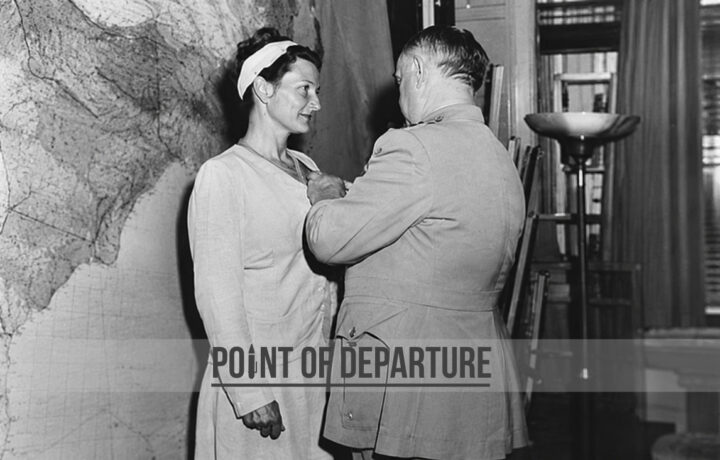
When the war ended, President Harry S. Truman wanted to present Hall with the Distinguished Service Cross in a public ceremony. She declined. She was, she said at the time, “still operational.” OSS chief William Donovan pinned the medal on her in a private ceremony in September 1945. She remains the only civilian woman to receive the award for wartime service.
Her peacetime career was a quieter, more frustrating fight. She joined the CIA in 1947 as one of the first women in the clandestine service. Still, she endured years of desk jobs before eventually becoming the first woman to serve as an operations officer in the agency’s cover action arm. She retired from the agency at the mandatory age of 60 in 1966, never having been given a peacetime overseas posting. Later, the CIA would acknowledge the obstacles that discrimination forced her to contend with.
She died in 1982, without ever granting an interview or writing a memoir.
History has since caught up. Today, CIA officers train at the Virginia Hall Expeditionary Center – a fitting tribute to a woman who wrote much of the very playbook they study. Her career offers five lessons that reach well beyond the bounds of the clandestine services.
1. Trust your instincts.
Hall skipped the meeting in Marseille because something felt wrong. A dozen agents went to prison; she ignored orders and stayed behind to free them. Experience hones intuition. Leaders who have earned theirs should listen closely when it speaks.
2. Refuse to let others define your limits.
The State Department saw a woman with one leg. Hall saw a career that hadn’t yet begun. Every closed door is a detour, not a dead end. Somewhere, another door is opening; you just have to find it.
3. Treat security as a leadership discipline.
Hall cut off careless agents – even ones she was assigned to work for – and when London objected, she told them to, well … bugger off. Protecting your people sometimes means getting sideways with your leadership.
4. Build networks of unlikely allies.
A prisoner’s wife. A priest. A doctor. A brothel owner. Hall’s networks worked because she saw value in people others overlooked. Talent rarely shows up where the org chart says it should.
5. Let the work speak for itself.
Hall turned down a presidential ceremony because the mission came first. She never wrote a memoir. She didn’t have to – her legacy didn’t need one.
London once told Virginia Hall to eliminate Cuthbert. She never did. Instead, she carried him over the Pyrenees, back into occupied France, and into the history books. Proof that the limits others place on us only matter if we let them.


