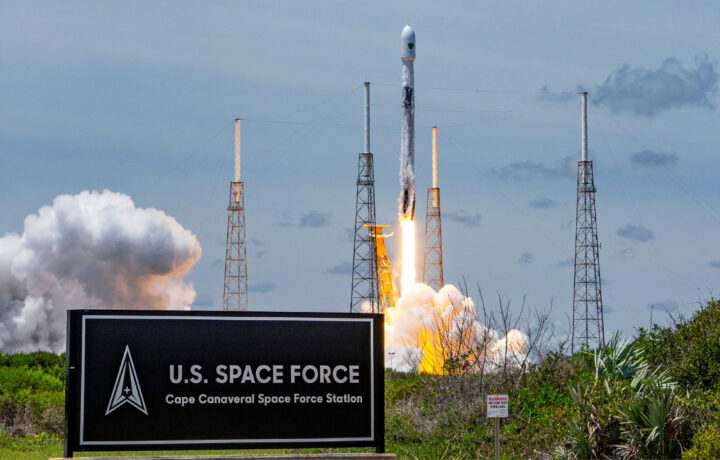
Cape Canaveral Space Force Station’s Space Launch Complex 37 (SLC-37), previously known as Launch Complex 37 (LC-37), was initially built to support the Apollo Program during the early days of the Space Race. It consisted of two launch pads.
LC-37A never saw use; however, LC-37 B hosted Saturn I and Saturn IB launches in the 1960s and, from 2002 to 2024, Delta IV and Delta IV Heavy launches. SLC-37 could soon see new activity, as the privately owned SpaceX received environmental approval from the United States Air Force to develop Starship-Super Heavy mega-rocket launch and landing operations.
The two-stage Starship is more than 400 feet (122 meters) tall. It was designed to be entirely and rapidly reusable, according to Space.com. SpaceX has touted the vehicle as being critical to the U.S. efforts to establish a footprint on the moon and to eventually reach Mars.
Three Launch Pads on the Space Coast
In addition to SLC-37A and SLC-37B at Cape Canaveral Space Force Station, SpaceX will continue to launch Starship from the historic Pad 39A at NASA’s neighboring Kennedy Space Center.
“We’ve received approval to develop Space Launch Complex-37 for Starship operations at Cape Canaveral Space Force Station. Construction has started,” SpaceX announced in a post on social media. “With three launch pads in Florida, Starship will be ready to support America’s national security and Artemis goals as the world’s premiere spaceport continues to evolve to enable airport-like operations.”
SpaceX offered its thanks to the Department of the Air Force, Space Launch Delta 45 (SLD 45), and the U.S. Fish and Wildlife Service for their respective efforts on the environmental review.
SpaceX Marks the Spot at SLC-37
The U.S. Federal Aviation Administration (FAA) and the Department of the Air Force previously approved SpaceX to increase its Falcon 9 launch rate at Cape Canaveral from 50 to 120 per year, following completion of an environmental assessment. The Falcon 9 rockets launch from SLC-40 and SLC-4E at Vandenberg Space Force Base in California.
SLC-37 could now host up to 76 Starship launches and 152 landings every year. The approval was announced in a November 20 Record of Decision (RoD), which completed an environmental review that included public hearings that began in February 2024. There were concerns about the environmental impact of Starship launches, particularly on the Space Coast’s flora and fauna. The Air Force has said it would “implement mitigation measures to avoid, minimize or compensate for” any environmental issues.
Some residents have expressed concern that the launches of the Starship will be louder than the current spacecraft. It would also prompt temporary airspace, maritime, and Playalinda Beach closures for an estimated 60.5 days annually.
“We’re working in partnership with Kennedy Space Center to build out launch complexes for Starship operations,” Space Launch Delta 45 commander Col. Brian Chatman, director of the Eastern Range at Patrick Space Force Base and Cape Canaveral Space Force Station, said during a Nov. 21 media teleconference.
CCSFS Vs. KSC
Although both Cape Canaveral Space Force Station (CCSFS) and Kennedy Space Center (KSC) are located on the Space Coast in the Sunshine State, the former is owned and operated by the United States Space Force, the sixth and newest branch of the U.S. military, whereas KSC is owned and operated by NASA.
CCSFS’s primary function has been military launch, testing, and operations, as well as hosting commercial launches. It is located in the southeastern part of Merritt Island, and it is operated by SLD-45. KSC, located adjacent to Cape Canaveral, is NASA’s primary launch site for manned and unmanned missions.


