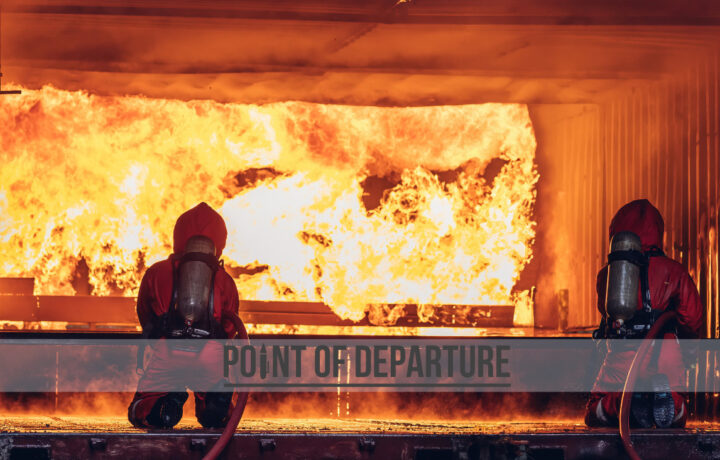
“It’s a living thing, Brian. It breathes, it eats, and it hates. The only way to beat it is to think like it.” – Donald “Shadow” Rimgale, Backdraft
My life is a tale of three careers. While most of that time was spent in uniform, the most formative moments came during my first career in the fire service. There, I learned hard lessons about personal courage, leadership under duress, and resilience. Those lessons served me well as a military leader, where the parallels were ubiquitous.
As a firefighter, your survival is often dependent on situational awareness honed through experience, training, and education. The more time and effort you invest, the sharper your knowledge, skills, and abilities become. You learn to differentiate sounds, identify specific odors, recognize subtle visual cues. You develop mental models that allow you to understand and predict the behavior of a fire, which help to improve decision making when time is not on your side.
Then there’s the backdraft.
The Backdraft
Were it not for Ron Howard’s 1991 film, Backdraft, most people wouldn’t recognize the term. The movie centers on two firefighter brothers – played by Kurt Russel and William Baldwin – caught up in a series of murders masked in suspicious fires: backdrafts.
For a firefighter, a backdraft can be a deadly game changer. When a fire is starved of oxygen, it doesn’t necessarily die. It can linger in a confined space, waiting for the fuel it so desperately needs to continue to burn – in a closet, in a closed room, in an attic. When someone unknowingly gives the fire the oxygen it craves, it explodes from its confinement, causing superheated, unburned fuel gases to ignite violently. Hence the term, backdraft.
A backdraft is a significant learning experience for a firefighter. If you’re fortunate enough to survive, you walk away with more than a few hard-earned lessons. For me, one of those lessons was about leadership.
The Hateful Eight for the narcissistic Leader
In the workplace, the narcissistic leader is the living embodiment of a backdraft. Instead of oxygen, their fuel is attention. According to Psychology Today, they need to be the center of attention and “do so by dominating meetings, presentations, phone conferences, and email” exchanges. Starved of that attention, they can become unpredictable and volatile. And, under the right circumstances, they can explode in outbursts of toxic, unregulated emotion.
Navigating the space around a narcissistic leader requires the same heightened sense of situational awareness that an experienced firefighter uses to read the nuances of a fire. We have to adapt our senses to perceive the subtleties of narcissism at work, learning to recognize and understand the signs when they present themselves.
And there will be signs. Eight of them.
1. Lack of empathy.
Narcissists exhibit a significant deficit in empathy, which stems from self-absorption, grandiosity, and an almost pathological need for admiration. As a result, they struggle to recognize or value the feelings of others.
2. Envy and jealousy.
If you’re a high performer, eventually you will run up against narcissistic envy. High performers possess qualities the narcissist feels they lack, which clash with their inflated self-image. Over time, that deep-seated envy morphs into jealousy, which in turn drives an obsession for control. Hell will follow.
3. Manipulation.
That obsession for control feeds their need for admiration and power over others. Manipulation is their path to control and will range from overt aggression to subtle mind games around the office.
4. Exploitation.
A hallmark of the narcissistic leader, exploitation derives from their lack of empathy and pervasive sense of entitlement. They see others as objects to serve their needs, fuel their ego, and achieve their goals. All without guilt or shame.
5. Gaslighting.
Narcissists have notoriously fragile egos, despite outward appearances. Gaslighting – a form of psychological abuse that causes you to question your own perceptions – is a favored behavior intended to create confusion and self-doubt in others.
6. Blame shifting.
Narcissistic leaders don’t do personal responsibility. When they make mistakes – which occurs frequently – they avoid accountability by redirecting fault to others. Blame shifting is a classic manipulation tactic used to shield their already fragile ego and maintain an inflated self-image.
7. Isolation.
With a narcissistic leader, isolation is a two-way street. If a narcissist feels threatened, an inner fear of inadequacy can drive them to withdraw from others. However, they also wield isolation as a manipulation tactic, isolating their intended targets in the same way that a predator will single out and separate prey from the herd.
8. Rage.
Narcissistic rage is the backdraft of leadership. When a narcissistic leader feels threatened, criticized, or challenged, it comes as a blow to their fragile ego and idealized self-worth. Their response will be as explosive and destructive as a backdraft – a disproportionate emotional response that can include verbal abuse, manipulation, or even violence.
The aftermath
Contending with a narcissistic leader comes with battle scars. Even if you’re able to escape relatively unscathed, they still manage to leave their mark. I’ve spent years reflecting on those experiences, rethinking the actions I took, the decisions I made, and the words I used. But resilience is hard baked into my psyche, so while those encounters definitely left some scar tissue, I walked away stronger for the experience.
That can’t be said for everyone. The emotional toll of a narcissistic leader can be profound, even leading to psychological trauma. While not formal mental health diagnoses, post-narcissist stress disorder (PNSD) and narcissistic abuse syndrome are very real outcomes of exposure to a narcissistic leader. The symptoms often overlap with those of post-traumatic stress disorder (PTSD) and can include cognitive dissonance, self-doubt, hypervigilance, and significant levels of shame.
Like those suffering from PTSD, survivors – because they’re survivors in their own right – of narcissistic leaders need to define a “new normal” to help them transition away from the trauma of past experience. While much of the literature concerning PNSD addresses personal relationships, there is much that can be achieved in the workplace to help someone define that new normal.
1. Listen.
Reflection is a powerful tool. In the aftermath of a narcissistic leader, reflection is often the best medicine. Allow people to discuss their experiences as they remember them. Listen to them and affirm what they’re saying. Let them vent.
2. Validate.
Emotions are a normal survival mechanism. After experiencing a narcissistic leader, expressing emotions is a natural and necessary thing to do. Don’t judge. Just validate.
3. Support.
For someone who’s been targeted by a narcissistic leader, every day is an opportunity to regain their footing and find value in who they are. Be there for them. Help them find their new normal.
Recently, I was chatting with someone who is in the midst of recovering from being the target of a narcissistic leader. Even as they regain their self-worth and confidence, the aftereffects of PNSD are clearly evident. Being on the receiving end of a seeming endless stream of abuse is not easy to overcome. That it occurred in the workplace makes no difference; they still need to be heard, validated, and supported. Being there is all that matters.


