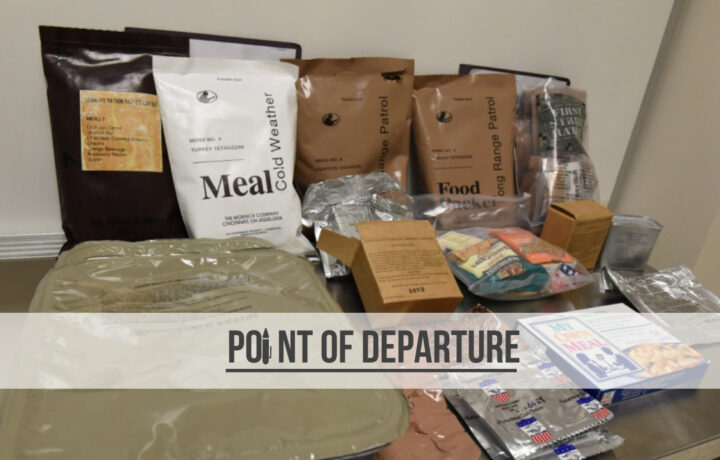
“If you want to know what despair tastes like, try the beef stroganoff MRE.” – Anonymous
Thirty-five years ago, on an otherwise unremarkable night in northern Saudi Arabia, I pulled my HMMWV into our Forward Operating Base and parked it near the festival tent that served as our battalion headquarters. It was late and I was tired, having just completed the 500-mile drive from Dammam, the industrial port city on the Arabian Gulf, to our base camp outside Rafha. I was also hungry, and I made my way to the stack of MRE boxes in the corner near the entrance.
On that night, I learned a time-honored piece of wisdom about what might euphemistically be known as the “no meal left behind program.” If you leave a case of MREs out for longer than a few minutes, the rats arrive. And I don’t mean actual rodents – even rodents don’t tend to consume MREs – but the two-legged kind that dig through cases of MREs in search of the best entrees and the even better accessories.
But what they leave behind is, well… understandable.
The only meals left were all the same: Menu No. 9, Chicken à la King. I had never been able to stomach the entrée, which had the consistency of baby vomit if not the flavor. Heating it didn’t help. Salt and pepper did little to improve the taste. And adding tabasco sauce only made it taste like spicy baby vomit. But when it’s all you have to eat, you learn to adapt or go hungry.
A Lesson in Culinary History
The MRE – Meal, Ready to Eat – possess a culinary lineage tracing back to the days of hardtack and salted meat. By World War II, troops were eating canned rations, but the bulk and weight of those meals proved increasingly impractical for modern, maneuver-based warfare. Seeking a lighter, more versatile alternative, the Pentagon adopted the MRE concept in 1975, with full-scale production beginning in 1978 and the official fielding – the dreaded MRE I – in 1981.
Early MREs were pre-cooked, shelf-stable meals packaged in lightweight retort pouches, a major shift from the days of canned C-rations. Initial responses, however, were less than glowing. In a 1983 field test with the Hawaii-based 25th Infantry Division, data revealed that troops consumed only about 60% of the available calories, citing limited variety and barely mediocre taste.
The meals hit stride in 1988 with MRE XVIII, which included expanded entrée sizes and choices, as well as commercial candy, hot sauce, and beverage mixes. Most of the initial abhorrent menu choices were gone, only to be replaced by ones that were equally awful. Every generation of MREs brought improvements, but two things remained consistent with each iteration: constipation and bad menu options.
It didn’t matter where you were or what you were doing. If you were the last one in line or the rats beat you to the stack of cases, your choices were not great.
The Worst of the Worst
I honestly tried to like Chicken à la King. I tried… and failed. As much effort as I put into adapting my palette to the taste, odor, and consistency of the entrée, it inevitably caused me to retch. There was a reason Menu No. 9 was always left behind in the box.
But it was hardly the worst MRE.
Since everyone’s experience slightly different – and we all have our own unique tastes – I decided to conduct a very informal, unscientific poll. “What’s the worst of the worst?” The answers were classic.
1. Frankfurters, Beef (“Four Fingers of Death”).
Rubber hot dogs suspended in some pinkish-brown mystery liquid. Trade value: none; the only accessory of value was peanut butter, and it wasn’t so rare that you couldn’t find it elsewhere.
2. Cheese & Veggie Omelet (“The Vomlet”).
Most omelets don’t smell like they were cooked in Yellowstone, nor do they have the consistency of Jell-O jigglers. Trade value: moderate; while the entrée was a lost cause, the jalapeño cheese spread could be traded for almost anything.
3. Pork Sausage with Gravy (“The Pork Brick”).
Tasted like medium-density fiberboard soaked in metallic gravy. Trade value: high; forget the entrée; the real value of this meal was the maple muffin top, which was a high-demand item.
4. Veggie Burger (“Cardboard Special”).
One bite and you knew why some people called them dirt burgers. Odorless, flavorless, and the consistency of dry clay, the entrée was the worst. Trade value: moderate; the cheese spread and fig bar had promise.
5. Tuna, Chunk, Light, Lemon Pepper (“Ocean’s Revenge”).
One of the most notoriously bad hot weather entrées – think odor and heat – it still had some redeemable qualities. Trade value: high; the meal was bad, but the tortillas, cheese spread, pound cake, and teriyaki beef stick made this a highly sought-after menu choice.
6. Country Captain Chicken (“Cat Food Chicken”).
It didn’t taste like any kind of chicken I’ve ever eaten, and the weird curry flavor and mushy texture were the worst. Trade value: limited; hot sauce was the only item of value in the meal.
7. Beef Teriyaki (“Teriyucky”).
Long before lab-grown meat was a thing, there was the Beef Teriyaki MRE. The weird chemical flavor left you thinking you were eating something the Toxic Avenger grew in a subterranean lair somewhere. Trade value: moderate; the chocolate drink mix traded well, especially during cold weather.
8. Chicken à la King (“Chicken à la Thing” or “Chicken Alley Cat”).
The only thing worse than the taste and odor of this entrée was the sight of the beige sludge oozing from the package like rancid baby vomit. Trade value: moderate; the pound cake and cocoa mix could go far on the open market.
9. Ham Slice (“Pink Hockey Puck”).
If you’re into cold slabs of salty, rubbery pork, then this meal was for you. Trade value: moderate; applesauce and cheese spread could open some doors for you.
10. Beef Patty (“Dog Food Patty”).
It really isn’t fair to call this a dog food patty. No self-respecting dog would have eaten this entrée. God help you if you ate this dehydrated, and it was all but inedible even when hydrated. Trade value: moderate; the fudge bar and cheese spread had some real field value.


