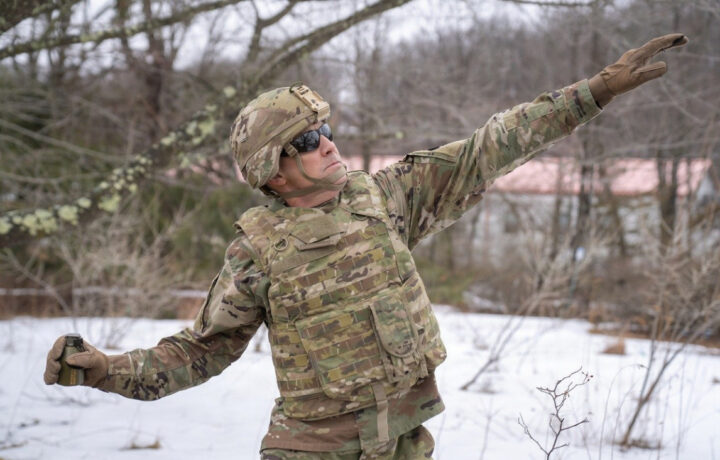
Since the Vietnam War, the United States Army has adopted a new tank and recently introduced an even newer variant, a new main battle rifle, a new combat helmet, retro dress uniforms, and around half a dozen camouflage patterns for its field uniforms. However, it had been since 1968 when the U.S. Army introduced a new hand grenade, the Mk3A2.
This week, the U.S. Army announced it had cleared the M111 Offensive Hand Grenade (OHG) for Full Material Release (FMR).
The new hand grenade was developed by the Capabilities Program Executive Ammunition and Energetics (CPE A&E), in conjunction with the U.S. Army Combat Capabilities Development Command (DEVCOM) Armaments Center at Picatinny Arsenal.
Once widely introduced across the service, the M111 OHG will replace the obsolete body and fuze of the Mk3A2 hand grenade series, with it becoming the first new lethal hand grenade to achieve FMR in nearly six decades.
“The Mk3A2 is restricted for use due to its asbestos body, unlike the M111, which utilizes a plastic body that is fully consumed during detonation,” the U.S. Army explained.
A “Safer” Grenade
Although the role of hand grenades hasn’t changed, the Army stated that the M111 would provide increased training and operational readiness, and even described it as being a “safer option.”
The M111 will enable soldiers to fight more effectively in close-quarter urban environments, leveraging blast overpressure (BOP) rather than fragmentation to deliver lethality.
“When used in grenades, BOP delivers devastating effects to enemy personnel and equipment without fragmentation and is a potent tactical advantage in the field,” the Army stated.
In the case of the legacy M67 fragmentation hand grenade, it projects lethal and incapacitating fragments that could be deflected when employed in enclosed or restricted terrain such as buildings, rooms, and structures. In contrast, the M111 OHG projects high BOP effects that are less affected by obstacles in enclosed and restricted terrain.
“One of the key lessons learned from the door-to-door urban fighting in Iraq was that the M67 grenade wasn’t always the right tool for the job. The risk of fratricide on the other side of the wall was too high,” explained Col. Vince Morris, Project Manager Close Combat Systems, CPE A&E. “But a grenade utilizing BOP can clear a room of enemy combatants quickly leaving nowhere to hide while ensuring the safety of friendly forces.”
More Specific Roles
The U.S. Army will continue to employ the M67, which soldiers can use to maximize lethal fragment effects. In contrast, in enclosed or restricted terrain, warfighters can rely on the M111 to maximize BOP effects on the enemy.
“We’ve given our Soldiers and joint warfighters the flexibility to determine in the field which type of grenade will best suit the current situation they are facing, be it open space or confined area,” explained Tiffany Cheng, one of the DEVCOM Armaments Center engineers who developed the M111 at Picatinny Arsenal.
The other key benefit of the new M111 design is standardization.
According to the Army, the new grenade and its training version, the M112, will leverage the same five-step arming process as the M67 and its training version, the M69. That will enable soldiers to train as they fight, improving combat performance and effectiveness.
The Army added that the M111 and M112 will use the same fuzes as the M67 and M69, respectively, thereby enabling Army acquisition professionals to save costs by leveraging economies of scale from common fuze production lines when sourcing both grenades.
Each grenade is built around government-owned intellectual property that enables the U.S. Army to compete for production contracts across the industrial base effectively. That should enhance production opportunities for multiple vendors, as well as for the soldiers and the American taxpayer.
“By standardizing the arming process and the fuzing, the Army saves taxpayer money without sacrificing lethality on the battlefield,” added Morris. “This is the kind of acquisition reform that is currently underway throughout the Army acquisition enterprise. We are taking advantage of that initiative to drive down costs while increasing combat effectiveness.”
The Concise History of Hand Grenades
Arguably, the first hand-thrown explosive or incendiary bombs appeared at the height of the Eastern (or Byzantine) Empire around the 8th century, when jars filled with the infamous “Greek Fire” were thrown at enemy soldiers. A few hundred years later, saltpeter-based gunpowder was developed in China, and it was used as a primitive bomb.
It was in the 15th century that these made their way to Europe and, over time, were placed in metal shells, creating what could be described as the first true grenades.
The word “grenade” in fact comes from the French “pomegranate,” and scholars suggest this is because the early hand grenades (as well as their modern counterparts) did in fact resemble the fruits, but also because the pomegranate tends to “explode” as it ripens to spread seeds over a vast perimeter. The weapon was originally a specialty weapon; hence, it was the “grenadiers” who carried and threw the ordnance.
It was during the American Civil War, however, that the grenade truly transformed from a device that needed a lit fuse to one with a plunger that detonated on impact. This lessened the likelihood of a bomb being thrown back, but was deadly to the thrower should the bomb accidentally be dropped.
The years leading up to the First World War saw the transformation of the hand grenade into what we would recognize today. Development continued throughout World War I and again during the Second World War. Even as we think of grenades as miniature bombs that can be thrown, there are many related “grenades,” including smoke grenades, flashbangs, blank grenades, incendiary grenades, gas grenades, and even anti-tank grenades.


