
Improving clearance processing times remains a critical – but not the only – benchmark in grading the health of the personnel vetting process. The latest security clearance processing times figures released by the Defense Counterintelligence and Security Agency (DCSA) at the National Industrial Security Program Policy Advisory Committee (NISPPAC) show a mixed bag for processing times. Top Secret security clearance processing times decreased in the first quarter of FY 2026, down to 227 days. But adjudication timelines increased, and overall security clearance processing times are above benchmarks. Secret clearance processing times saw improvements and are at 156 days. All reported figures are DCSA industry numbers for the fastest 90 percent of cases.
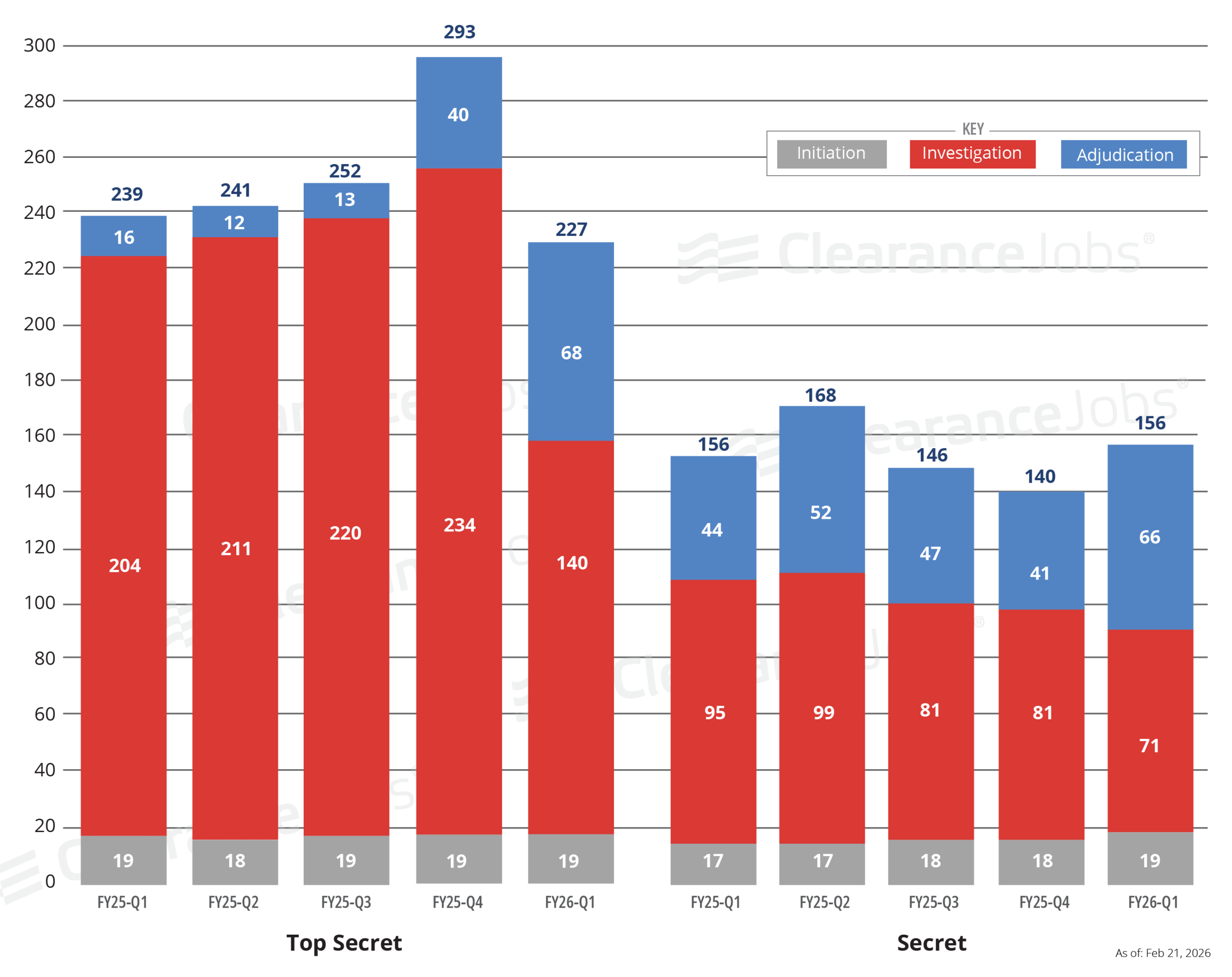
If you’re feeling like clearance timelines are improving, but not fast enough, you’re not wrong. The data going into 2026 tells a story of incremental progress layered over persistent friction. On paper, most Secret clearances are landing somewhere in the 60–150 day range, while Top Secret investigations are still stretching into the 120–240 day window. But averages only tell part of the story. When you factor in adjudication delays, polygraph backlogs, and the long tail of more complex cases, many candidates still experience timelines that feel closer to six months to a year, or longer for Top Secret clearance investigations.
Trusted Workforce 2.0 and continuous vetting have helped reduce backlog and modernize parts of the process, but inconsistency across agencies and program-specific requirements still creates a “two-speed system.” Some candidates move more quickly, especially with clean records and strong sponsorship, while others stall in queues driven by mission priority, polygraph scheduling, or adjudicative complexity. The result is a hiring environment where timelines are predictable in theory but highly variable in practice, forcing both candidates and employers to plan for the average, while operating in the reality of the exception.
That lag in candidate experience is one of the things Trusted Workforce 2.0, and specifically the Trusted Workforce Implementation Group, is looking to address. At the NISPPAC meeting DCSA described how TWIG was working to deliver the future state of the Trusted Workforce business model, and how engaging with customer agencies and industry is key to casting a future vision for personnel vetting modernization. That includes products like an online status tracking with real time status and averages that speak to that specific candidate’s case type.
Metrics matter in the clearance process, but so does transparency.


