Secretary of War Pete Hegseth has led efforts to see slimmer and fitter military personnel across all ranks. That has resulted in a new physical fitness test, and this week, the United States Army also replaced its long-standing height and weight tables. Out are the circumference-based tape test and supplemental body fat assessment.
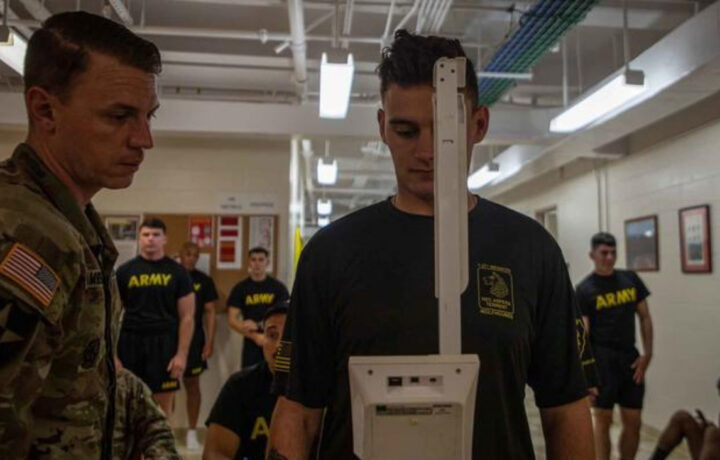
Instead, soldiers will be measured with the new Waist-to-Height Ratio (WHtR) health assessment tool, which is part of a broader effort within the U.S. Army to accurately assess soldier health, increase force readiness, and continue to align the Army Body Composition Program with medically validated practices, the service announced.
The service has stated that the WHtR is a more accurate health predictor, stating that scientific research has shown that it remains a superior predictor of long-term cardiovascular and metabolic health risks compared to legacy methods. The Army also stated it is fairer and that it accommodates a wider variety of physical body types, while maintaining readiness standards. It is also more straightforward, reducing administrative friction for leaders, and aligns with the Pentagon’s goal to standardize fitness metrics across the joint force.
“This is about lethality and health,” explained Sgt. Maj. Monsanto, deputy chief of staff, G-1, Directorate of Prevention, Resilience, Readiness. “We are adopting new metrics to ensure our soldiers are healthy and physically fit to fight and win.”
The Army Directive 2026-06 (Army Body Composition Program and Standards) was developed to align the Army Body Composition Program (ABCP) with medically validated, streamlined approaches that are to promote consistency, fairness, and the overall health of the joint force.
The service also confirmed an administrative update, and previously, requirements that an NCO be appointed to run the ABCP program have been rescinded, and commanders will now directly oversee the program.
Two Annual WHtR Assessments
The new benchmark for compliance is a waist-to-height ratio of 0.55 or less. It will measure an individual’s waistline at the navel and divide the measurement by their height in inches, producing the ratio.
All U.S. Army soldiers, as well as United States Military Academy and Senior ROTC cadets, will now be expected to undergo a WHtR assessment twice annually.
“The Army will conduct a 180-day assessment of the new WHtR to validate accuracy and determine if adjustments are needed,” the service added.
Soldiers are required to have the WHtR screening recorded in ATIS within 90 days of the directive’s publishing date. In addition, commanders may direct a WHtR assessment at any time if they believe a soldier fails to meet the standard.
Those soldiers whose WHtR is 0.55 or greater will receive a confirmation test conducted by another team on the same duty day to verify its accuracy.
“If a soldier fails the WHtR assessment, placement in the Army Body Composition program will follow to begin the process for compliance,” the Army explained. It added that no separation actions for WHtR failure will occur until the Army completes a 180-day assessment and issues further guidance. Still, soldiers will remain enrolled until they meet the WHtR standard.
The service has called that transition to the WHtR assessment a significant step in modernizing the Army’s approach to health and fitness.
“By adopting an accurate and medically validated standard, we are ensuring our soldiers are prepared for the demands of the modern battlefield and fostering a healthier, more lethal force.”
Last year, the U.S. Army announced changes to the fitness standards. The Army Fitness Test (AFT) became the official physical fitness test of record for all soldiers, replacing the Army Combat Fitness Test (ACFT). The new AFT was built around five events that were designed to enhance soldier fitness, improve warfighting readiness, and increase the lethality of the force. It consists of the three-repetition maximum deadlift, hand-release push-up army extension, sprint-drag-carry, plank, and two-mile run.


